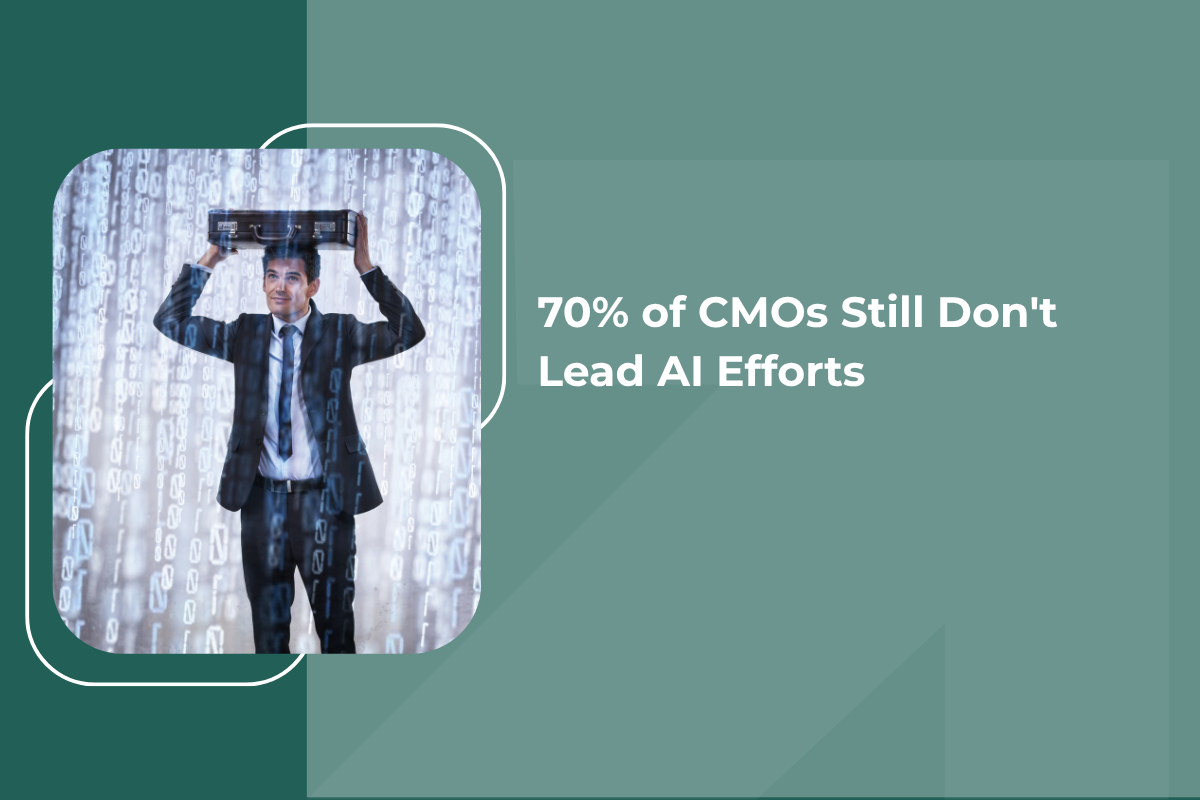
Only 30% of US CMOs are directly leading their marketing organizations' AI efforts, according to Forrester's Q2 2024 B2C Marketing CMO Pulse Survey. That means seven in ten aren't steering the technology that's already baked into their martech stack, programmatic media buys, and social platforms.
The gap isn't about curiosity. In late 2023, 171 US marketing executives told Forrester that generative and predictive AI was their number-one support need out of 30 listed priorities. A year later, 90% of B2C marketing executives said they planned to increase AI spending over the next 12 months. Money is moving. Leadership structure isn't keeping up.
The problem isn't that CMOs don't care. It's that AI changes who makes decisions, who owns workflow redesign, and who approves risk tradeoffs. When leadership is fragmented across marketing, IT, and vendors, scaling anything beyond a pilot becomes a negotiation instead of an execution.
Forrester's point is that "leading" doesn't mean the CMO personally runs every test. It means setting governance, defining decision rights, and establishing management expectations while direct reports execute. The firm says CMOs need to act as a connector and rely on a rock-solid management team, which only works if the CMO first creates space by letting go of other responsibilities.
The urgency comes from the fact that AI is no longer a separate innovation track. It's already embedded in routine systems that influence daily execution. Organizations treating it as a side project are under-managing a capability that's live in production.
Forrester's research shows AI is reshaping workflows, skills, decision-making, and organizational design simultaneously. Teams are dealing with unclear expectations, uneven readiness, and pressure to show rapid progress. The firms that figure this out will be the ones that assign formal ownership, document who approves what, and run narrow pilots tied to workflow redesign rather than output generation.
The uncomfortable truth is that most marketing organizations are spending more on AI while fewer than a third have clear leadership at the top. That's how you get a lot of tools and very little transformation.
Recent posts

×