Table of Contents
Anthropic’s Claude Learns to “Dream” and Revolutionizes AI Agents With Self-Improving Memory
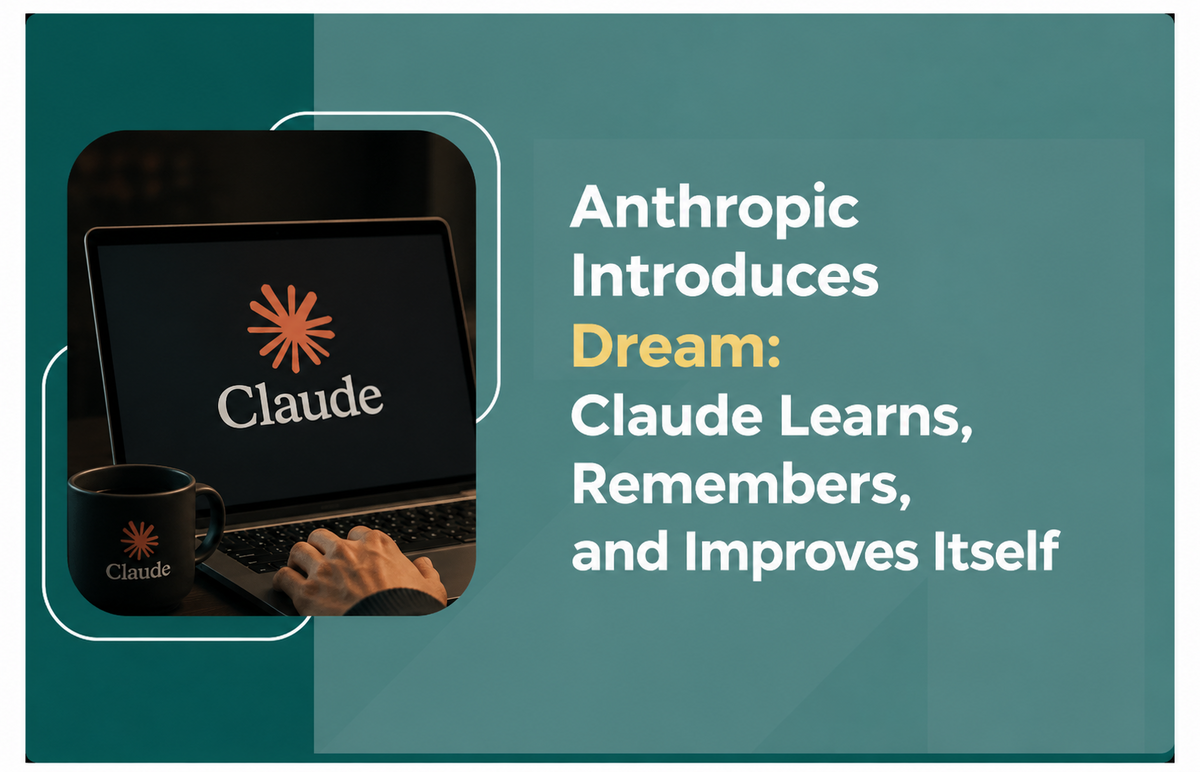
Anthropic has officially introduced one of the most important upgrades in the AI agent race: Claude can now “dream.”
Announced during the Code with Claude developer conference, the new Dreaming capability allows Claude Managed Agents to revisit previous sessions, reorganize memory, identify recurring patterns, and improve future performance without retraining the underlying model.
This marks a major turning point for AI agents, especially in AI marketing, AI ads, and AI performance marketing where long-term context and operational memory matter more than one-time prompts.
For years, one of the biggest frustrations with AI systems was simple:
they forgot everything.
Every new session started from zero.
Anthropic’s latest release changes that dynamic completely.
What Happened?
Anthropic launched Dreaming as part of its Claude Managed Agents platform.
The feature works asynchronously in the background. Claude reviews transcripts from previous sessions, analyzes memory stores, removes duplicated or outdated information, and extracts recurring insights that can improve future decision-making.
Importantly, the original memory remains untouched. Instead, Claude creates a reorganized version developers can choose to adopt or discard.
This creates something closer to institutional learning rather than temporary chatbot memory.
According to Anthropic, the system can analyze up to 100 previous sessions while identifying:
- Repeated mistakes
- Shared workflow patterns
- Team preferences
- Long-term operational behaviors
The feature is currently available as a research preview for developers using Claude Managed Agents.
Harvey’s 6x Improvement Changes the Conversation
One of the biggest signals came from Harvey, the AI legal platform.
Harvey reportedly achieved roughly a 6x increase in completion rates after enabling Dreaming on long-form drafting workflows.
What makes this important is that the improvement did not come from a better model.
It came from better memory.
That distinction matters because it suggests the next phase of AI competition may not be model intelligence alone. Instead, persistent operational memory could become the real differentiator.
Key Features Anthropic Released
Alongside Dreaming, Anthropic also introduced several major upgrades.
Outcomes-Based Evaluation
Claude can now evaluate its own outputs against predefined rubrics and retry tasks if results fail to meet expectations.
Anthropic claims this improved task success rates by around 10 points compared to standard prompting approaches.
Multi-Agent Orchestration
Anthropic also introduced orchestration systems capable of running up to 20 specialized AI agents in parallel under a lead coordinator.
This architecture could significantly impact:
- AI marketing operations
- AI content production
- Google Ads optimization
- Meta Ads campaign management
- AI video generation pipelines
- AI image generation workflows
Expanded Usage Limits
Anthropic doubled five-hour usage limits for Pro and Max users, signaling confidence in broader adoption of agentic workflows.
Why This Matters for AI Marketing and AI Ads
The implications for AI marketing are enormous.
Modern marketing systems rely heavily on continuity:
- Audience behavior
- Creative testing history
- Funnel optimization
- Ad performance analysis
- Customer preferences
- Conversion patterns
Traditional AI systems lose this operational context quickly.
But persistent memory changes how AI can optimize campaigns over time.
An AI agent managing Google Ads could eventually remember:
- Which creatives historically converted best
- Which audiences underperformed
- Which seasonal campaigns worked
- Which landing pages created friction
Similarly, Meta Ads optimization could become increasingly autonomous as AI agents continuously learn from campaign history rather than isolated prompts.
This could fundamentally reshape AI performance marketing over the next few years.
The Bigger Industry Shift
Anthropic’s move reflects a broader industry transition:
AI is moving from reactive tools to persistent operational systems.
The first wave of generative AI focused on content generation.
The second wave focused on AI agents.
The next wave may focus entirely on memory and self-improvement.
That shift could create a new competitive hierarchy in AI.
The best systems may no longer be the ones with the largest models.
They may be the ones with the strongest memory infrastructure and execution capabilities.
In practical terms, businesses will increasingly demand AI systems that:
- Learn continuously
- Improve workflows automatically
- Retain organizational context
- Execute campaigns end-to-end
Where GrowEasy Fits In
AI models are becoming the brain.
But businesses still need an execution engine.
That’s where GrowEasy fits in.
GrowEasy helps businesses execute AI-generated campaigns across multiple channels while automating critical performance marketing operations.
The platform:
- Automates Google Ads and Meta Ads
- Optimizes AI performance marketing funnels
- Scales blogs, creatives, and ad campaigns
- Executes AI-driven marketing workflows
- Connects AI outputs directly to business growth systems
As AI tools like Claude become smarter through memory and self-improvement, platforms like GrowEasy become the operational layer that turns intelligence into execution.
AI = Brain
GrowEasy = Execution Engine
Future Implications
Claude’s Dreaming feature may look experimental today, but the long-term implications are massive.
If AI agents can:
- Reflect on past work
- Improve independently
- Coordinate with other agents
- Maintain institutional memory
then AI stops behaving like software and starts behaving more like a persistent digital workforce.
That could transform everything from AI marketing and AI ads to customer support, software development, and enterprise operations.
The era of forgetful AI may officially be ending.
P.S. GrowEasy is AI powered digital marketing and lead generation platform with inbuilt CRM, WhatsApp marketing & automation, and AI agents on phone and WhatsApp.