Summary:
OpenAI has launched Daybreak, a cybersecurity initiative leveraging advanced AI models to detect software vulnerabilities and automate security processes. This marks a shift in AI's role from productivity enhancement to integral software defense, addressing the growing complexity of AI-powered cyber threats. By integrating security into development workflows, Daybreak aims to make software inherently resilient, transforming traditional cybersecurity practices. This development underscores the increasing importance of AI in both cybersecurity and broader business operations, as companies seek to combine AI-driven productivity with robust security measures.
Table of Contents
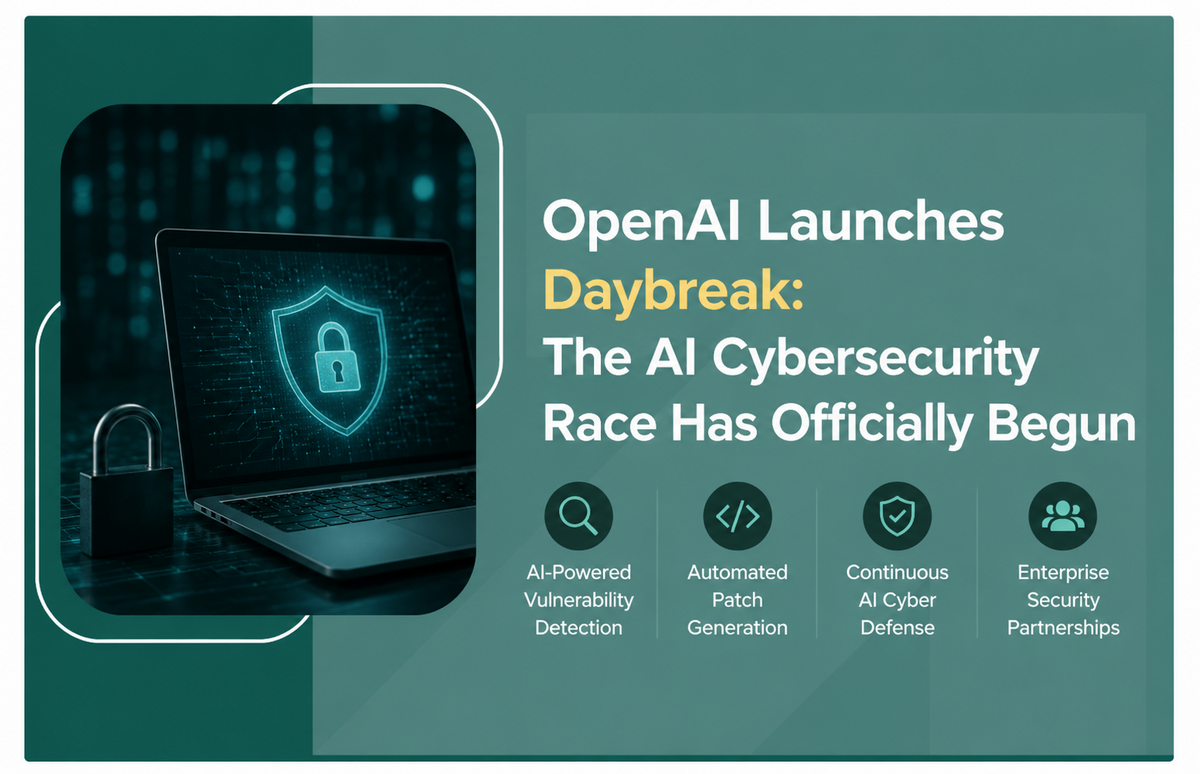
OpenAI Launches Daybreak: The AI Cybersecurity Race Has Officially Begun
OpenAI has officially launched Daybreak, a new cybersecurity initiative designed to help organizations detect vulnerabilities, validate fixes, and continuously secure software using frontier AI models and Codex Security.
The announcement signals a major shift in the artificial intelligence industry. AI is no longer being positioned only as a productivity tool or content generator. It is now becoming a core layer of software defense.
And this launch arrives at a critical time.
As cyber attacks become more automated and AI-powered, security teams are struggling to keep up with the speed and complexity of modern threats. OpenAI’s answer is clear: use AI to defend software before attackers exploit weaknesses.
What Is OpenAI Daybreak?
Daybreak combines OpenAI’s most advanced models, Codex’s agentic capabilities, and partnerships with major cybersecurity organizations to create a continuous AI-powered defense layer for software development.
The platform is designed to:
- Identify vulnerabilities in codebases
- Generate and validate patches
- Perform threat modeling
- Analyze dependency risks
- Provide remediation guidance
- Continuously monitor software systems
According to OpenAI, the goal is to make software “resilient by design” rather than treating security as a final step after development is complete.
This changes the traditional cybersecurity workflow completely.
Instead of reacting to breaches after deployment, Daybreak pushes security directly into the development loop.
Key Features of Daybreak
1. AI-Powered Vulnerability Detection
Daybreak uses frontier AI models to reason across massive codebases and identify subtle vulnerabilities before attackers discover them.
This includes:
- Secure code review
- Threat analysis
- Dependency risk detection
- Attack path identification
The system can prioritize high-impact vulnerabilities and reduce manual investigation time from hours to minutes.
2. Automated Patch Generation
One of the biggest breakthroughs is automated remediation.
Daybreak can generate patches directly inside repositories while keeping scoped access, monitoring, and review controls in place.
This means developers can:
- Detect issues
- Generate fixes
- Validate patches
- Deploy securely
All inside a continuous AI-assisted workflow.
3. Tiered AI Security Access
OpenAI also introduced a layered security framework:
- GPT-5.5 for general use
- Trusted Access for Cyber for verified defensive environments
- GPT-5.5-Cyber for advanced security simulations and red teaming
This structure attempts to balance powerful cyber capabilities with safeguards and controlled deployment.
4. Enterprise Security Partnerships
Several major cybersecurity companies are already working with OpenAI, including:
- Cloudflare
- Cisco
- CrowdStrike
- Oracle
- Zscaler
These partnerships indicate that AI-native cybersecurity may rapidly become part of enterprise infrastructure.
OpenAI Daybreak vs Anthropic Claude Mythos
The launch also intensifies competition in AI cybersecurity.
While OpenAI focuses on continuous AI-powered defense integrated into development workflows, Anthropic’s Claude Mythos emphasizes deeper reasoning about vulnerabilities, system behavior, and attack escalation patterns.
In simple terms:
- Daybreak focuses on execution speed and automated remediation
- Mythos focuses on deep analysis and understanding system failures
Together, they represent two complementary approaches to AI security.
And both reveal the same trend:
Cybersecurity is becoming one of the most important battlegrounds for frontier AI.
Why This Matters for AI Marketing and Business
This launch is bigger than cybersecurity alone.
Modern businesses increasingly rely on:
- AI marketing
- AI ads
- AI video generation
- AI image generation
- AI performance marketing
- Automated workflows
- AI-powered SaaS infrastructure
As companies integrate more AI tools into operations, the attack surface grows rapidly.
That means cybersecurity can no longer remain separate from product development or marketing technology stacks.
Future AI systems will likely:
- Continuously monitor software
- Detect anomalies in real time
- Protect marketing automation pipelines
- Secure customer data
- Validate AI-generated code
- Automate security remediation
The companies that combine AI productivity with AI security will have a major competitive advantage.
Industry Impact
OpenAI’s Daybreak could significantly disrupt:
- Traditional application security vendors
- Penetration testing workflows
- Security operations centers
- DevSecOps pipelines
- Enterprise compliance systems
AI-assisted cyber defense may soon become standard infrastructure for enterprise software teams.
The larger implication is even more important:
AI systems are beginning to defend the very digital environments they help create.
This is the start of autonomous cyber defense.
Where GrowEasy Fits In
AI is rapidly becoming the brain behind modern business operations.
But execution still matters.
That’s where GrowEasy fits in.
While AI systems like Daybreak generate intelligence, GrowEasy acts as the execution engine that helps businesses operationalize AI-driven growth.
GrowEasy helps businesses:
- Execute AI-generated campaigns
- Automate Google Ads and Meta Ads
- Optimize AI performance marketing funnels
- Scale blogs, creatives, and ad campaigns
- Automate customer engagement workflows
- Connect AI tools with real-world business execution
In simple terms:
AI = Brain
GrowEasy = Execution Engine
As AI becomes deeply integrated into cybersecurity, marketing, automation, and software development, platforms that connect AI intelligence with scalable execution will become essential.
The Future of AI Security
OpenAI Daybreak represents something larger than another AI product launch.
It reflects a future where:
- Security becomes continuous
- AI agents operate inside development workflows
- Software defends itself in real time
- AI-generated systems are continuously monitored and validated
The cybersecurity race is no longer just about humans versus hackers.
It is quickly becoming:
AI defenders versus AI attackers.
And the companies building the best autonomous defense systems may define the next era of enterprise technology.
P.S. GrowEasy is AI powered digital marketing and lead generation platform with inbuilt CRM, WhatsApp marketing & automation, and AI agents on phone and WhatsApp.