Table of Contents
OpenAI Launches GPT-Realtime-2 and Pushes Voice AI Into a New Era
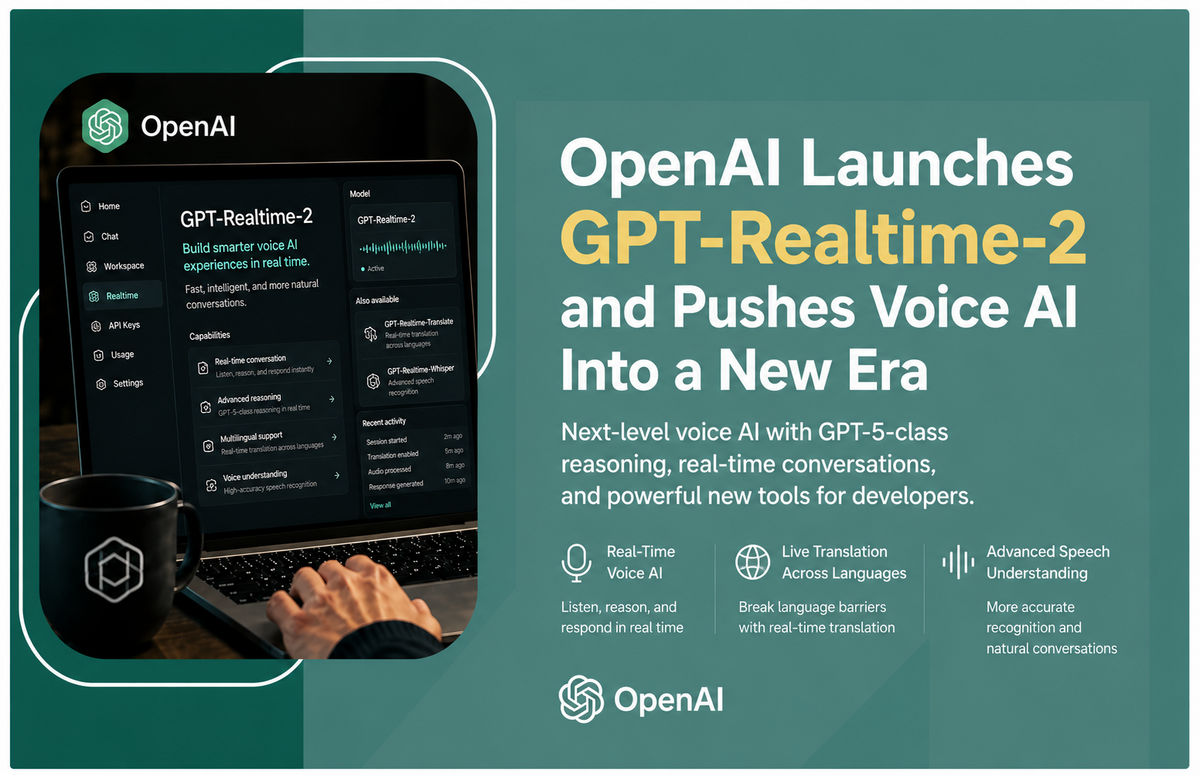
OpenAI has officially introduced GPT-Realtime-2 in its API, marking one of the biggest upgrades yet for AI-powered voice agents. The company says the new model brings GPT-5-class reasoning into real-time conversations, allowing voice AI systems to think, solve problems, and adapt dynamically while speaking with users.
This launch signals a major shift in how businesses will use AI across customer support, sales, AI marketing, and automation workflows.
The announcement also included GPT-Realtime-Translate and GPT-Realtime-Whisper, expanding OpenAI’s audio stack for developers building next-generation conversational experiences.
What Happened
Until now, most voice assistants followed predictable patterns. They could respond to commands, answer simple questions, or execute predefined workflows.
GPT-Realtime-2 changes that model.
The new API allows voice agents to:
- Listen continuously during conversations
- Reason in real time
- Understand evolving context
- Solve complex problems while interacting
- Deliver more natural conversational experiences
This transforms AI voice systems from scripted assistants into intelligent collaborators.
OpenAI is clearly positioning voice as one of the next major interfaces for AI applications.
Key Features and Updates
GPT-5-Level Reasoning in Voice
The biggest upgrade is reasoning capability. GPT-Realtime-2 reportedly brings advanced decision-making and contextual understanding into live conversations.
This means AI voice agents can:
- Handle nuanced conversations
- Adapt responses dynamically
- Maintain deeper context
- Perform multi-step reasoning while speaking
Real-Time Translation
OpenAI also introduced GPT-Realtime-Translate, enabling live multilingual communication.
This could become a massive advantage for:
- Global customer support
- International sales teams
- AI-powered meetings
- Cross-border commerce
Advanced Speech Recognition
GPT-Realtime-Whisper expands OpenAI’s speech recognition stack with improved streaming transcription and audio understanding.
This strengthens:
- AI call center systems
- Meeting assistants
- Voice search
- AI automation workflows
Why This Matters for AI Marketing and AI Ads
This launch is not just about voice assistants.
It directly impacts AI marketing, AI ads, performance marketing, and customer acquisition.
Here’s why:
AI Sales Agents Become More Human
Businesses can now deploy AI agents capable of:
- Handling objections
- Guiding purchase decisions
- Qualifying leads
- Personalizing conversations live
That creates a new category of AI-powered sales automation.
AI Customer Support Gets Smarter
Traditional chatbots often fail because conversations break easily.
With GPT-Realtime-2, AI systems can reason through problems and maintain contextual memory during live interactions.
This could significantly reduce support costs while improving user experience.
AI Performance Marketing Evolves
Voice-first interaction opens new opportunities for:
- AI-powered lead generation
- Conversational funnels
- AI appointment booking
- Personalized ad experiences
- Automated customer journeys
The future of Google Ads and Meta Ads may increasingly rely on conversational AI interfaces rather than static landing pages.
AI Video Generation and AI Image Generation Integration
As OpenAI expands multimodal capabilities, voice interaction could eventually combine with AI video generation and AI image generation systems.
Imagine:
- AI sales reps generating custom product demos live
- AI agents creating personalized ad creatives during conversations
- Real-time content adaptation based on user responses
This creates entirely new forms of interactive marketing.
Industry Impact
The launch of GPT-Realtime-2 could reshape multiple industries simultaneously.
Customer Support
AI agents may soon handle a large percentage of Tier-1 and Tier-2 support operations.
SaaS and Automation
Voice-first interfaces may become standard for AI software platforms.
E-Commerce
AI shopping assistants could replace traditional product discovery flows.
Digital Marketing
Performance marketing teams may shift toward conversational funnels powered by AI voice agents.
The companies that integrate real-time AI interaction early could gain major competitive advantages.
Future Implications
The broader implication is clear:
AI is moving from passive tools to active collaborators.
This changes how humans interact with software entirely.
Instead of clicking through interfaces, users may increasingly:
- Speak naturally
- Ask AI to execute workflows
- Collaborate with AI agents in real time
Voice may become one of the dominant interfaces of the AI era.
And OpenAI is positioning itself aggressively at the center of that transition.
Where GrowEasy Fits In
AI models like GPT-Realtime-2 provide the intelligence layer.
But businesses still need execution.
That’s where GrowEasy fits in.
GrowEasy acts as the execution engine for AI-powered business growth by:
- Automating Google Ads and Meta Ads
- Scaling AI-generated campaigns
- Optimizing AI performance marketing funnels
- Managing lead generation workflows
- Automating customer communication
- Scaling blogs, creatives, and ad content
In simple terms:
AI = Brain
GrowEasy = Execution Engine
As AI voice agents become smarter, platforms like GrowEasy can help businesses operationalize these capabilities into measurable marketing and revenue growth.
Final Thoughts
GPT-Realtime-2 represents a major milestone in conversational AI.
The shift from reactive assistants to intelligent real-time collaborators could redefine:
- Customer support
- Sales
- Marketing
- Business automation
- Human-computer interaction
The next generation of AI winners may not just build smarter models.
They’ll build smarter conversations.
P.S. GrowEasy is AI powered digital marketing and lead generation platform with inbuilt CRM, WhatsApp marketing & automation, and AI agents on phone and WhatsApp.