Summary:
OpenAI's introduction of Jalapeño, its first custom AI chip developed with Broadcom, marks a significant step in AI infrastructure, aiming to enhance performance, cost-efficiency, and scalability of AI services. By creating its own silicon, OpenAI gains greater control over AI inference processes, crucial for applications like ChatGPT and Codex. This move aligns OpenAI with tech giants investing in custom AI hardware, potentially reshaping AI service delivery. Jalapeño is part of a broader strategy to integrate advanced AI models with optimized infrastructure, promising faster, cheaper, and more accessible AI capabilities for businesses worldwide.
Table of Contents
OpenAI Launches Jalapeño, Its First AI Chip, Marking a New Era for AI Infrastructure
Introduction
OpenAI has officially entered the semiconductor industry with the launch of Jalapeño, its first custom AI inference chip developed in collaboration with Broadcom. The announcement marks a major milestone in the evolution of artificial intelligence, as OpenAI expands beyond building cutting-edge AI models to designing the hardware that powers them.
The company believes chips are the foundation of the AI economy. By owning more of the technology stack, OpenAI aims to make AI faster, more reliable, more affordable, and accessible to millions of users worldwide.
What Happened
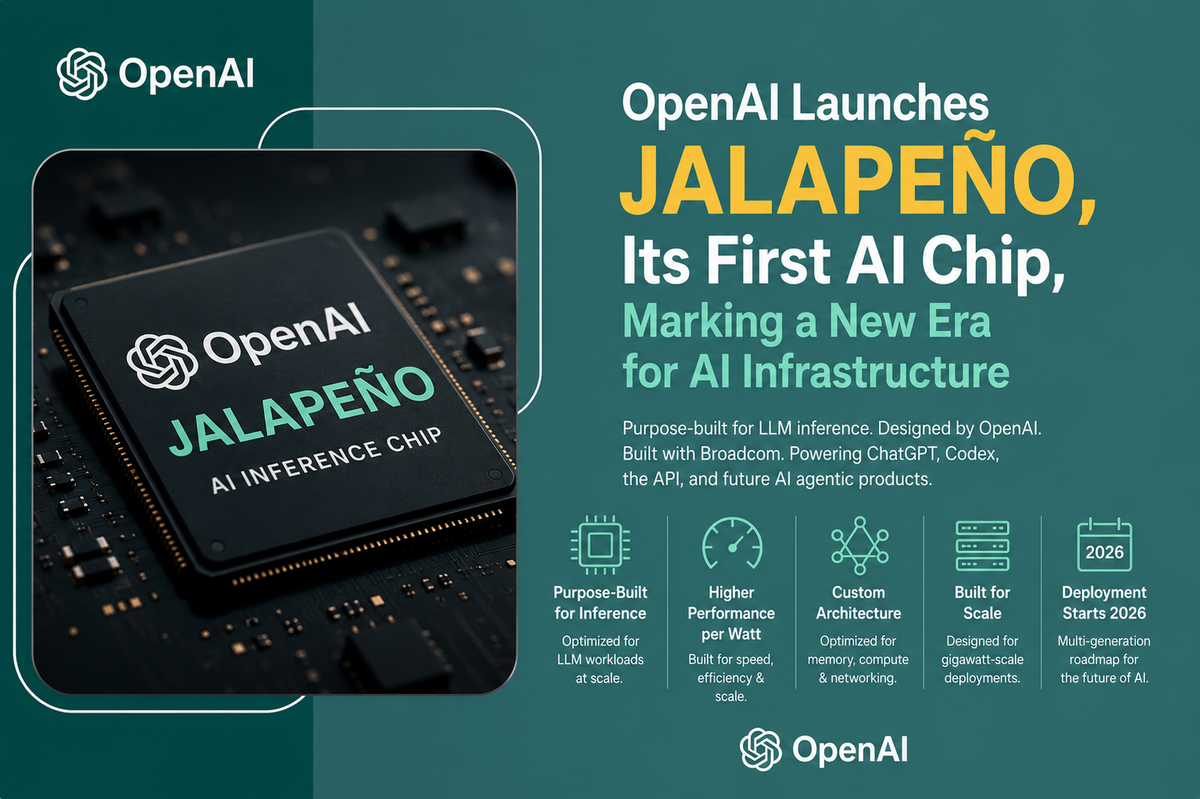
On June 24, 2026, OpenAI and Broadcom unveiled Jalapeño, a custom AI accelerator purpose-built for large language model (LLM) inference. Unlike traditional GPUs that support a wide range of AI workloads, Jalapeño has been designed specifically for the inference demands of ChatGPT, Codex, the OpenAI API, and future AI agents.
The chip was developed from initial design to manufacturing tape-out in just nine months, making it one of the fastest advanced ASIC development cycles ever announced. Engineering samples are already running production-level workloads, including GPT-5.3-Codex-Spark.
One of the most interesting aspects of the project is that OpenAI's own AI models helped accelerate parts of the chip design and optimization process, demonstrating how AI is beginning to improve the infrastructure required to build even more powerful AI systems.
Key Features of Jalapeño
- Purpose-built for LLM inference rather than general-purpose AI computing.
- Optimized architecture for memory movement, networking, and compute efficiency.
- Early testing shows significantly better performance per watt than current state-of-the-art AI accelerators.
- Designed around OpenAI's real-world production workloads powering ChatGPT, Codex, APIs, and future agentic AI products.
- Developed in partnership with Broadcom for silicon implementation and Celestica for board, rack, and system integration.
- Forms the foundation of a multi-generation AI hardware roadmap scheduled for large-scale deployment beginning in late 2026.
Why This Matters
The launch of Jalapeño is about much more than building another AI chip.
Inference has become one of the biggest costs in delivering AI services at scale. Every ChatGPT response, AI-generated image, coding suggestion, or AI-powered business workflow depends on inference infrastructure.
By designing its own silicon, OpenAI gains greater control over performance, cost, energy efficiency, and scalability. Better hardware means faster AI responses, lower operating costs, improved reliability, and the ability to serve significantly more users.
For businesses investing in AI marketing, AI ads, AI tools, AI video generation, AI image generation, Google Ads, Meta Ads, and AI performance marketing, improvements in inference infrastructure will eventually translate into lower costs, faster applications, and more powerful AI capabilities.
Industry Impact
OpenAI's move positions it alongside technology giants such as Google, Amazon, Microsoft, and Meta that have invested heavily in custom AI silicon.
The AI race is no longer limited to developing the smartest language models. Companies are now competing across the entire technology stack, from chips and networking to software, models, and end-user products.
Owning custom infrastructure reduces dependence on third-party hardware suppliers while enabling tighter optimization between hardware and software. This creates a long-term competitive advantage that could reshape how AI services are delivered across industries.
The announcement also strengthens Broadcom's position as one of the leading infrastructure partners powering next-generation AI data centers.
Future Implications
Jalapeño represents only the first generation of OpenAI's custom compute platform.
The company plans to deploy the chip at gigawatt-scale data centers with infrastructure partners beginning in 2026, with multiple future generations already in development.
As AI models become more capable and autonomous, specialized inference hardware will become increasingly important. Companies that control both the intelligence layer and the infrastructure beneath it will likely define the next decade of artificial intelligence.
The future of AI will not be determined only by better models. It will also be shaped by faster, cheaper, and more efficient infrastructure capable of bringing advanced intelligence to billions of people.
Where GrowEasy Fits In
While OpenAI is building the intelligence infrastructure behind the future of AI, businesses still need a platform to execute AI-powered marketing at scale.
GrowEasy serves as the execution layer for AI.
AI models generate ideas, content, campaigns, and strategies. GrowEasy transforms those outputs into measurable business growth by automating campaign execution across multiple marketing channels.
GrowEasy helps businesses:
- Execute AI-generated marketing campaigns automatically.
- Automate Google Ads and Meta Ads management.
- Optimize AI performance marketing funnels for better ROI.
- Scale blogs, ad creatives, landing pages, and marketing content.
- Manage lead generation, CRM, WhatsApp marketing, and AI-powered customer engagement from a single platform.
Simply put:
AI is the Brain.
GrowEasy is the Execution Engine.
As AI infrastructure like Jalapeño makes artificial intelligence faster, cheaper, and more accessible, GrowEasy enables businesses to put that intelligence into action through automated marketing, lead generation, and customer acquisition.
Final Thoughts
OpenAI's launch of Jalapeño signals a major shift in the AI industry. The next phase of competition is no longer just about building better AI models but about owning the infrastructure that powers them.
By combining custom silicon, frontier AI models, and scalable products into one integrated platform, OpenAI is laying the foundation for faster, more efficient, and more affordable artificial intelligence.
For businesses, marketers, and developers, this evolution could unlock a new generation of AI applications that are more powerful, cost-effective, and accessible than ever before.
P.S. GrowEasy is AI powered digital marketing and lead generation platform with inbuilt CRM, WhatsApp marketing & automation, and AI agents on phone and WhatsApp.