Summary:
Rumik AI's launch of Silk Mulberry 1.5 marks a significant development in India's AI landscape, introducing a multilingual voice model tailored to the country's diverse linguistic needs. This model offers high-quality, expressive speech at a low cost, supporting natural code-switching between languages like Hindi and English. By focusing on real-time applications and regional communication styles, Rumik AI aims to enhance AI interactions and reduce operational costs for businesses. This approach highlights a broader trend of developing specialized AI models for local markets, potentially setting a precedent for future innovations in emerging regions.
Rumik AI Launches Silk Mulberry 1.5, A Multilingual Voice Model That Could Reshape Voice AI in India
Introduction
India's AI ecosystem has been steadily evolving from building applications on top of global models to developing foundational AI technologies of its own.
That shift became more visible with the launch of Silk Mulberry 1.5, a new multilingual voice model from Rumik AI that focuses on one of the biggest challenges in speech AI: how real Indians actually communicate.
The company claims the model delivers top-tier voice quality while operating at over 95% lower cost than many leading alternatives, potentially opening the door for large-scale adoption of voice AI across businesses and developers.
What Happened
Rumik AI announced Silk Mulberry 1.5, describing it as one of the fastest multilingual voice models available.
The model is designed specifically for real-time voice applications and multilingual communication patterns common across India.
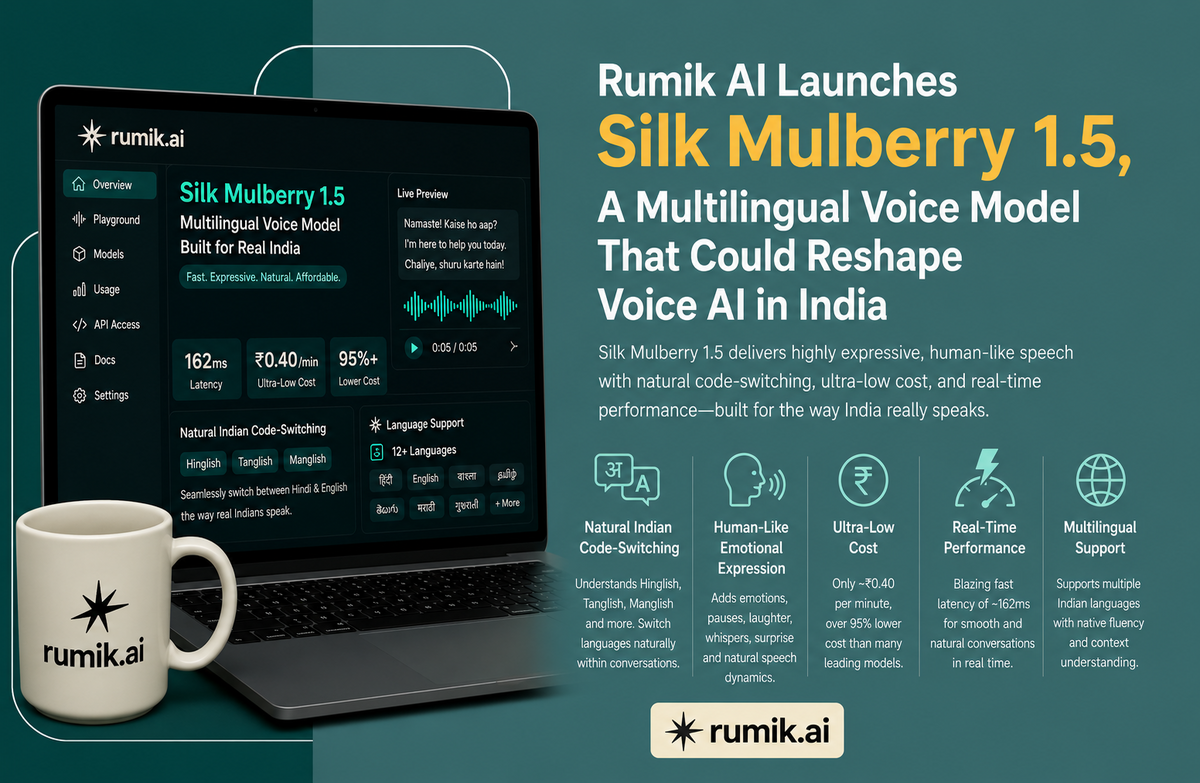
According to the company, Silk Mulberry 1.5 can generate highly expressive speech with latency around 162 milliseconds while costing approximately ₹0.40 per minute. It also supports natural code-switching between languages, allowing users to move between Hindi and English seamlessly within the same conversation.
Key Features and Updates
Natural Indian Code-Switching
One of the standout capabilities is handling conversational language patterns such as:
- Hinglish
- Tanglish
- Manglish
Rather than translating content word-for-word, the model understands how multilingual speakers naturally blend languages during everyday conversations.
Human-Like Emotional Expression
The model incorporates emotional delivery, vocal pauses, laughter, whispering, surprise reactions, and natural speech dynamics that make AI-generated voices sound significantly more human.
Ultra-Low Cost
At approximately ₹0.40 per minute, Silk Mulberry 1.5 positions itself as an affordable alternative for startups, enterprises, and developers looking to deploy voice AI at scale.
Real-Time Performance
With latency reported around 162 milliseconds, the model is optimized for conversational AI, customer support agents, AI companions, and voice-based applications.
Why It Matters
Voice is becoming one of the most important interfaces in artificial intelligence.
As AI marketing, AI ads, AI video generation, and AI image generation continue to evolve, voice is emerging as the missing layer that makes AI interactions feel truly human.
For businesses, this means:
- More engaging AI customer support
- Realistic AI sales agents
- Automated multilingual content creation
- Personalized AI marketing campaigns
- Better conversational experiences across Google Ads and Meta Ads ecosystems
The ability to generate natural multilingual speech at low cost could significantly reduce operational expenses while improving customer engagement.
Industry Impact
The launch highlights a broader trend emerging across the AI industry.
Instead of competing directly with global giants on model size, startups are focusing on specialized capabilities tailored to local markets.
India's linguistic diversity creates unique challenges that many global models struggle to handle effectively.
By optimizing for Indian speech patterns, code-switching behavior, and regional communication styles, Rumik AI is targeting a market that remains underserved by many international AI providers.
This strategy could become a blueprint for future AI startups across emerging markets.
Future Implications
The future of AI may not be dominated solely by larger foundation models.
Instead, specialized models built for specific languages, regions, and use cases may create the next wave of innovation.
If Silk Mulberry 1.5 delivers on its performance claims at scale, it could accelerate adoption of:
- AI customer service agents
- AI voice assistants
- AI sales representatives
- AI content creators
- AI-powered business automation
For marketers, creators, and businesses, this could unlock new opportunities in AI performance marketing while dramatically reducing costs.
Where GrowEasy Fits In
AI can generate content, voices, creatives, and campaigns.
But execution remains the biggest challenge.
This is where GrowEasy fits into the stack.
AI = Brain
GrowEasy = Execution Engine
GrowEasy helps businesses execute AI-generated campaigns across channels by:
- Automating Google Ads campaigns
- Automating Meta Ads campaigns
- Optimizing AI performance marketing funnels
- Scaling content production including ads, blogs, and creatives
- Connecting AI-generated assets directly to lead generation workflows
As voice AI models like Silk Mulberry 1.5 become more capable, platforms like GrowEasy can act as the execution layer that turns AI outputs into measurable business growth.
Final Thoughts
Silk Mulberry 1.5 is more than another AI model launch.
It represents a growing shift toward localized AI innovation designed for real-world users rather than benchmark scores alone.
If the next era of AI is defined by personalization, multilingual communication, and affordability, Indian AI startups like Rumik AI may play a far bigger role than many expect.