Summary:
Sakana AI has launched Sakana Fugu, a multi-agent AI orchestration system that coordinates various advanced AI models through a single API, offering a new approach to AI development. Instead of focusing on building larger models, Sakana Fugu leverages the collective intelligence of multiple models to achieve superior results. This system could significantly impact AI marketing, enterprise workflows, and reduce vendor lock-in risks by allowing organizations to utilize a diverse range of AI capabilities. As orchestration platforms become central to AI operations, they may redefine how AI models are utilized across industries.
Table of Contents
Sakana Fugu Launches Multi-Agent AI System That Could Redefine Frontier AI
Introduction
A major new player has entered the AI race, and it's taking a very different approach.
Japanese AI company Sakana AI has introduced Sakana Fugu, a multi-agent orchestration system designed to coordinate multiple advanced AI models through a single API. Instead of competing by building the biggest model, Sakana AI is betting that intelligently combining the world's best models can produce even stronger results.
The announcement is attracting attention across the AI industry because benchmark results suggest that Fugu Ultra is already competing with, and in some cases outperforming, several leading frontier models.
What Happened
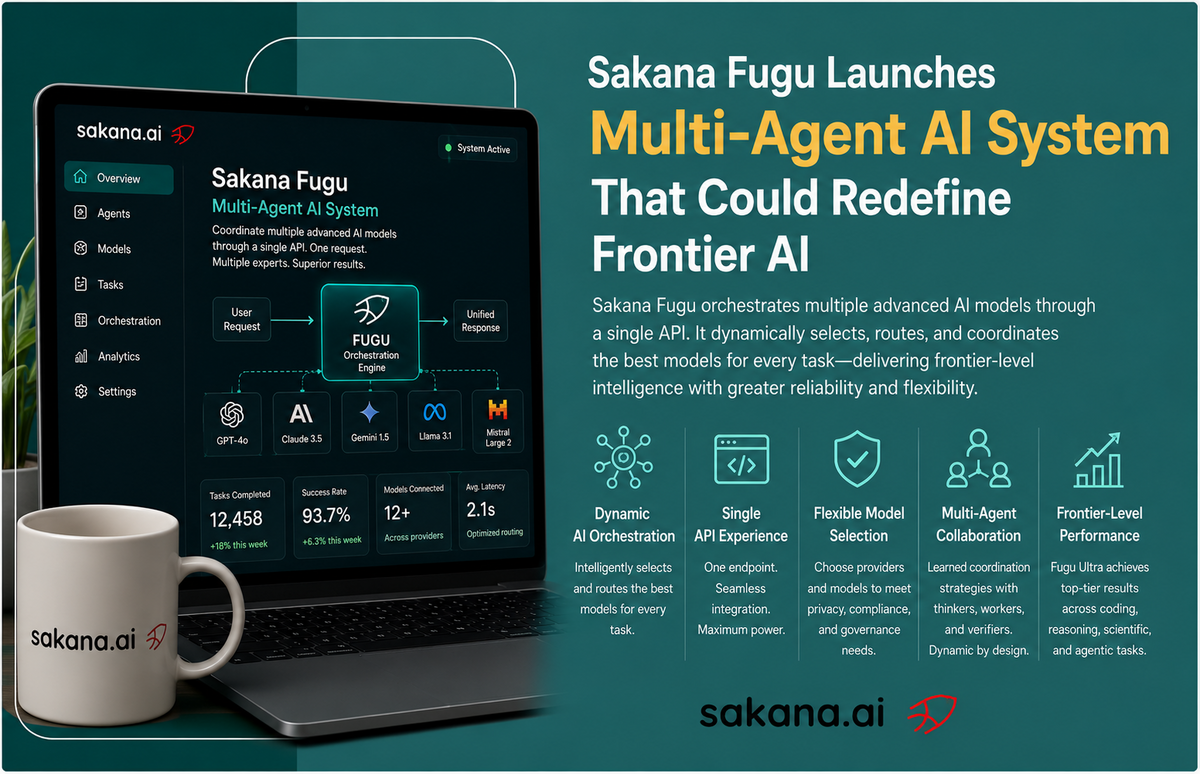
Sakana AI unveiled Sakana Fugu as what it calls a "multi-agent system delivered as one model."
Users send a single request through one API endpoint.
Behind the scenes, Fugu dynamically selects, routes, coordinates, and verifies work across a pool of AI models. Different models can handle different parts of a complex problem before the system combines everything into a unified response.
This creates an AI experience that feels like one model while actually leveraging collective intelligence from multiple systems.
Key Features and Updates
Dynamic AI Orchestration
Fugu automatically determines which models should participate in solving a task.
Single API Experience
Developers interact with one endpoint while the platform manages routing and optimization.
Flexible Model Selection
Organizations can control which providers and models participate in the orchestration layer to satisfy privacy, compliance, and governance requirements.
Multi-Agent Collaboration
Instead of relying on fixed workflows, Fugu uses learned coordination strategies that dynamically assign roles such as thinkers, workers, and verifiers.
Frontier-Level Benchmark Performance
Published benchmark results show Fugu Ultra achieving highly competitive scores across coding, reasoning, scientific, and agentic workloads.
Why It Matters
The AI industry has largely focused on training larger and larger foundation models.
Sakana Fugu introduces a different vision.
Instead of asking, "How do we build a bigger model?"
The question becomes:
"How do we coordinate the best models more effectively?"
This has significant implications for:
- AI marketing
- AI ads
- AI video generation
- AI image generation
- AI performance marketing
- Google Ads optimization
- Meta Ads automation
- Enterprise AI workflows
Marketing teams increasingly depend on multiple AI tools for content creation, audience research, campaign strategy, analytics, and creative production.
An orchestration layer could unify these capabilities and produce stronger outputs than any individual system.
Industry Impact
For businesses, the emergence of AI orchestration may shift purchasing decisions.
Organizations may no longer need to bet on a single provider.
Instead, they can access collective intelligence from multiple systems while reducing vendor lock-in risks.
This is especially important for enterprises concerned about:
- Compliance requirements
- Regional restrictions
- Export controls
- Model availability
- Operational resilience
The ability to dynamically route around unavailable models could become a major competitive advantage.
Future Implications
The launch of Sakana Fugu highlights an important trend:
The next generation of AI may be defined less by larger models and more by smarter coordination.
We are likely entering an era where orchestration platforms become the operating systems of AI.
Model providers will continue building powerful foundation models.
But orchestration layers may become the intelligence that decides when and how those models are used.
If that vision succeeds, the biggest winners may not be the companies with the largest models, but the companies that coordinate them most effectively.
Where GrowEasy Fits In
AI can generate ideas.
But businesses still need execution.
That is where GrowEasy comes in.
AI = Brain
GrowEasy = Execution Engine
GrowEasy helps businesses execute AI-generated campaigns at scale by:
- Automating Google Ads campaigns
- Automating Meta Ads campaigns
- Optimizing AI performance marketing funnels
- Scaling blogs, ad creatives, and content production
- Turning AI insights into real business outcomes
As AI orchestration systems like Sakana Fugu become more powerful, businesses will need platforms that can operationalize those outputs across marketing channels.
GrowEasy acts as that execution layer.
Instead of stopping at AI-generated recommendations, GrowEasy helps teams launch, optimize, and scale campaigns automatically across their growth stack.
Final Thoughts
Sakana Fugu represents one of the most interesting developments in AI this year.
Its core idea is simple but powerful:
The future may belong not to one superintelligent model, but to a coordinated team of specialized AI systems working together.
If benchmark performance continues to improve, AI orchestration could become one of the most important trends shaping the next generation of AI marketing, AI ads, AI video generation, AI image generation, Google Ads automation, Meta Ads optimization, and enterprise AI adoption.
P.S. GrowEasy is AI powered digital marketing and lead generation platform with inbuilt CRM, WhatsApp marketing & automation, and AI agents on phone and WhatsApp.