Summary:
Zhipu AI's launch of GLM-5.2, featuring a 1 million token context window and open-source availability, underscores a pivotal moment in AI development. By advocating for open access and collaboration, the company challenges the trend of restricted AI models, sparking industry-wide discussions on the balance between innovation and control. This release highlights the strategic importance of distribution in AI's future, as companies that enable broad adoption may gain competitive advantages.
Table of Contents
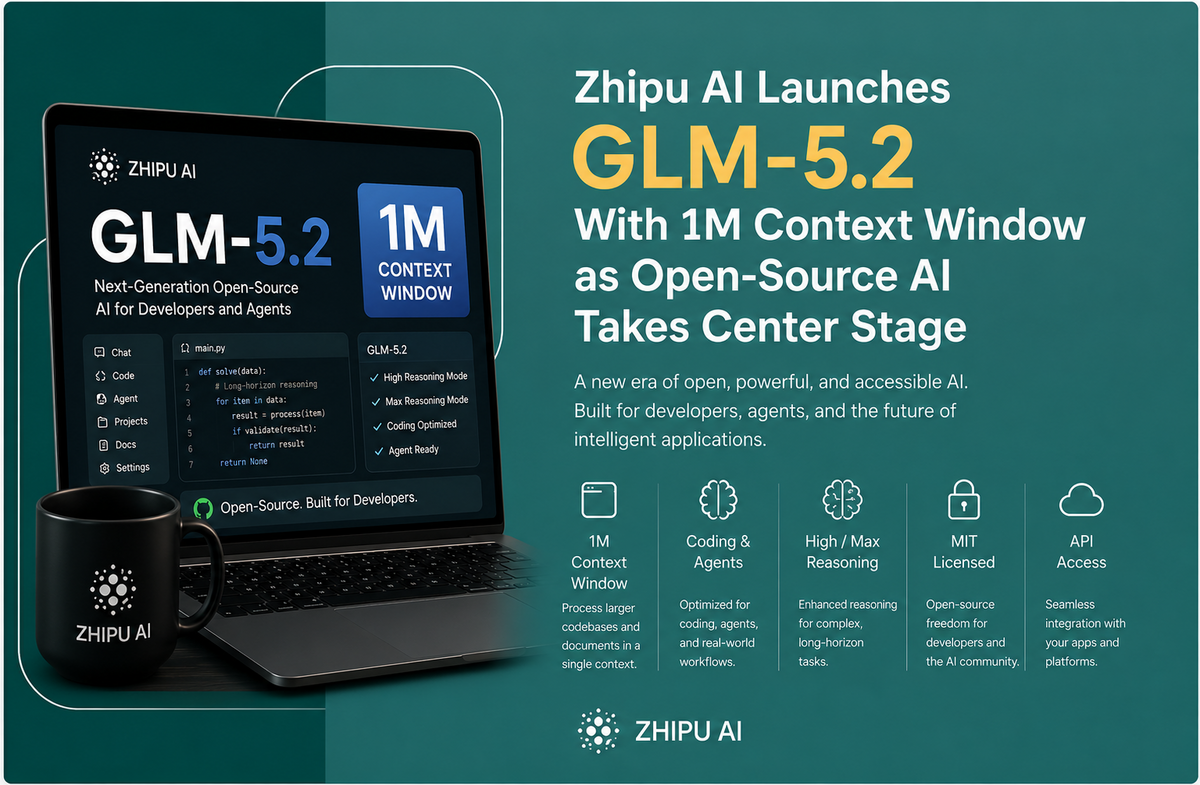
Zhipu AI Launches GLM-5.2 With 1M Context Window as Open-Source AI Takes Center Stage
Introduction
The global AI race took a dramatic turn this week.
Chinese AI company Zhipu AI unveiled GLM-5.2, its newest flagship model, while simultaneously positioning the launch as a response to growing restrictions around frontier AI access. The timing immediately captured industry attention and reignited debate around one of the biggest questions in artificial intelligence:
Should frontier intelligence remain open or be tightly controlled?
What Happened
Zhipu AI officially released GLM-5.2 to users of its GLM Coding Plans, announcing that API access and MIT-licensed open-source weights would follow shortly. The company's messaging strongly emphasized openness, accessibility, and developer empowerment.
In its launch statement, Zhipu argued that AGI development should remain a collaborative global effort rather than becoming restricted behind organizational or geopolitical barriers.
The launch quickly became one of the most discussed stories in the AI ecosystem because it arrived amid broader debates around access to advanced AI models and export controls.
Key Features of GLM-5.2
According to Zhipu AI, GLM-5.2 introduces several major upgrades:
- 1 million token context window
- Focus on coding and long-horizon agent tasks
- High and Max reasoning modes
- Planned MIT-licensed open-source release
- API availability for developers
- Integration with popular coding workflows and agent ecosystems
The 1M-token context window is particularly notable because it allows developers to process significantly larger codebases, documentation sets, and agent workflows within a single context.
Why It Matters
This launch has implications far beyond coding.
The future of AI marketing, AI ads, AI video generation, and AI image generation increasingly depends on powerful foundation models that can reason across massive datasets and complex workflows.
Large context windows can improve:
- Multi-step marketing automation
- Campaign planning
- Long-form content generation
- Customer journey analysis
- AI-powered business operations
- Enterprise knowledge management
As AI performance marketing becomes more sophisticated, businesses will increasingly depend on models capable of handling extensive context and executing long-horizon tasks.
Industry Impact
The launch highlights a growing divide in the AI industry.
One side focuses on tightly controlled access to frontier intelligence.
The other focuses on open-source distribution and developer accessibility.
Open-source models have historically accelerated innovation by allowing startups, researchers, and businesses to build without dependency on a single provider.
GLM-5.2 enters a rapidly evolving landscape where organizations are searching for alternatives that offer:
- Lower costs
- Greater flexibility
- More control over deployment
- Reduced dependency on individual vendors
For developers building AI agents, coding assistants, and enterprise automation systems, open-source availability can become a major competitive advantage.
Future Implications
The next chapter of AI may not be decided solely by benchmark scores.
Distribution could become just as important as intelligence.
Companies that provide powerful models while enabling broad adoption may gain significant ecosystem advantages over competitors relying exclusively on closed platforms.
As AI capabilities continue to improve, the battle between open-source and closed-source ecosystems is likely to shape the future of innovation, developer adoption, and enterprise deployment.
GLM-5.2 represents more than a product release.
It represents a strategic vision for how frontier AI should be shared with the world.
Where GrowEasy Fits In
Powerful AI models can generate insights, strategies, content, and recommendations.
But businesses still need execution.
That's where GrowEasy fits in.
Think of it this way:
AI = Brain
GrowEasy = Execution Engine
GrowEasy helps businesses turn AI-generated outputs into real marketing results by:
- Executing AI-generated campaigns
- Automating Google Ads management
- Automating Meta Ads campaigns
- Optimizing AI performance marketing funnels
- Scaling blogs, ad creatives, and content production
- Managing leads through CRM and automation workflows
- Converting AI recommendations into measurable business growth
As models like GLM-5.2 become more powerful, the opportunity shifts from simply generating ideas to executing them efficiently.
GrowEasy serves as the execution layer that transforms AI intelligence into business outcomes.
Conclusion
Zhipu AI's GLM-5.2 launch is one of the most significant open-source AI announcements of the year.
With a 1 million token context window, planned MIT licensing, and a strong open-access message, the company is positioning itself at the center of the growing debate over the future of AI.
Whether open-source ultimately wins remains uncertain.
But one thing is becoming clear:
The future of AI will be shaped not only by who builds intelligence, but by who makes it accessible.
P.S. GrowEasy is AI powered digital marketing and lead generation platform with inbuilt CRM, WhatsApp marketing & automation, and AI agents on phone and WhatsApp.