
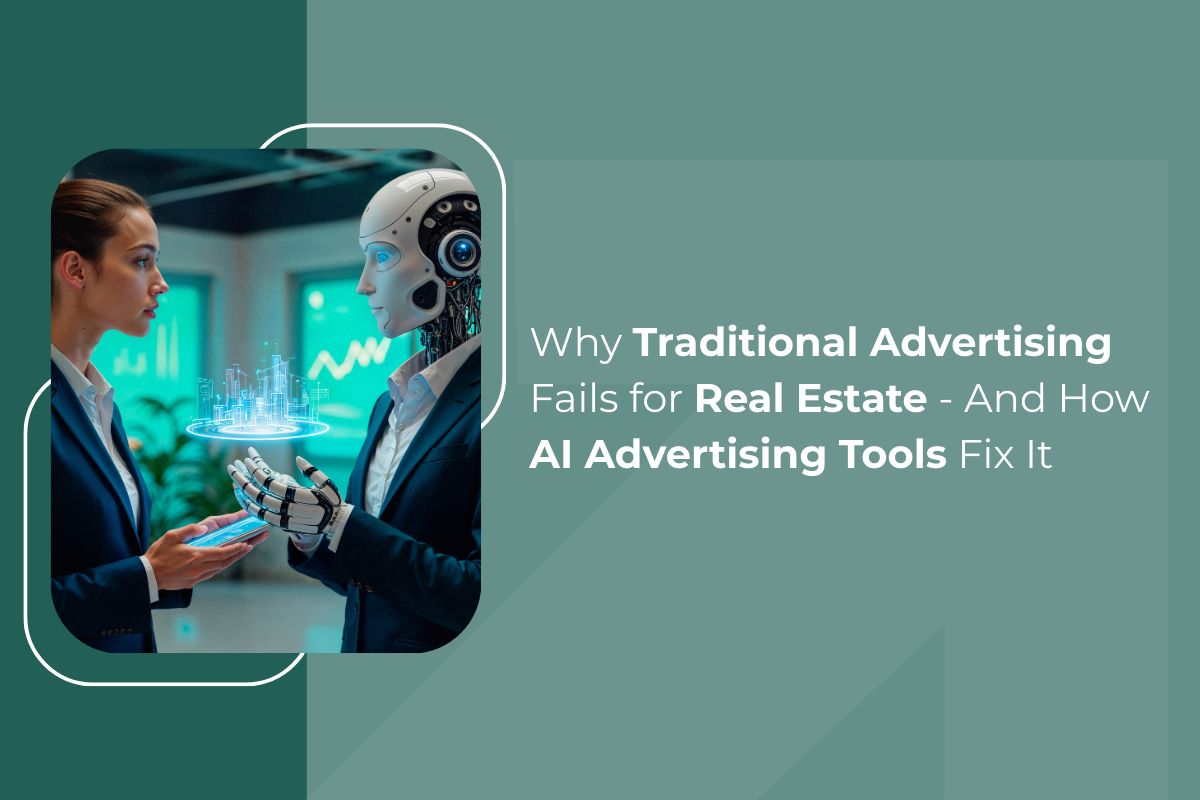
Big spend. Loud promise. Thin results. This gap between effort and outcome sits at the heart of today’s real estate advertising challenges in India, especially for developers still relying on traditional formats instead of data-driven real estate digital marketing.
The way people search for homes has changed, but traditional formats have stayed frozen in time. This is where the cracks start to show, especially for developers and brokers trying to balance visibility, cost, and lead quality.
Today, we explore why old-school property advertising struggles to perform and how AI-led real estate marketing corrects those gaps without changing the fundamentals of the business.
How Expensive Is Traditional Real Estate Advertising in India?
Print media has long been treated as a badge of seriousness in Indian real estate. Full-page credibility. Sunday supplements. Front-page visibility. The numbers tell a harsher story.
A quarter-page ad in a leading national daily like the Times of India costs close to ₹7 lakh. The journey after that looks like this:
- Around 400 website visits
- Roughly 130 qualified enquiries
- Only 3 to 4 actual buyers
That works out to nearly ₹17.5 lakh spent to acquire one buyer.
For mid-sized developers and independent brokers, this math does not hold. Yet cost is only one side of the real estate advertising challenges story, pushing many to explore performance-led digital marketing services instead of fixed-cost media.
Why is There Zero Targeting and Massive Wastage in Property Advertising?
Traditional property advertising works on reach, not relevance. A newspaper reaches everyone who opens it. Buyers. Renters. Students. Retirees. People with no intent to purchase at all. There is no way to filter by budget, location preference, family size, or purchase timeline.
Modern real estate digital marketing platforms work very differently. They identify people already searching for homes, comparing prices, saving listings, and checking locality details. The message reaches fewer people, yet far more of them matter.
Why Is Measuring Performance So Difficult in Traditional Real Estate Advertising?
Another core weakness in traditional advertising lies in measurement.
Once a print campaign goes live, visibility ends there. No clarity on which ad brought which lead. No idea which message worked. Making changes means reprinting and waiting weeks.
AI-driven real estate digital marketing tools offer live performance data. Campaigns can be adjusted within hours. Messaging, bidding, targeting, and listings change while buyer interest is still active. This feedback loop keeps spending aligned with outcomes.
How Does Slow Adaptation Hurt Property Advertising Results?
Indian real estate does not move in straight lines. Demand changes with interest rates. There are launch overlaps. Regulatory updates alter buyer confidence. Festive seasons create spikes.
Print-led property advertising struggles to keep pace. Production and placement cycles stretch for weeks. By the time an ad appears, the moment has often passed.
AI-powered real estate digital marketing reacts in near real time. Messaging adapts to market sentiment. Budgets shift toward performing listings. Campaigns pause or scale without friction.
Why Do Language Barriers Limit Traditional Real Estate Advertising?
India is multilingual at its core. English newspaper advertising reaches only a narrow slice of the market.
India’s digital audience is largely regional-language driven. IAMAI and Nielsen report that 57 per cent of urban internet users prefer consuming content in Indian languages, while around 68 per cent of all Indian internet users favour native-language content overall.
Google and KPMG further confirm that Indian-language users already outnumber English users online, highlighting why English-only traditional real estate advertising reaches only a narrow slice of active buyers. (2)
Why Is Lead Quality a Major Real Estate Advertising Challenge?
Print ads attract curiosity. The sales teams spend hours filtering, calling, and following up with people who have no real intent.
AI-driven property advertising focuses on qualification first. Buyer behaviour signals decide who gets priority. Sales effort shifts toward prospects who mention timelines, revisit listings, and compare options seriously.
How Do Missed Responses Cost Developers Serious Buyers?
Traditional workflows depend on manual response. A buyer sees an ad, notes a number, and calls during business hours. If no one answers, the trail often ends there.
Every hour of delay cuts conversion probability sharply.
AI-powered chatbots respond instantly, day and night. They answer questions, suggest suitable properties, book site visits, and collect buyer details. This immediacy fixes a silent leak that has long weakened real estate advertising outcomes.
How Do AI Advertising Tools Repair Real Estate Advertising at Scale?
India’s PropTech market reached ₹1.66 billion in 2025 and is expected to grow to ₹4.29 billion by 2031 at a CAGR of 16.95 per cent. This growth reflects how AI tools directly solve long-standing real estate advertising challenges.
How Does AI Improve Lead Targeting and Qualification?
AI systems study buyer behaviour across search queries, browsing depth, listing comparisons, budget checks, and location interest.
Each enquiry receives a conversion probability score. Buyers discussing timelines or revisiting listings move higher in priority, while casual browsers move lower. This structure allows brokers to focus energy where outcomes are most likely.
How Does 24/7 AI Engagement Prevent Lead Leakage?
AI chatbots respond instantly to every enquiry, regardless of time or day. They handle common questions, share listings, suggest alternatives, and book site visits.
These systems understand context. A buyer asking about Vastu compliance near a metro station receives a specific answer, not a generic script. Language preference is respected, keeping conversations natural and friction-free.
How Does Multilingual AI Expand Reach Beyond Metros?
AI platforms support communication across 12 to 22 Indian languages. They recognise cultural preferences such as joint family housing needs, religious considerations, and Vastu requirements.
Content adapts for platforms popular outside metros, allowing developers to tap Tier II and Tier III demand without running separate campaigns.
How Does AI Personalisation Increase Buyer Engagement?
AI systems analyse both explicit filters like price and size, and implicit signals like time spent on listings or repeated searches.
If a buyer searches for a “2BHK near metro under ₹80 lakh with good ventilation,” the system understands family needs, safety expectations, and lifestyle preferences. Over time, recommendations become sharper, keeping buyers engaged longer.
How Does AI Centralise Leads and Automate Follow-Ups?
Every enquiry from portals like 99acres and MagicBricks, websites, WhatsApp, Instagram, and calls flows into one CRM.
Automated workflows send reminders, schedule visits, share pre-visit details, and follow up after site visits. Agents see full histories and lead status in one place, reducing missed opportunities.
How Do Real-Time Analytics Improve Property Advertising Decisions?
Dashboards display cost per lead, cost per acquisition, conversion rates by listing, and source attribution.
AI systems test different headlines, descriptions, and calls-to-action automatically. Budgets shift toward versions that perform best, keeping campaigns efficient and responsive.
How Does AI Help with Accurate Pricing and Market Intelligence?
Automated valuation models analyse sales history, rental trends, neighbourhood growth, RERA data, and demographic shifts.
Knight Frank India reports that AI models predict Mumbai property prices within a 5 per cent margin of error. Developers receive pricing suggestions that balance volume and margin while responding to live demand signals.
Where Real Estate Advertising Is Heading?
The gap between traditional formats and AI-led real estate digital marketing continues to widen. One relies on visibility. The other relies on intent, timing, and relevance.
For Indian developers and brokers, it is about efficiency and control. AI tools change how accurately effort turns into outcomes. That shift defines the next phase of property advertising in India.
Easy and fast setup
Marketing Doesn't Have to Be Hard. Let AI Do the Work.
Start getting leads in 5 minutes – no marketing team needed.
Start Now