Summary:
China's decision to block Meta's acquisition of Manus AI highlights a shift in the global AI landscape, emphasizing control and security over mere innovation. This move underscores the strategic importance of AI technologies, with implications for international AI collaborations and the future of AI-driven industries. As AI agents like Manus evolve, they promise to transform sectors such as marketing by enabling more autonomous and efficient operations, while companies like GrowEasy aim to bridge AI capabilities with practical execution.
Table of Contents
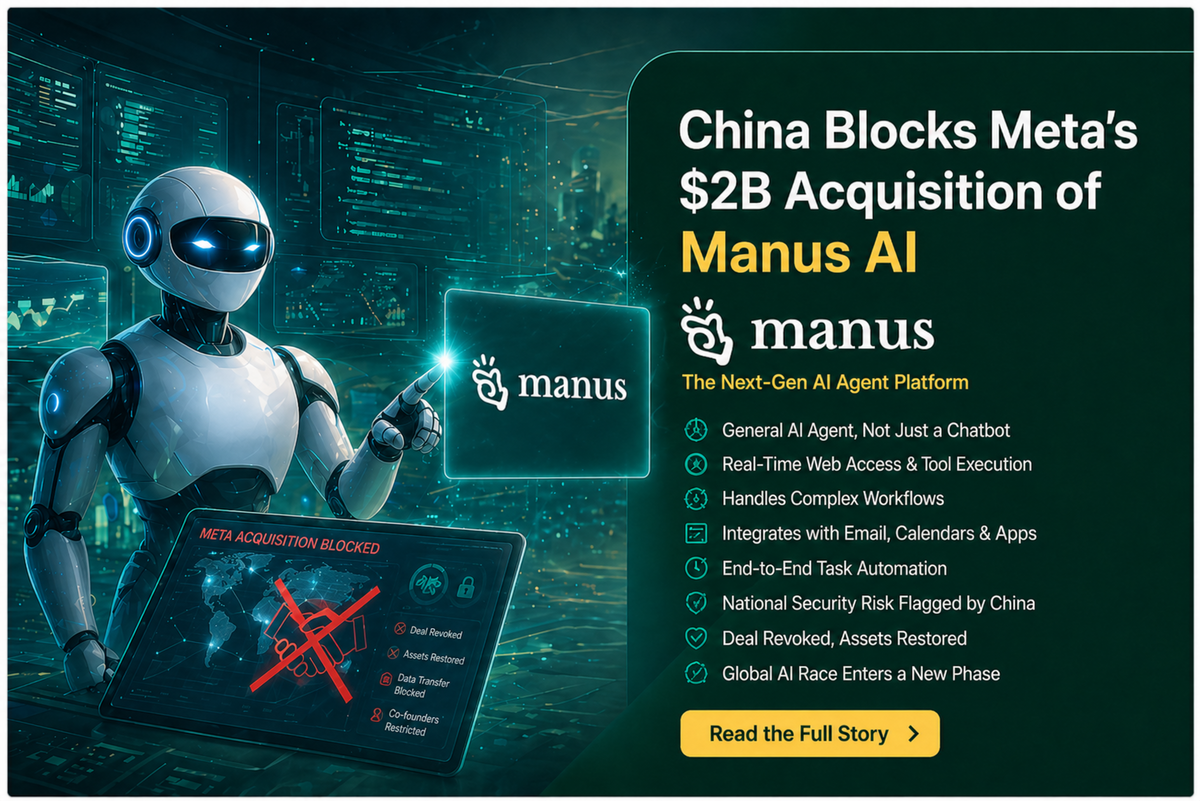
In a dramatic escalation of the global AI race, China has officially blocked Meta from acquiring Manus AI, a next-generation AI agent platform valued at $2 billion.
This move signals a deeper shift. AI is no longer just about innovation. It is now about control, security, and global dominance.
What Happened
Meta had moved to acquire Manus AI in December after the company gained global attention in early 2025.
Despite Manus shifting its base to Singapore, Chinese regulators intervened.
Authorities:
- Ordered the deal to be revoked
- Demanded restoration of Chinese assets
- Prevented transfer of data and technology
Reports also indicate that Manus’s co-founders were summoned and restricted during the review process.
What Is Manus AI
Manus is not a traditional chatbot.
It is a general AI agent, designed to go beyond conversation.
Key capabilities include:
- Real-time web access
- Tool calling and execution
- Handling complex workflows
- Interacting with apps like email and calendars
Unlike typical AI tools used in AI marketing or AI ads, Manus can perform tasks end-to-end, making it significantly more powerful.
Why China Blocked the Deal
China has classified Manus as a national security-sensitive technology.
Even though the company restructured in Singapore, regulators argued:
- The parent entity remains Chinese
- The technology originated in China
- Foreign ownership poses strategic risks
Under Chinese law, any foreign investment involving sensitive technologies can be blocked.
This reflects a broader stance:
AI innovation is now treated like critical infrastructure.
Why It Matters for AI Marketing and AI Ads
The rise of AI agents like Manus will redefine:
AI marketing
- Autonomous campaign execution
- Real-time optimization
- Reduced human dependency
AI ads
- Dynamic creative generation
- Automated targeting and scaling
- Continuous performance learning
AI performance marketing
- End-to-end funnel automation
- Data-driven decision making
- Faster iteration cycles
Platforms like Google Ads and Meta Ads could evolve rapidly as agent-based AI becomes mainstream.
Industry Impact
This decision sets a powerful precedent:
- Governments may increasingly restrict AI exports
- Cross-border AI acquisitions will face scrutiny
- Tech companies may need to localize AI development
For companies like Meta, this is a major setback in catching up in the AI race.
For China, it is a clear signal:
retain control over high-impact AI technologies.
Future Implications
The global AI landscape is shifting toward fragmentation.
We may see:
- Separate AI ecosystems (US vs China)
- Restricted access to advanced AI tools
- Increased regulation of AI innovation
At the same time, AI agents will continue to evolve rapidly.
The next wave of AI will not just assist humans.
It will act independently.
Where GrowEasy Fits In
As AI tools become more powerful, execution becomes the real bottleneck.
That’s where GrowEasy comes in.
AI = Brain
GrowEasy = Execution Engine
GrowEasy:
- Executes AI-generated campaigns
- Automates Google Ads and Meta Ads
- Optimizes AI performance marketing funnels
- Scales content across ads, blogs, and creatives
It bridges the gap between AI intelligence and real-world marketing results.
Final Thoughts
China blocking Meta’s Manus AI deal is more than a regulatory decision.
It is a signal that the AI race is entering a new phase.
One where control matters as much as innovation.
And where AI agents could redefine how businesses operate globally.