Summary:
The introduction of Kimi K2.6 by Moonshot AI marks a significant shift in the AI industry, moving from traditional chatbots to a multi-agent AI workforce capable of executing complex, long-duration tasks. This open-source model aims to enhance business operations by automating marketing, engineering, and research processes, challenging proprietary systems and fostering innovation in AI-driven businesses.
Table of Contents
A New AI Race Has Started
The AI industry has entered a new phase with the launch of Kimi K2.6, an open-source model developed by Moonshot AI. Unlike traditional chatbots, this system is designed to function as a multi-agent AI workforce capable of handling complex tasks over long durations.
This launch signals a major shift in how AI systems are being built and deployed across industries.
What Happened
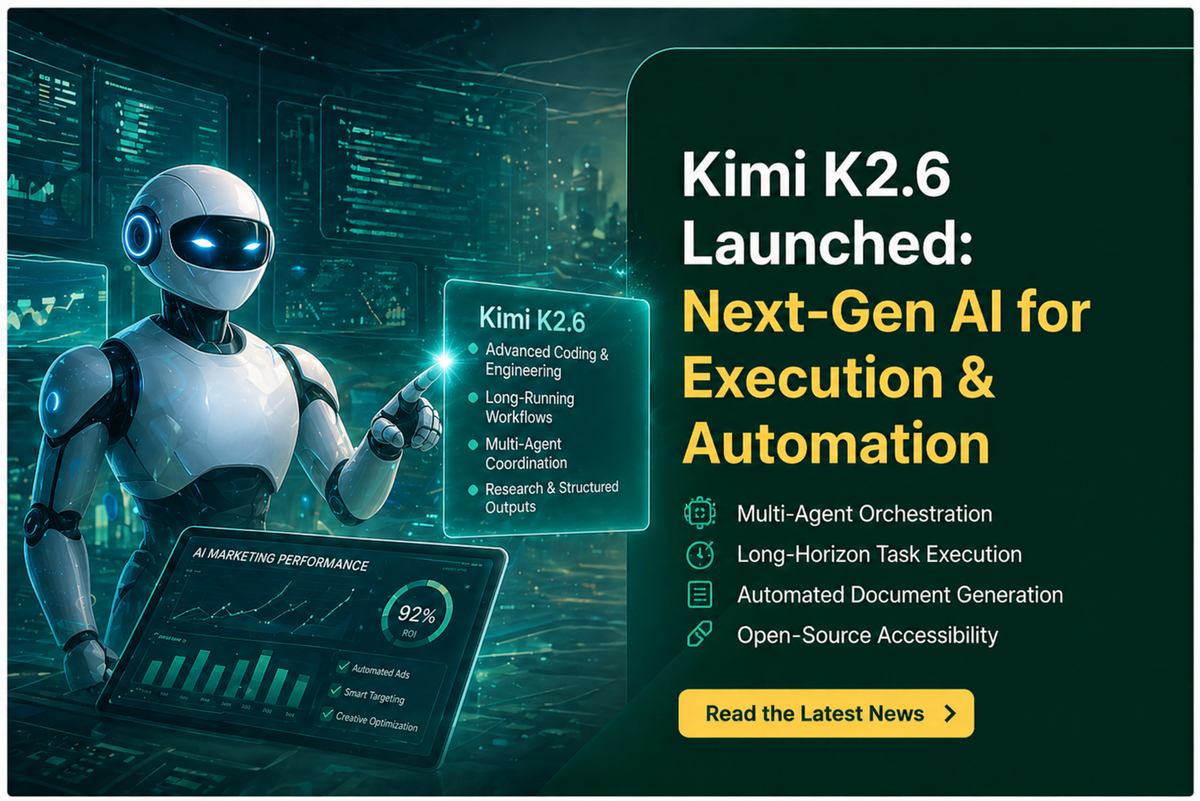
Moonshot AI officially introduced Kimi K2.6, a next-generation AI system designed for:
• Coding and engineering tasks
• Long-running autonomous workflows
• Multi-agent coordination systems
• Research and structured output generation
The model is reported to perform competitively against leading proprietary systems, including Claude Opus in coding and agent-based benchmarks, while still evolving in reasoning and vision-heavy tasks.
Key Features of Kimi K2.6
Kimi K2.6 is built around execution, not just conversation.
Key capabilities include:
• Multi-agent orchestration (AI swarms working together)
• Long-horizon task execution (hours of continuous work)
• Automated document generation (slides, reports, datasets)
• Advanced coding and engineering workflows
• Open-source accessibility for developers
This positions it as a foundation model for building autonomous AI systems.
Why It Matters for AI Marketing and Automation
The biggest impact is not technical, it is business-driven.
Kimi K2.6 represents a shift toward:
• AI marketing systems that execute campaigns end-to-end
• AI ads automation with reduced human input
• AI video and content pipelines running continuously
• Performance marketing workflows powered by agents
This moves AI from “assistive tools” to “operational systems.”
Industry Impact
The release intensifies competition between open-source and closed AI ecosystems.
While proprietary models like ChatGPT and Claude still lead in reasoning and multimodal capabilities, open-source systems like Kimi are rapidly closing the gap in real-world execution tasks.
This could lead to:
• Cheaper AI infrastructure for startups
• Faster adoption of autonomous agents
• Increased experimentation in AI-driven businesses
Future Implications
If systems like Kimi K2.6 continue evolving, businesses may shift toward:
• Fully automated AI teams
• Agent-based marketing operations
• Reduced dependency on manual workflows
• Scalable AI-driven production systems
The AI landscape is moving from chat interfaces to execution engines.
Where GrowEasy Fits In
AI models like Kimi K2.6 represent intelligence, but businesses still need execution layers to turn that intelligence into revenue.
This is where GrowEasy comes in.
GrowEasy executes AI-generated campaigns by:
• Automating Google Ads and Meta Ads
• Running performance marketing funnels at scale
• Converting AI outputs into real campaigns and leads
• Managing WhatsApp marketing and CRM workflows
• Scaling content, creatives, and ad operations
AI = Brain
GrowEasy = Execution Engine
Together, they bridge the gap between AI capability and business results.