Summary:
Reve 2.0, a new AI image model from a Palo Alto-based lab, introduces a groundbreaking approach to image generation by treating images as structured code, allowing for precise control and editing. This model separates planning from rendering, enabling high-resolution, lossless editing and improved typography. Its layout-driven method enhances creative consistency and efficiency, particularly for marketing teams needing scalable asset creation. This shift towards controllability in AI image generation could significantly impact industries reliant on creative automation, marking a new phase in AI development focused on structured creative engineering.
Table of Contents
Reve 2.0 Launches Revolutionary 4K AI Image Model and Disrupts the Future of Image Generation
Introduction
The AI image generation race just took a surprising turn.
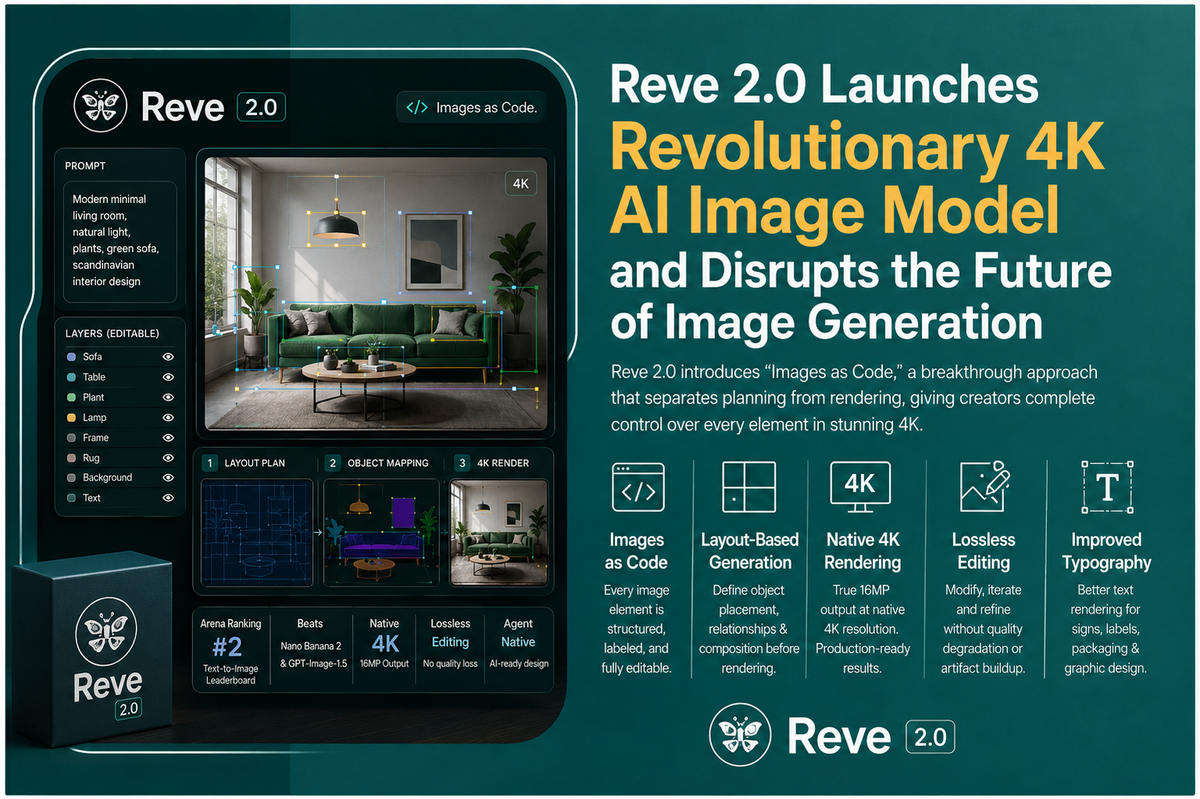
Reve, a relatively small AI research lab based in Palo Alto, has launched Reve 2.0, a next-generation image model that is rapidly attracting attention across the AI industry. The company claims its new model ranks #2 on the Arena Text-to-Image leaderboard, outperforming several well-known competitors including Nano Banana 2 and GPT-Image-1.5.
However, the most important story is not the ranking. It is the technology behind it.
Reve 2.0 introduces a new concept called "Images as Code," potentially redefining how creators, marketers, designers, and businesses interact with AI-generated visuals.
What Happened?
Reve officially unveiled Reve 2.0 with a bold vision.
Instead of generating images directly from text prompts, the system separates planning from rendering.
The model first creates a highly structured layout that defines objects, positioning, relationships, typography, composition, and scene structure. Only after the planning stage does the rendering engine generate the final image.
This architecture allows users to inspect, edit, and manipulate individual components of an image with unprecedented precision.
According to the company, every generated image is segmented and labeled, making every visual element addressable and editable.
Key Features and Updates
Native 4K Rendering
Reve 2.0 generates images at native 4K resolution, delivering true 16-megapixel output without relying on post-generation upscaling workflows.
This means creators can iterate directly at production-quality resolution.
Images as Code
The model treats images as structured code rather than static visual outputs.
Each element can be modified independently, enabling precise control over composition and editing.
Layout-Based Generation
Instead of hoping prompts generate the desired result, users gain access to explicit layouts that define where every object appears.
This dramatically improves consistency and creative control.
Lossless Editing
One of the biggest challenges in AI image generation is degradation during repeated edits.
Reve claims its architecture minimizes artifact accumulation and preserves image quality throughout iterative workflows.
Agent-Native Design
Because images are represented through structured intermediate representations, AI agents can reason about image content more effectively.
This opens the door for advanced AI-assisted creative workflows.
Improved Typography
Text rendering remains one of the biggest challenges in image generation.
Reve 2.0 introduces improved handling of typography, signage, packaging, labels, and graphic design elements, making AI-generated visuals significantly more useful for commercial applications.
Why It Matters
The implications extend far beyond artistic image generation.
For businesses focused on AI marketing, AI ads, Google Ads, Meta Ads, AI video generation, and AI image generation, controllability is becoming more important than raw image quality.
Marketing teams rarely need a beautiful image only once.
They need:
• Hundreds of ad variations
• Localized creative assets
• Brand-compliant visuals
• Consistent campaign iterations
• Fast creative testing
Traditional AI image generation often forces marketers into repetitive prompt engineering and regeneration cycles.
Reve's layout-driven approach could make campaign asset creation dramatically more efficient.
This shift could have major implications for performance marketing teams seeking scalable creative production.
Industry Impact
The launch highlights a broader trend emerging across the AI ecosystem.
The first phase of generative AI focused on proving that machines could generate content.
The second phase is about control.
Just as software development evolved from raw machine code to highly structured programming systems, AI creativity may be evolving from prompt-based experimentation toward structured creative engineering.
Companies building AI marketing, AI ads, content creation platforms, and creative automation tools will likely pay close attention to this development.
If Reve's architecture delivers on its promises, it could influence future product roadmaps across the industry.
Future Implications
The future of AI image generation may look very different from today's workflows.
Instead of generating complete images and hoping for the best, creators may soon interact with editable visual systems where every object, color, text block, and design element is fully controllable.
This would move AI image generation closer to professional design software while preserving the speed and scalability of generative AI.
The long-term impact could extend beyond images into AI video generation, creative automation, digital advertising, game development, virtual production, and interactive media.
Reve 2.0 may be remembered not simply as another image model launch, but as an early signal that controllability is becoming the next major frontier in generative AI.
Where GrowEasy Fits In
As AI models become increasingly capable of generating creative assets, businesses still face a critical challenge: execution.
This is where GrowEasy fits into the ecosystem.
AI models like Reve act as the Brain by generating ideas, visuals, creatives, and content.
GrowEasy acts as the Execution Engine .
GrowEasy helps businesses:
• Execute AI-generated campaigns at scale
• Automate Google Ads and Meta Ads management
• Optimize AI performance marketing funnels
• Scale content production across ads, blogs, and creatives
• Turn AI-generated assets into measurable business outcomes
As AI tools continue to improve, companies will increasingly need platforms that transform AI outputs into real-world growth.
The future belongs not only to AI creation, but also to AI execution.
AI creates.
GrowEasy executes.
P.S. GrowEasy is AI powered digital marketing and lead generation platform with inbuilt CRM, WhatsApp marketing & automation, and AI agents on phone and WhatsApp.