
Table of Contents
Signs It's Time to Make the Switch
Step 1: Audit What Your Agency Is Actually Doing For You
Step 2: Decide What You're Actually Replacing
Step 3: Get Your Creative Assets and Account Access Before You Cancel
Step 4: Run a Parallel Test Before Fully Switching
Step 5: Set Up the AI Ad Manager Properly
What Changes Day-to-Day After the Switch
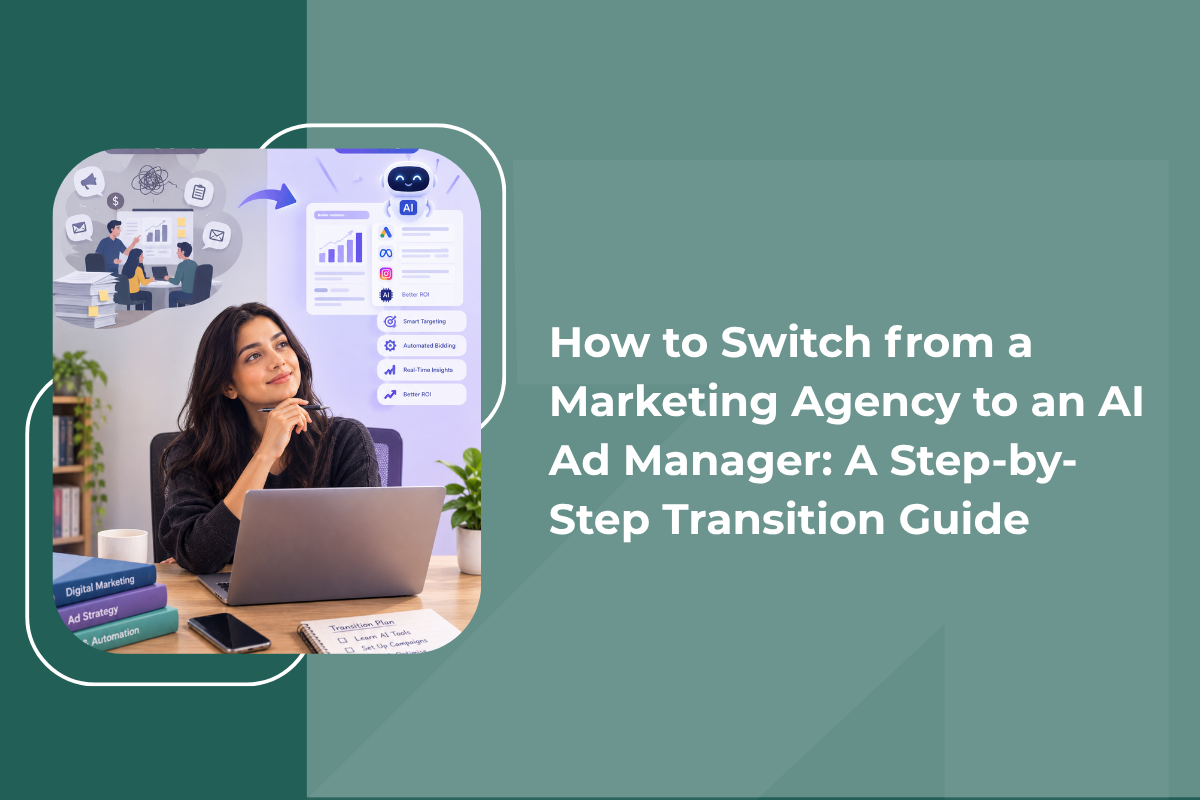
Every month, a growing number of small businesses in India quietly let their agency retainer lapse and move their ad campaigns to an AI-powered platform instead. Not because the agency did a bad job necessarily, but because the retainer, often ₹30,000 to ₹50,000 or more a month, stopped making sense once an AI ad manager could handle the same core work at a fraction of the cost, with faster turnaround and none of the back-and-forth delays.
If you're considering the same move, the switch is far less disruptive than it sounds, as long as you do it in the right order. This guide walks through exactly how to plan the transition, what to keep, what to let go of, and what to watch for in the first few weeks.
Signs It's Time to Make the Switch
Not every business should switch, and not every agency relationship deserves to be ended. But a few recurring signs suggest an AI ad manager is worth seriously evaluating:
- You're paying a flat monthly retainer regardless of ad spend or results, and the retainer itself now costs more than what you're actually spending on ads.
- Campaign changes take days, not minutes, because every creative swap or targeting tweak has to go through an account manager and a review cycle.
- You don't have visibility into what's actually happening inside the account, you get a monthly report, not real-time access to performance.
- Leads arrive by email or a shared spreadsheet, days after they were generated, instead of the moment someone actually shows interest.
- Your budget is genuinely small (a few thousand rupees a day or less), and an agency retainer eats a disproportionate share of what you're spending, leaving little left for actual ad delivery.
- You've outgrown the need for full-service strategy and mostly need consistent execution, audience targeting, creative testing, and optimisation, rather than a strategic partner.
If two or three of these sound familiar, the transition is worth planning properly rather than abandoning ads altogether out of frustration.
Step 1: Audit What Your Agency Is Actually Doing For You
Before switching anything, get a clear picture of what you're currently paying for. Request account access (you're usually entitled to this, since the ad account should be under your business, not the agency's) and review:
- Which platforms are running (Facebook, Instagram, Google, or a mix)
- Current monthly ad spend versus the retainer fee, these are often two very different numbers
- What creative assets exist and who owns them
- Current targeting setup and what's been tested already
- Recent performance: cost per lead, cost per click, conversion rates over the last few months
This audit does two things: it tells you what a replacement platform needs to be able to do, and it gives you a performance baseline to judge the new setup against, so the switch isn't a leap of faith.
Step 2: Decide What You're Actually Replacing
An agency typically does more than just run ads, some of that value transfers cleanly to an AI ad manager, and some doesn't.
What an AI ad manager replaces well:
- Manual bid and budget management (now largely automated by the ad platforms themselves anyway)
- Audience targeting and expansion
- Creative testing and delivery optimisation
- Campaign setup and launch speed
- Real-time performance monitoring
What still needs a human decision, either you, or occasionally outside help:
- Overall brand strategy and positioning
- High-effort creative production (professional photography, video shoots)
- Complex, multi-channel campaigns spanning far beyond paid social and search
- One-off, highly specialised campaigns (a major product launch, a brand overhaul)
For most small businesses, the bulk of what an agency retainer was covering, day-to-day campaign management, targeting, and optimisation, is exactly what an AI ad manager is built to replace. The strategic and creative-production pieces, if you still need them occasionally, can usually be handled as one-off projects rather than an ongoing monthly retainer.
Step 3: Get Your Creative Assets and Account Access Before You Cancel
This is the step most businesses skip, and it's the one that causes the most pain afterward. Before ending an agency relationship:
- Confirm ownership and download every creative asset (images, videos, copy) the agency has used or produced for you
- Ensure your ad accounts (Meta Business Manager, Google Ads) are under your own business login, not the agency's, if they're not, request a transfer before cancelling
- Export historical performance data and audience insights if possible; even basic learnings (which creative styles performed best, which audiences converted) are useful starting signals for a new platform
- Get clarity on your notice period and any final invoicing, so the transition timeline is clean
Doing this before the relationship ends avoids the common scenario where a business loses access to its own ad account, historical data, or creative library the moment a retainer lapses.
Step 4: Run a Parallel Test Before Fully Switching
Rather than cancelling the agency and switching everything overnight, the lower-risk approach is running a short parallel test, a smaller campaign on the new AI ad manager, alongside your existing agency-managed campaigns, for two to four weeks. This lets you compare cost per lead, lead quality, and turnaround speed directly, with real numbers rather than assumptions, before making the full switch.
This is also the stage to test something most agencies won't offer by default: routing leads directly into a conversational channel like WhatsApp instead of a lead form or email, since Indian buyers generally respond faster and more consistently through chat-based follow-up than through email.
Step 5: Set Up the AI Ad Manager Properly
Once you've decided to move forward, setup itself is the fastest part of the whole transition, often the exact opposite of how long agency onboarding usually takes. On a platform built for this, the process typically looks like:
- Connect your ad accounts. Link Meta Business Manager (and Google Ads if relevant) directly, so campaigns run from your own accounts, not a third party's.
- Define your objective clearly. Leads, messages, or sales, this single decision shapes how the AI optimises everything that follows.
- Provide your creative inputs. Product photos, business details, and offer information, the AI builds ad creative, copy, and targeting from these rather than requiring you to design ads manually.
- Set your budget. Start with a working daily or campaign budget rather than committing your full previous agency spend immediately, this gives the system a stable learning window without over-committing before you've seen results.
- Choose where leads land. Route incoming leads to wherever your team can respond fastest, for most Indian small businesses, that's a WhatsApp inbox rather than email, since response speed on WhatsApp directly affects conversion.
- Let the campaign run without interference for the first one to two weeks. Just as with any AI-optimised ad system, constant early changes reset the learning process and delay stable performance.
What Changes Day-to-Day After the Switch
The most noticeable shift for most business owners isn't the ad performance itself, it's the pace. Instead of submitting a change request and waiting for an account manager to make it, you (or whoever manages the account) can adjust budget, pause underperforming creative, or launch a new campaign directly, in minutes rather than days. Reporting becomes something you check in real time rather than something that arrives as a monthly PDF weeks after the fact.
The other major shift is cost structure. Instead of a fixed retainer regardless of spend or results, the ongoing cost becomes ad spend plus a much smaller platform fee, meaning more of your total marketing budget is actually going toward reaching customers, rather than covering an agency's overhead and account management time.
Making the Switch with GrowEasy
GrowEasy is built specifically for Indian small businesses making this exact transition, from agency-managed to AI-managed advertising, without needing a media buyer, a design team, or Ads Manager expertise on staff. Campaigns launch in under five minutes from a working budget starting around Rs. 1,000, with AI generating targeting, creative, and copy, and continuously optimising bids and audiences around the clock rather than on a weekly account-manager check-in cycle.
The critical advantage for businesses leaving an agency model is integration: every prospect syncs instantly to a native WhatsApp CRM the second they interact with your ad, not a spreadsheet or a monthly report, and campaigns can run in Hindi, Tamil, Marathi, Telugu, Kannada, and Bengali for businesses whose audience extends beyond English-first metros. Billing is in INR, with no minimum monthly retainer regardless of ad spend, which is the specific cost structure most businesses are switching to escape in the first place.
FAQs
Is it risky to switch from an agency to an AI ad manager?
The main risk is switching abruptly without a plan, losing account access, creative assets, or historical data in the process. Auditing what you currently have, securing ownership of your accounts and creative, and running a short parallel test before fully cancelling the agency substantially reduces that risk.
How much can a small business save by switching from an agency to an AI ad manager?
Savings vary by business, but the structural difference is consistent: agency retainers are typically a fixed monthly fee regardless of ad spend, often ₹30,000–₹50,000 or more, while AI ad manager platforms generally charge a much smaller platform fee on top of actual ad spend, meaning a larger share of the total budget goes toward reaching customers rather than covering agency overhead.
Do I need marketing experience to manage an AI ad manager myself?
No. These platforms are specifically designed so a business owner without prior advertising experience can set an objective, provide basic business and creative inputs, and let the AI handle targeting, creative generation, and optimisation.
Will I lose my ad account history when I switch?
Only if you don't secure access before ending the agency relationship. Ensure your Meta Business Manager and Google Ads accounts are under your own business login, and export any available historical performance data, before finalising the switch.
Can I still get strategic marketing advice after switching to an AI ad manager?
For day-to-day campaign strategy, objectives, budget, audience, the AI platform itself is designed to guide that. For occasional, higher-level brand or multi-channel strategy work, many businesses handle that as a one-off project rather than an ongoing retainer, once routine campaign management no longer requires one.
How long should I run agency and AI ad manager campaigns in parallel before fully switching?
Two to four weeks is generally enough to get a reliable comparison of cost per lead, lead quality, and turnaround speed, long enough to get past the initial AI learning period, but not so long that you're paying for both indefinitely.
Easy and fast setup
Marketing Doesn't Have to Be Hard. Let AI Do the Work.
Start getting leads in 5 minutes – no marketing team needed.
Start Now