
Table of Contents
The Core Difference: Discovery vs. Community
Audience: Who You'll Actually Reach on Each Platform
Content Format: What Actually Performs on Each
Ad Formats and What Each Platform Is Best For
Cost Comparison: Is One Cheaper Than the Other?
Which Platform Fits Your Business Type
When You Should Run Both, Not Just One
Both platforms sit inside the same company, both let you run ads from the same Meta Ads dashboard, and both can reach a similar audience with the same budget. So why do so many small businesses see completely different results depending on which one they lean into?
Because Instagram and Facebook are not interchangeable, even though they share the same ad infrastructure. They attract different age groups, reward different content formats, and get used for different reasons at different points in a customer's decision. Picking the right one, or the right split between both, depends on what you sell, who buys it, and what stage of the buying journey you're trying to reach them at.
This guide breaks down exactly where each platform wins, so you can stop guessing and put your time and ad budget where it will actually work.
The Core Difference: Discovery vs. Community
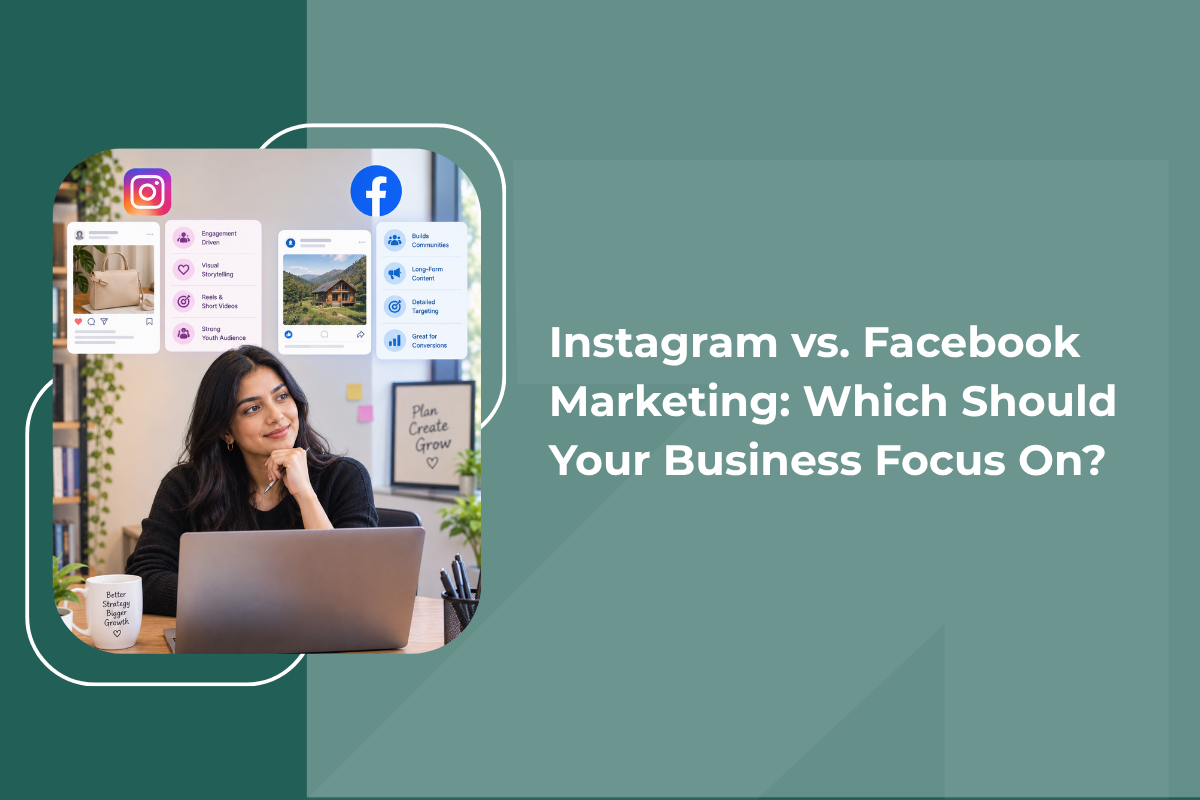
Think of Instagram as where people go to discover, new brands, new products, new ideas, often before they were actively looking for them. The Explore page, Reels, and hashtag search are all built around surfacing content from accounts a user doesn't yet follow. This makes Instagram strong for reaching new audiences who match your ideal customer profile but have never heard of you.
Facebook, by contrast, functions more like a community and utility platform. People use it to stay in touch with local groups, check business hours and reviews, join community discussions, and message businesses directly. Its audience skews slightly older and broader than Instagram's, and it remains the platform where local service businesses, clinics, real estate agents, home services, educational institutes, often see the strongest direct response, because that's where their exact customer base is still actively checking recommendations and reviews.
Neither platform is universally "better." The right choice depends on whether your business needs discovery-driven reach among a younger, visually engaged audience, or trust-driven local reach among a broader age range that's already searching with intent.
Audience: Who You'll Actually Reach on Each Platform
Instagram's user base in India skews younger, with strong usage concentrated in the 18–34 age range, and it is heavily visual and mobile-first by design. If your customer is a younger urban professional, a design-conscious homebuyer, a fitness enthusiast, or a D2C shopper who discovers brands through Reels and influencer content, Instagram is where that behaviour lives.
Facebook's user base spans a wider age range and includes a meaningfully larger share of users in their 30s, 40s, and beyond, which matters for businesses selling to parents (education, healthcare, insurance), homeowners (real estate, home services, construction), and local community-based audiences. Facebook Groups and local community pages also remain active in ways Instagram doesn't really replicate, making it a stronger platform for businesses relying on word-of-mouth and local trust signals.
Content Format: What Actually Performs on Each
- On Instagram, Reels are currently the dominant format for reach, short, hook-driven video that performs even for accounts with a small following, because the algorithm distributes Reels based on content quality and watch time rather than follower count alone. Carousels perform well for educational or step-by-step content. Stories are the lower-effort daily layer, good for polls, behind-the-scenes, and quick updates. A polished, visually consistent grid still matters because it's the first thing a new visitor checks before deciding whether to follow or message you.
- On Facebook, longer-form captions and text posts still get meaningful engagement in a way they generally don't on Instagram. Native video performs well, but so do simple photo posts paired with a clear, direct caption, something that would feel underdressed on Instagram often works fine on Facebook. Facebook also rewards posts that generate comments and shares within Groups and community pages, which Instagram's discovery model doesn't prioritise in the same way.
The practical implication: content built for Instagram (short, visual, hook-first) usually needs to be reworked, not just reposted, to perform well on Facebook, and vice versa. Businesses that copy-paste the same asset across both platforms typically see one of the two underperform.
Ad Formats and What Each Platform Is Best For
Both platforms run through the same Meta Ads system, but performance still varies by objective and audience.
Instagram ads tend to perform strongly for:
- Product-based businesses relying on visual appeal (fashion, home decor, food, fitness)
- Younger-audience services (coaching for competitive exams, fitness studios, salons)
- Reels and Story ad placements that blend naturally into organic content, rather than feeling like a traditional ad
Facebook ads tend to perform strongly for:
- Local service businesses relying on click-to-message or lead form conversions
- Real estate, healthcare, financial services, and education, where the buyer is often slightly older and doing more deliberate research
- Click-to-WhatsApp ads for businesses where the buying conversation happens over chat rather than a landing page, a format that works especially well for Indian SMBs, since it puts a "Send Message" button directly on the ad, opening a WhatsApp conversation the moment someone taps it, with no landing page or form in between
In practice, most businesses running Meta campaigns don't have to choose exclusively, the ad platform lets you run the same campaign across both placements and let the delivery algorithm allocate spend toward whichever platform is converting better for your specific audience. But understanding which platform your organic content and audience naturally favour still helps you write better ad copy and pick better creative for each.
Cost Comparison: Is One Cheaper Than the Other?
Cost per click and cost per lead on Meta platforms fluctuate constantly based on industry, competition, audience size, and creative quality, there's no fixed "Instagram is cheaper than Facebook" rule that holds universally. What tends to hold more consistently is this: Instagram placements can deliver cheaper reach and engagement for visually strong creative aimed at a younger audience, while Facebook often delivers a lower cost per qualified lead for local service businesses targeting a broader or older demographic with a clear, direct offer.
The more reliable lever for controlling cost on either platform isn't which one you pick, it's creative quality. A strong, engaging Reels-style video can cut cost per result by a significant margin compared to a flat, static image, simply because the platform's delivery algorithm rewards content that keeps people watching and engaging, regardless of which app it's shown on.
Which Platform Fits Your Business Type
| Business Type | Better Starting Platform | Why |
| Real estate | Facebook (with Instagram for listings/visuals) | Broader buyer age range, strong local trust signals, click-to-message conversion |
| D2C / fashion / food brands | Instagram | Visual discovery, younger buyer base, Reels-driven reach |
| Coaching institutes / higher education | Both, weighted toward Facebook for parents, Instagram for students | Two distinct audiences making the same decision |
| Healthcare / clinics | Facebook | Older, local, trust-and-review-driven audience |
| Interior design / home renovation | Instagram | Highly visual, portfolio-driven decision-making |
| Financial services (insurance, loans, MFDs) | Facebook | Older audience, higher-consideration purchase, lead form and WhatsApp conversion |
| Coaching / fitness studios | Instagram | Younger audience, community and personality-driven content |
When You Should Run Both, Not Just One
For most businesses with more than one buyer persona, a coaching institute selling to both students and parents, or a D2C brand with both younger and older buyers, running both platforms in parallel, with content adapted to each, outperforms picking only one. The two platforms aren't really competing for the same attention; they're reaching different segments of the same overall market.
The practical approach for a small business with limited time: start with the single platform that best matches your primary buyer, get comfortable with what content and offers convert there, then expand to the second platform once you have a repeatable system rather than trying to manage both from day one with no working playbook yet.
How GrowEasy Simplifies Running Both
Rather than manually deciding platform-by-platform and managing two separate ad setups, GrowEasy's AI Ads Manager runs campaigns across Facebook and Instagram from a single guided setup, letting the platform's delivery system allocate spend toward whichever placement performs better for your specific audience and budget, a decision most small businesses don't have the data or time to make manually anyway.
Campaigns go live in under five minutes, starting from a working budget of around Rs. 1,000, with AI generating the targeting, ad creative, and copy rather than requiring a media buyer or agency. For businesses where the buying conversation naturally happens in chat rather than on a landing page, GrowEasy also supports Click-to-WhatsApp ad formats across both platforms, with every lead delivered directly to your WhatsApp inbox and logged in a built-in CRM the moment they respond, and regional language ad creation in Hindi, Tamil, Marathi, Telugu, Kannada, and Bengali for businesses targeting audiences beyond English-first metros.
FAQs
Is Instagram or Facebook better for small business advertising?
Neither is universally better, it depends on your audience and industry. Instagram tends to favour younger, visually driven buyers and discovery-based decisions. Facebook tends to favour a broader or older audience and trust-driven local decisions. Many businesses run both once they understand which platform their specific customer base actually uses.
Do I need separate content for Instagram and Facebook, or can I post the same thing on both?
You can post the same asset technically, but performance is usually better when content is adapted slightly for each, shorter, hook-first video for Instagram, and longer captions or straightforward photo posts for Facebook, since the two platforms reward different formats.
Which platform is cheaper for running ads?
Cost varies by industry, audience, and creative quality more than by platform. Instagram often delivers cheaper reach for strong visual content aimed at younger audiences; Facebook often delivers lower cost per qualified lead for local service businesses with an older audience. Creative quality tends to matter more than platform choice for controlling cost.
Should a real estate business focus on Instagram or Facebook?
Facebook generally performs better as a primary platform for real estate lead generation, given the broader buyer age range and stronger local trust and review signals, though Instagram remains valuable for showcasing listings and design-forward property visuals.
Can I run the same ad campaign across both platforms at once?
Yes. Meta's ad system allows a single campaign to run across both Facebook and Instagram placements, letting the algorithm allocate spend toward whichever platform performs better for your specific audience, rather than requiring two separate campaigns.
How do I decide which platform to focus on first if I only have time for one?
Start with whichever platform your actual customers use most, based on your industry and buyer age range, not personal preference. A visually driven, younger-skewing business should start with Instagram; a local service business with a broader-age buyer should start with Facebook.
Easy and fast setup
Marketing Doesn't Have to Be Hard. Let AI Do the Work.
Start getting leads in 5 minutes – no marketing team needed.
Start Now