
Table of Contents
Imagine a call getting answered, a natural conversation happening, questions getting asked and answered, and a follow-up getting scheduled, all without a human on the other end of the line. This is not a futuristic concept anymore; it is what AI voice agents are already doing for sales teams handling high call volumes today.
What Are AI Voice Agents?
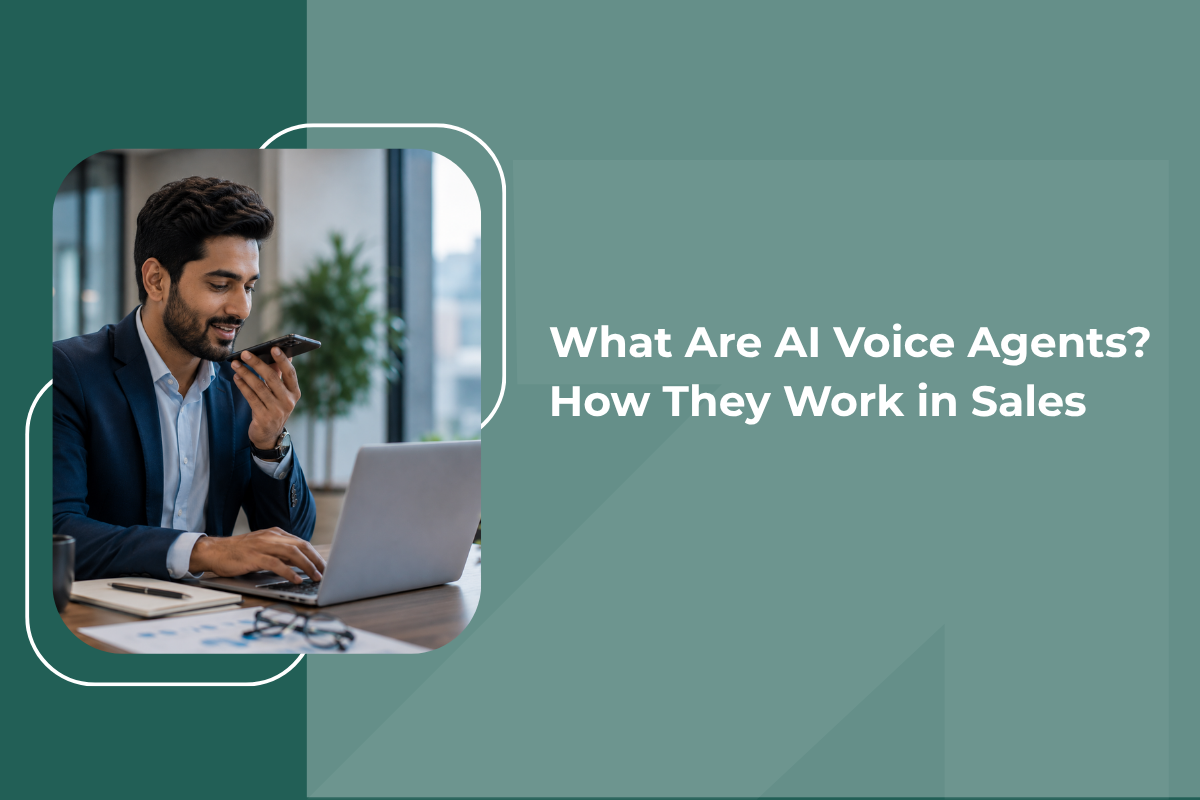
An AI voice agent is a software system that can conduct real, spoken conversations over the phone, understanding what a caller says, responding naturally, and carrying out tasks like answering questions, qualifying leads, or scheduling follow-ups, all without a human agent involved in that specific call.
Unlike the robotic, menu-based systems many people associate with automated phone calls, a modern ai voice agent platform aims to sound natural and conversational, understanding open-ended responses rather than forcing callers to select from a fixed menu of options.
How AI Voice Agents Actually Work
Behind a natural-sounding conversation, several technologies work together in real time:
1. Speech-to-text conversion: The moment a person speaks, their voice is converted into text almost instantly, allowing the system to understand what's being said rather than working with raw audio.
2. Natural language understanding: Once converted to text, the system interprets the actual meaning and intent behind what was said, not just matching keywords, but understanding context, follow-up questions, and even indirect responses.
3. Response generation: Based on the conversation so far and the specific goal of the call, the system generates an appropriate response, whether that's answering a question, asking a follow-up, or moving the conversation toward its next step.
4. Text-to-speech conversion: The generated response is converted back into natural-sounding speech, ideally with tone and pacing that feels conversational rather than robotic.
5. Real-time decision-making: Throughout the call, the system continuously decides what to say next based on the caller's responses, adapting rather than following a rigid, pre-scripted path.
This entire cycle happens in the span of a normal conversational pause, which is what allows the interaction to feel like a real conversation rather than a delayed, mechanical exchange.
How AI Voice Agents Differ from Traditional IVR
Many people's mental image of automated phone systems comes from traditional Interactive Voice Response (IVR), "Press 1 for sales, press 2 for support." These systems are rigid, menu-based, and can't handle anything outside their predefined options.
AI voice agents work fundamentally differently:
- IVR requires callers to navigate a fixed menu; voice agents understand open-ended, natural speech
- IVR can't handle unexpected questions; voice agents can interpret and respond to a wide range of phrasing and intent
- IVR follows a rigid script regardless of context; voice agents adapt their responses based on what's actually being said
- IVR typically routes to a human for anything beyond simple tasks; voice agents can often complete entire conversations independently
This difference is what makes modern voice agents genuinely useful for sales conversations, rather than just a frustrating menu system callers try to escape as quickly as possible.
Use Cases for AI Voice Agents in Sales
- Initial lead qualification: When a new lead comes in, a voice agent can make the first call, ask qualifying questions about budget, timeline, and interest, and only pass genuinely promising leads to a human salesperson for the next conversation.
- Appointment scheduling and confirmation: Voice agents can call to confirm an upcoming appointment, reschedule if needed, or send a reminder, a routine task for a Travel Agency CRM handling booking confirmations, freeing up a significant chunk of a human rep's day.
- Follow-up calls for cold or dormant leads: Leads that have not responded in a while can be re-engaged through an automated call, checking if their interest or circumstances have changed, without requiring a human to manually work through a long list.
- After-hours lead response: Since a voice agent doesn't need to sleep, it can handle initial calls or enquiries that come in outside business hours, ensuring a lead gets some form of immediate response rather than waiting until the next working day.
- Survey and feedback collection: Post-sale or post-service calls to gather feedback can be handled by a voice agent, a common need for a Healthcare CRM collecting patient feedback after a visit, freeing up human time for conversations that require more judgment or relationship-building
The Benefits for Sales Teams
Handling volume without adding headcount A voice agent can make or receive far more calls in a day than a single human rep, which matters significantly for teams dealing with high lead volumes or large calling lists.
Consistency in every conversation Unlike human reps who might have an off day or forget to ask a key qualifying question, a voice agent follows its logic consistently across every single call.
Instant response, any time of day Since availability is not limited by working hours, leads get an immediate response even outside typical business hours, directly addressing one of the biggest reasons leads go cold in the first place.
Freeing human time for high-value conversations By handling repetitive, early-stage calls automatically, human salespeople can focus their time on leads that are genuinely qualified and ready for a deeper conversation.
Where Human Agents Still Matter Most
it is worth being realistic about the current limitations. AI voice agents tend to work best for structured, relatively predictable conversations, qualification, reminders, basic information gathering. They're generally less suited to:
- Complex negotiations involving nuanced back-and-forth
- Conversations requiring genuine emotional sensitivity, like handling a frustrated or upset customer
- Highly technical discussions that require deep, specific product expertise
- Relationship-building conversations where rapport matters as much as the information exchanged
The most effective approach tends to combine both: AI Voice Agents for volume, consistency, and early-stage conversations, and human salespeople for the conversations that genuinely benefit from human judgment and connection.
Choosing an AI Voice Agent Platform
If you're evaluating platforms for your sales process, a few things worth checking:
- How natural does the conversation actually sound, especially with interruptions or unexpected responses?
- Can call scripts and qualifying logic be customized to match your specific sales process?
- Does it integrate with your existing CRM, so call outcomes and transcripts are logged automatically?
- Is there a clear, smooth handoff to a human agent when a conversation needs one?
- How does it perform with different accents, background noise, and real-world calling conditions rather than just quiet test environments?
An AI voice calling agent built with careful attention to these details tends to perform far more reliably in real sales conditions than one optimized only for demo scenarios.
Building Trust with Callers
One practical question businesses often face is whether callers should be told they're speaking to an AI voice agent. In most cases, transparency works better in the long run, a brief, natural mention early in the call tends to set the right expectations without disrupting the flow of conversation. Callers who later realize they were speaking to an automated system without being told often feel misled, which can hurt trust far more than simply being upfront from the start.
This transparency also matters for compliance in many regions, where disclosure requirements around automated calling are becoming more common. Building it into the conversation naturally, rather than treating it as an afterthought, tends to result in both better caller experience and fewer complaints down the line.
Final Thoughts
AI voice agents represent a genuine shift in how sales teams can handle calling at scale, not by replacing human conversation entirely, but by taking on the repetitive, high-volume, and time-sensitive parts of calling that don't necessarily need a human touch. For sales teams juggling large lead volumes, this can mean faster response times, more consistent qualification, and significantly more human time freed up for the conversations that matter most.
If your team is still relying entirely on manual calling for every single conversation, it is worth exploring where a voice agent could take over the repetitive parts, and where your best salespeople should be spending their time instead.
Easy and fast setup
Marketing Doesn't Have to Be Hard. Let AI Do the Work.
Start getting leads in 5 minutes – no marketing team needed.
Start Now