
Summary:
AI calling CRMs enhance sales efficiency by automating repetitive tasks like dialing, waiting, and note-taking, allowing sales teams to focus on meaningful conversations. These systems integrate AI to queue calls, transcribe conversations, and generate summaries, improving productivity and enabling better lead engagement. This technology is particularly beneficial for high-volume sales environments, freeing human resources for tasks requiring personal interaction.
Table of Contents
Sales teams that rely heavily on calling, whether cold outreach, follow-ups, or support, eventually run into the same bottleneck: a salesperson can only dial, wait, and talk to one person at a time. As call volumes grow, this becomes the single biggest constraint on how many conversations a team can actually have in a day. An AI calling CRM is built specifically to remove that bottleneck.
What Is an AI Calling CRM?
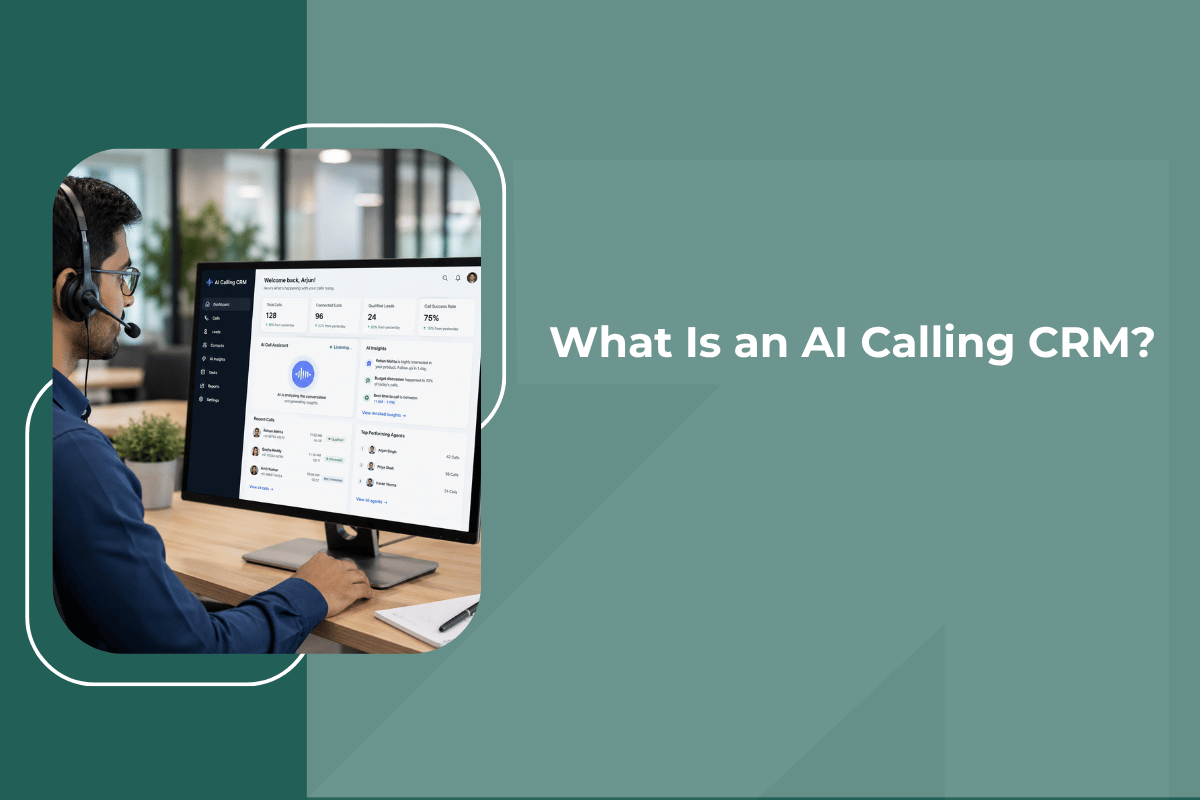
An AI calling CRM combines traditional CRM functionality, contact records, pipeline tracking, follow-up reminders, with AI-powered calling capabilities layered directly into the system. Instead of a salesperson manually dialing numbers one by one, the CRM can automatically queue calls, dial numbers in sequence, transcribe conversations in real time, and even use ai cold calling software to have entire conversations without a human on the line for certain use cases.
The goal is not necessarily to replace human conversations entirely, it is to remove the repetitive, low-value parts of calling (dialing, waiting, manual note-taking) so salespeople spend more of their time actually talking to people who are ready to engage.
Core Capabilities of an AI Calling CRM
1. Automated dialing: Rather than manually dialing each number, the system queues a list of contacts and dials them automatically, connecting the salesperson only once someone picks up, eliminating time spent on unanswered calls, busy signals, or voicemail.
2. Real-time call transcription: Conversations are transcribed as they happen, removing the need for a salesperson to take manual notes mid-call while also trying to stay engaged in the conversation.
3. AI-generated call summaries: After a call ends, the system can automatically generate a summary of key points discussed, next steps agreed upon, and any objections raised, saving significant time compared to writing notes manually after every call.
4. Sentiment and intent detection: Some systems can flag whether a call seemed positive, neutral, or negative, and estimate how likely the lead is to convert based on tone and language used during the conversation.
5. Automated outbound calling for qualification: Using automated outbound calling software, the system can handle a first round of basic qualifying questions automatically, only routing genuinely interested leads to a human salesperson for the next conversation.
6. Call scoring and coaching insights: Recorded and transcribed calls can be analyzed to identify patterns in what top performers say differently, helping managers coach the rest of the team based on real data rather than guesswork.
Why This Matters for Growing Sales Teams
As a sales team scales, the math of manual calling becomes a real constraint. A rep who spends significant portions of their day just dialing, waiting for someone to pick up, or manually logging notes has meaningfully less time for actual selling conversations.
An AI Voice Agents CRM approach changes this equation by automating the mechanical parts of calling, dialing, logging, summarizing, while keeping the human conversation itself where it matters most: with leads who are genuinely engaged and worth a real, human touch.
This shift tends to matter most for teams handling high call volumes: outbound sales, follow-up-heavy pipelines, or teams doing initial qualification calls across a large number of leads.
How an AI Calling CRM Differs from a Regular Dialer
A basic dialer simply automates the act of calling, it doesn't understand what's being said or generate any insight from the conversation. An AI calling CRM goes further by combining the calling mechanism with actual conversation intelligence:
- A dialer connects calls faster, an AI calling CRM also transcribes and summarizes them
- A dialer doesn't know if a call went well; an AI calling CRM can flag sentiment and intent
- A dialer requires manual follow-up scheduling, an AI calling CRM can suggest or automatically set the next follow-up based on how the conversation went
- A dialer treats every contact the same, an AI calling CRM can prioritize based on signals detected during previous conversations
This difference is what separates a tool that simply speeds up dialing from one that actively makes the sales process smarter over time.
Common Use Cases
- Outbound prospecting at scale; Teams making hundreds of outbound calls a day benefit significantly from automated dialing and instant call summaries, since the time saved compounds quickly across a large call volume.
- Lead qualification before human handoff: Basic qualifying questions, budget, timeline, interest level, can be handled through automated calling, with only genuinely qualified leads passed to a human salesperson for a deeper conversation.
- Appointment reminders and confirmations: Simple, repetitive calls like confirming an appointment or reminding someone of a scheduled call, a routine task for a Travel Agency CRM handling booking confirmations, are well suited to automation, freeing up human reps for more complex conversations.
- Post-call follow-up automation: Once a call ends, the system can automatically log the summary, update the lead's status, and schedule the next follow-up, removing several manual steps that would otherwise fall on the salesperson. This is especially valuable for a Healthcare CRM, where appointment follow-ups need to happen reliably and on time
What to Look for When Evaluating One
- Does it integrate cleanly with your existing CRM data, or does it require a separate system entirely?
- How accurate is the transcription and summary generation for your specific industry's terminology?
- Can call scripts and qualifying questions be customized to match your actual sales process?
- Does it clearly indicate when a call was automated versus human, maintaining transparency where relevant?
- Is there a smooth handoff process from automated qualification to a human salesperson when needed?
A Balanced Perspective
It is worth being clear-eyed about where AI calling tools genuinely help versus where human conversation still matters most. Repetitive, early-stage tasks, initial qualification, reminders, basic information gathering, are well suited to automation. Complex negotiations, relationship-building, and nuanced objection handling still tend to benefit from a skilled human salesperson.
The most effective setups tend to use AI calling capabilities to handle volume and repetition, while reserving human time for the conversations that genuinely need it.
Getting Team Adoption Right
Introducing an AI calling CRM works best when the team understands it as a way to remove tedious work, not as a threat to their role. Reps who previously spent significant chunks of their day manually dialing and typing notes tend to adopt these tools quickly once they see the time savings firsthand, often within the first week of consistent use.
A useful approach is starting with one specific, high-volume task, like automated dialing for a cold-calling list, or automated summaries for follow-up calls, rather than trying to automate every part of the calling workflow at once. This lets the team build trust in the accuracy of transcripts and summaries before relying on more advanced features like automated qualification calls.
Final Thoughts
An AI calling CRM is not about removing the human element from sales calls, it is about removing the repetitive, mechanical parts of calling so that human time gets spent where it actually creates value. For teams handling high call volumes, the combination of automated dialing, real-time transcription, and AI-generated summaries can meaningfully change how much a team accomplishes in the same number of working hours.
If your team's calling process still relies entirely on manual dialing and note-taking, it is worth exploring how much of that workload could be handled automatically, freeing up time for the conversations that truly need a human touch.
Easy and fast setup
Marketing Doesn't Have to Be Hard. Let AI Do the Work.
Start getting leads in 5 minutes – no marketing team needed.
Start Now