
Table of Contents
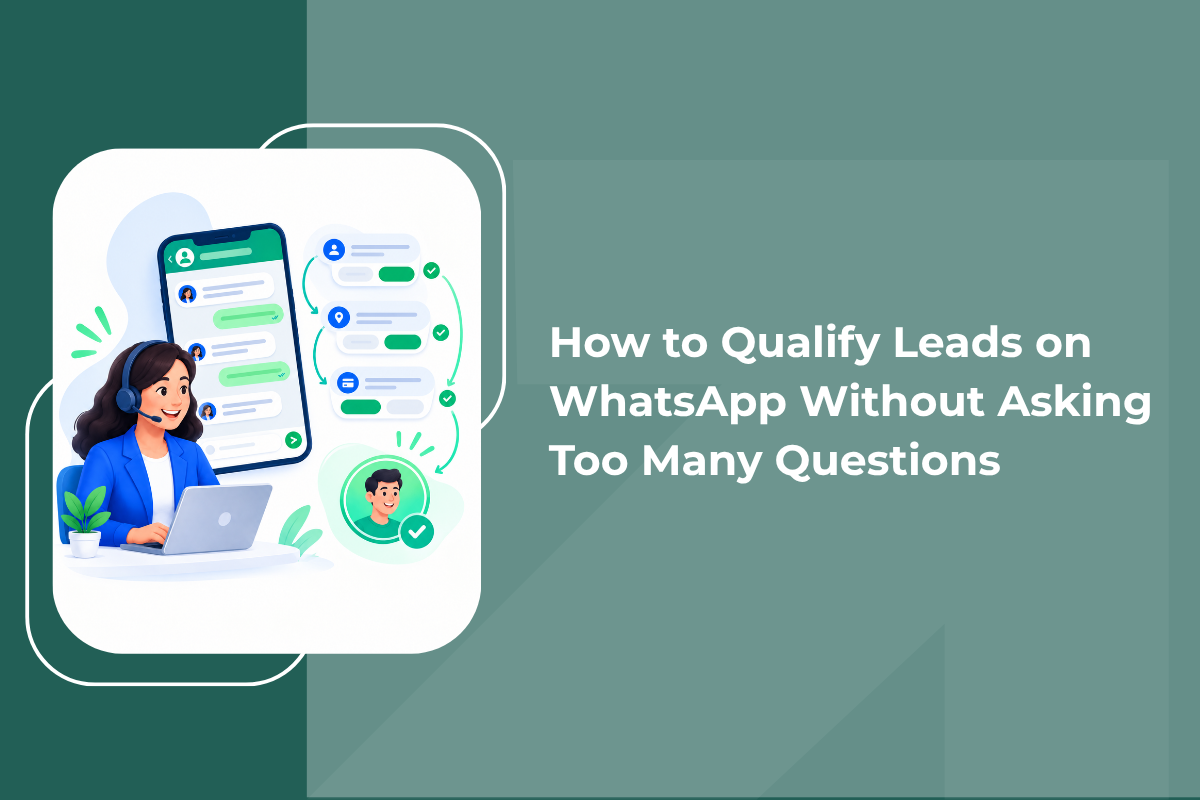
There's a very specific way businesses lose good WhatsApp leads: not through bad ads, not through slow follow-up, but through a wall of qualifying questions the moment someone says "hi." Name, city, budget, timeline, requirement, preferred contact time, by question four, the lead has stopped replying. WhatsApp is a conversational channel, not a web form, and it punishes anything that feels like one.
The good news is that qualifying leads well and qualifying leads fast aren't in conflict. You just need a different approach than the one most businesses copy from their old website contact form.
Why Long Qualification Kills WhatsApp Leads
WhatsApp conversations happen in a completely different psychological mode than a website form fill. When someone fills a form, they've already committed to the interruption, they're seated, focused, expecting to answer several fields. When someone messages you on WhatsApp, they're often mid-scroll, expecting the same speed and tone as texting a friend.
A few reasons long qualification sequences fail specifically on WhatsApp:
- It breaks the "chat" feeling. Five questions in a row reads like an interrogation, not a conversation.
- Drop-off compounds with every question. If 20% of leads abandon each question, by question five you've lost the majority of people who started.
- It delays the moment of value. Leads message you because they want something, pricing, availability, a callback. Every extra question before you deliver that value increases the chance they give up and message a competitor instead.
- It assumes patience that doesn't exist on mobile. WhatsApp is typically used one-handed, often while doing something else. Long exchanges get abandoned mid-thread more than on any other channel.
This is closely tied to lead scoring, too, if your qualification process is scaring off leads before you ever learn anything about them, no scoring model can save you. (We cover the scoring side of this in AI Lead Scoring in 2026.
The Core Principle
Instead of front-loading every question, qualify progressively, start with the minimum needed to route the lead correctly, then deepen the conversation only with leads who show real intent.
Think of it as three layers:
- Layer 1, Instant triage (0–1 questions) - Enough to know if this person is even in your target market. Example: "Hi! Are you looking for [product/service] for yourself or your business?" One question, binary or short answer, gets replied to almost every time.
- Layer 2, Core qualifier (1–2 questions, asked conversationally, not as a list) - The one or two facts that actually determine whether this is a real opportunity, usually some combination of need, timeline, or budget range. Ask these as natural follow-ups based on their previous answer, not as a fixed script fired regardless of context.
- Layer 3, Deep qualification (only for leads who clear layers 1–2) - Detailed requirements, exact budget, specific preferences, this is a conversation your sales rep has, not something you extract upfront from every single lead. Most leads never need to reach this layer through automation at all.
This layered approach mirrors how a good human salesperson naturally qualifies on a call, they don't open with twelve questions either. They ask one thing, listen, and let the next question follow from the answer.
Practical Frameworks That Work
1. The One-Question Filter
Pick the single question that best splits your audience into "worth pursuing" and "not right now." For a real estate business, it might be "Looking to buy or rent?" For a coaching business, "Are you exploring this for yourself or a team?" One well-chosen question does more filtering than three generic ones.
2. Answer-Then-Ask
Never ask a question without first responding to what the lead just said. If someone asks "what's the price," don't reply with "first tell me your budget." Give a real answer (even a range), then ask your qualifying question. This single change dramatically improves reply rates because it respects the transaction the lead initiated.
3. Multiple-Choice Over Open-Ended
"What's your budget?" invites silence, because typing out a number feels like commitment. "Is your budget under ₹50L, ₹50L–1Cr, or above 1Cr?" gets tapped in two seconds, especially with WhatsApp's quick-reply buttons. Wherever possible, turn open text questions into button choices.
4. Let Behavior Do Some of the Qualifying
Not every signal needs to come from a direct question. Response speed, message length, and whether someone engages with a shared catalog or price list all tell you about intent without asking anything at all. A lead who replies within 30 seconds and asks a follow-up question is almost always more qualified than one who takes six hours to send a one-word reply, no extra question required.
5. Delay the "Hard" Questions Until After Value Is Delivered
Send a price list, a portfolio, or a quick answer first. Leads are far more willing to share a budget or timeline after you've given them something useful than before.
Sample Flow: What This Looks Like End to End
Here's a simplified version of a well-qualified WhatsApp flow for a service business:
Lead: Hi, I saw your ad. Do you have interior design packages?
Business (instant auto-reply): Hey! Yes, we do Quick one, is this for a new home or a renovation?
Lead: New home, 3BHK
Business: Great, that's our most popular size. Our 3BHK packages start around ₹8L. Roughly when are you looking to start, within a month, 1–3 months, or just exploring for now?
Lead: Within a month
Business: Perfect, I'll connect you with our design consultant right away, they'll call you in the next 15 minutes. Sounds good?
Notice: two light questions total, both embedded naturally in a real conversation, real value (price range) delivered before the second question, and a clear next step at the end. This lead is now scored high-intent and routed instantly, the exact handoff we describe in AI Lead Scoring in 2026.
Automating This Without Losing the Human Feel
Manually replicating this flow for every single lead doesn't scale once you're past a handful of conversations a day, which is where AI-powered WhatsApp auto-replies come in. A well-configured AI agent can:
- Respond within seconds, any time of day, in the lead's preferred language (Hindi, Tamil, Telugu, Gujarati, Bengali, and more, depending on your setup).
- Ask the right layer-1 and layer-2 question based on the conversation so far, not a rigid fixed script.
- Recognize when someone has already answered a question earlier in the thread and avoid repeating it.
- Hand off to a human rep the moment a lead clears your qualification bar, with full context passed along, no "please repeat what you already told the bot."
This is the exact workflow behind GrowEasy's WhatsApp automation, where Click-to-WhatsApp ad leads flow straight into an AI-qualified conversation and then into your CRM, without a human needing to trigger any step manually. If you're running paid ads into WhatsApp already, it's worth pairing this with our breakdown of Click-to-WhatsApp ads for Indian businesses, since ad targeting and conversation qualification work best when they're designed together.
What to Avoid
- Don't ask for information you can infer. If the ad they clicked already targeted "3BHK buyers in Pune," don't ask city and property type again, you already know.
- Don't repeat the same question if a lead goes quiet and returns later. Check conversation history first.
- Don't gather basic information behind qualification. If a lead asks for pricing, give at least a range before asking anything else. Making them "earn" an answer feels transactional in the wrong way.
- Don't make every question mandatory before routing to a human. Some leads are clearly hot from message one ("I want to book a demo today"), route them immediately rather than forcing them through a script built for average leads.
The Bigger Picture
Qualification isn't really about collecting data, it's about making a fast, accurate decision on where each lead should go next: to a rep immediately, into a nurture sequence, or quietly deprioritized. The businesses that get the most out of WhatsApp as a lead channel are the ones that treat qualification as a light, adaptive conversation rather than a checklist. Get that right, and you'll not only qualify leads faster, you'll qualify more of them, because fewer will drop off before you learn anything at all.
Once qualification is dialed in, the next challenge is usually volume, making sure a good qualification flow doesn't fall apart when you go from 10 leads a day to 100+. That's exactly what we walk through in how to handle 100+ WhatsApp leads a day without missing conversations or follow-ups.
If you want to see this kind of layered, automated qualification running on your own WhatsApp number, GrowEasy sets it up as part of its AI CRM and WhatsApp automation platform, check pricing to see which plan fits your lead volume.
FAQs
How many questions should a WhatsApp qualification flow actually have?
As a rule of thumb, one to two questions before routing to a human is enough for most businesses. Anything beyond that should be reserved for leads who've already shown strong intent.
Should qualification questions be the same for every lead?
No, the best flows adapt based on ad source, prior answers, and behavior. A lead who clicked a very specific ad ("2BHK under ₹60L") needs fewer questions than one from a broad, generic campaign.
Can AI handle qualification in regional languages?
Yes. Modern WhatsApp automation tools support qualification conversations in multiple Indian languages, which matters a lot for businesses whose leads are more comfortable replying in Hindi, Tamil, Telugu, or another regional language rather than English.
Easy and fast setup
Marketing Doesn't Have to Be Hard. Let AI Do the Work.
Start getting leads in 5 minutes – no marketing team needed.
Start Now