
Table of Contents
Part 1: The Definition Deep Dive
What is Cost Per Qualified Lead (CPQL)?
Part 2: Why CPL is Killing Your B2B Marketing ROI
1. The "Freebie Seeker" Problem
Part 3: The CPQL Advantage: Aligning Marketing with Revenue
1. Higher Quality Pipeline (Obviously)
Part 4: The Technical Challenge (Why You Haven't Switched Yet)
Part 5: How GrowEasy Solves the CPQL Equation
1. Native CRM with Automated AI Qualification
In the high-pressure world of B2B digital marketing, dashboards can be intoxicating. You present the monthly report to the executive team: "Our Google Ads campaigns are crushing it. We generated 500 leads this month, a 30% increase over last month, and our Cost Per Lead (CPL) is down by 25%."
High-fives all around. Marketing is delivering. But three weeks later, the CFO asks why revenue isn't growing despite the massive influx of leads. The VP of Sales is furious, claiming the sales team is drowning in "garbage" leads that never answer the phone or have zero budget.
The disconnect is immediate and painful. And it stems from optimizing for the wrong metric. For years, CPL has been the North Star of digital advertising. But in a modern, revenue-focused organization, CPL is a vanity metric. If you want to prove ROI and align your marketing spend with actual sales outcomes, you must shift your focus from Cost Per Lead to Cost Per Qualified Lead (CPQL).
In this deep dive, we explore why this shift is critical and how to build the technical infrastructure, specifically, a robust integrated CRM like GrowEasy, to make it happen.
Part 1: The Definition Deep Dive
To solve the problem, we first need to agree on the definitions.
What is Cost Per Lead (CPL)?
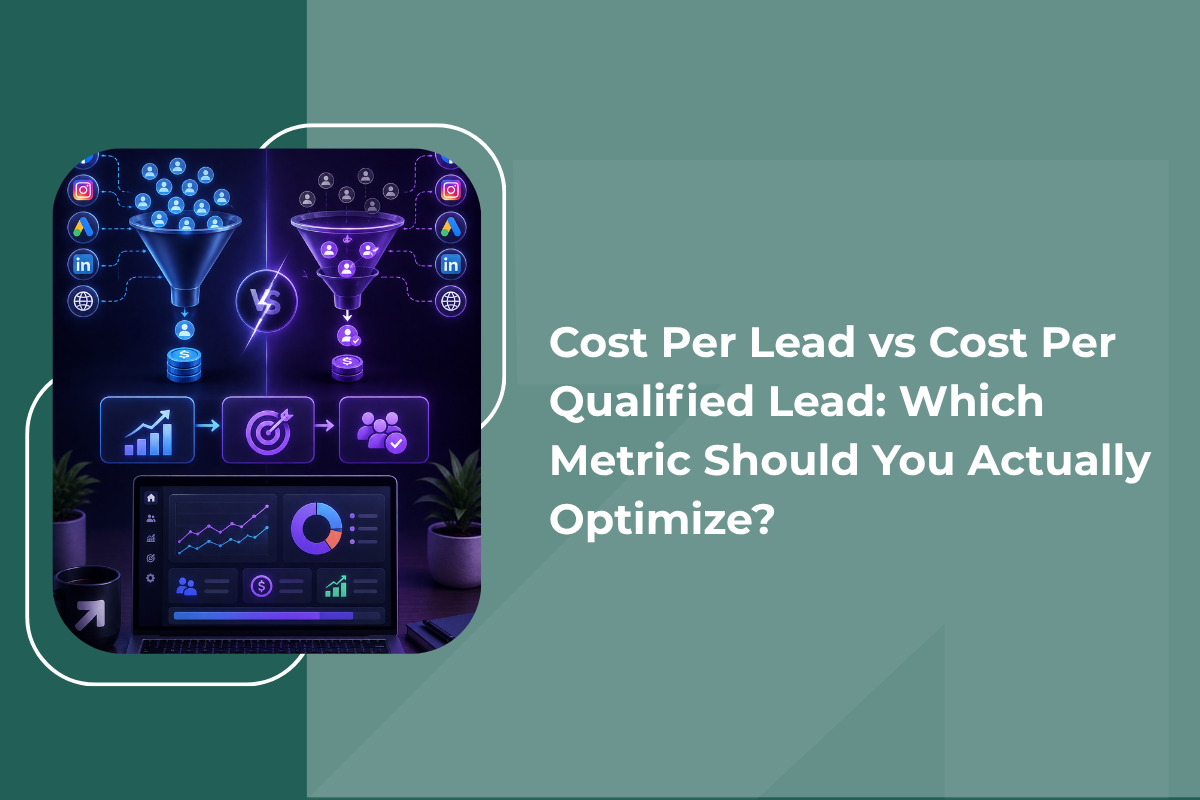
CPL is the total cost of your marketing campaign divided by the total number of prospects who engaged with your content and provided their contact information (usually via a form fill).
CPL=Total Campaign SpendTotal Number of Leads Acquired
CPL= Total Number of Leads Acquired / Total Campaign Spend
If you haven't nailed down your CPL number yet, start with how to calculate CPL correctly in the first place before moving on to CPQL.
The Implication: CPL measures volume and top-of-funnel efficiency. It tells you how much it costs to get someone to raise their hand initially. It does not account for whether that person is a fit for your product.
What is Cost Per Qualified Lead (CPQL)?
CPQL measures the total cost required to acquire a lead that has been vetted, scored, and meets the specific criteria of your Ideal Customer Profile (ICP). These are leads that the sales team has agreed are worth their time to pursue.
CPQL=Total Campaign SpendNumber of Qualified Leads (MQLs or SQLs)
CPQL= Number of Qualified Leads (MQLs or SQLs) / Total Campaign Spend
The Implication: CPQL measures revenue efficiency. It answers the question: "How much does it cost us to find a potential customer?"
Part 2: Why CPL is Killing Your B2B Marketing ROI
The fundamental flaw with optimizing for CPL is that it encourages, and often rewards, marketing behavior that drives down quality while driving up volume.
Here is how a CPL obsession destroys your pipeline:
1. The "Freebie Seeker" Problem
If you are running broad campaigns on LinkedIn or Meta offering a generic "State of the Industry" whitepaper, you will attract a high volume of students, job seekers, and competitors. They want the PDF; they do not want your enterprise software. They fill out the form, your CPL drops, and your sales team wastes hundreds of hours calling people who cannot buy. This problem compounds when you're also dealing with the fake and freebie-seeker leads dragging CPL down artificially, worth fixing both at once.
2. Form-Friction Trade-offs
To lower CPL, marketers often reduce friction. They remove fields from forms (like "Company Size" or "Budget"). While this increases conversion rates, it eliminates the data necessary to qualify the lead upstream. You get a name and an email address, but zero context.
3. Sales Team Resentment
When marketing celebrates a low CPL month, but sales knows those leads are useless, it creates a toxic cultural divide. Sales reps stop following up on marketing leads entirely, leading to missed revenue targets.
Part 3: The CPQL Advantage: Aligning Marketing with Revenue
When you optimize for CPQL, everything changes. You stop looking at the ad platform dashboard (Google/Meta/LinkedIn) as the source of truth and start looking at your internal CRM as the source of truth. Here is why the shift to CPQL is non-negotiable for B2B growth:
1. Higher Quality Pipeline (Obviously)
By definition, optimizing for CPQL means you are only investing budget in channels and campaigns that consistently deliver target accounts. Your conversion rates from MQL (Marketing Qualified Lead) to SQL (Sales Qualified Lead) increase dramatically.
2. Better Sales Productivity
Your SDRs (Sales Development Reps) are no longer engaged in data validation. They are engaged in actual selling. When they call a lead generated from a CPQL-optimized campaign, they know the prospect has the budget, authority, and need for the solution.
3. Accurate ROI Reporting
CPL allows you to report on "activity." CPQL allows you to report on "contribution to revenue." When the CEO asks, "Where should we spend the next $100k?" the CPQL data tells you exactly which campaign is generating the lowest cost customer, not just the lowest cost click.
Part 4: The Technical Challenge (Why You Haven't Switched Yet)
If CPQL is so great, why is everyone still addicted to CPL? Because calculating and optimizing for CPQL requires closed-loop marketing. You cannot optimize for CPQL if your ad platforms do not know what happened to the lead after they clicked the ad.
- The Silo Problem: Your Facebook Ads Manager knows someone clicked "Submit."
- The Gap: There is no connection between Facebook and your sales team's spreadsheets.
- The Result: Facebook assumes every lead is a good lead and optimizes to find more people like the "fake leads" it already generated.
To switch to CPQL, you need a centralized system like GrowEasy’s native CRM that captures the lead, scores them, tracks their sales stage, and feeds that 'status change' back to the ad networks.
Part 5: How GrowEasy Solves the CPQL Equation
You cannot execute a CPQL strategy with spreadsheets and disconnected ad platforms. You need an integrated AI Sales Platform and CRM designed for closed-loop optimization. GrowEasy bridges the gap between marketing spend and sales revenue. Here is how we facilitate the shift to CPQL optimization:
1. Native CRM with Automated AI Qualification
Don't push raw Facebook leads into a generic CRM. When leads enter the Ecosystem, the AI immediately goes to work:
- Data Enrichment: Appending firmographic data (Revenue, Company Size, Industry) to even the most basic lead (e.g., just an email address).
- ICP Scoring: Automatically grading the lead against your specific Ideal Customer Profile. Only leads that meet the "Qualified" threshold are ever pushed to the sales team or counted as a qualified lead in your reporting dashboard.
For a deeper look at how automated qualification actually scores and grades a lead conversation by conversation, see our dedicated guide.
2. Closing the Loop (The Most Important Feature)
When the AI (or a salesperson) updates a lead status in the CRM to "Qualified," "Proposal Sent," or "Closed-Won," that data signal is automatically sent back to the ad networks via their offline conversion APIs. By feeding "actual sales outcomes" back to the ad platforms, you stop training the algorithms to find "people who fill out forms" and start training them to find "people who buy."
Conclusion: Move Your Metric, Grow Your Revenue
The transition from CPL to CPQL is not just a minor reporting change, it is a fundamental shift in how your company views marketing. It moves marketing from a cost center responsible for generating "buzz" (leads) to a revenue center responsible for generating pipeline (qualified leads).
Yes, your lead volume might drop initially. Your reported CPL will almost certainly go up. But your sales team will thank you, your CFO will see the ROI, and your company will grow sustainably by acquiring customers, not just contacts.
Stop wasting budget on leads that will never close.
Book a demo today to see how our integrated AI and CRM platform can help you identify, target, and optimize for your highest-value customers, transforming your marketing from CPL chaos to CPQL clarity.
Easy and fast setup
Marketing Doesn't Have to Be Hard. Let AI Do the Work.
Start getting leads in 5 minutes – no marketing team needed.
Start Now