
Summary:
AI lead qualification agents are transforming how businesses handle incoming leads by automating the initial engagement process. These agents quickly respond to inquiries, ask pertinent questions, and assess the prospect's intent, allowing sales teams to focus on high-value leads. This approach streamlines lead management, ensuring faster responses and better prioritization, ultimately enhancing the efficiency of sales operations.
Table of Contents
What Is an AI Lead Qualification Agent?
Why Lead Qualification Is Becoming More Important
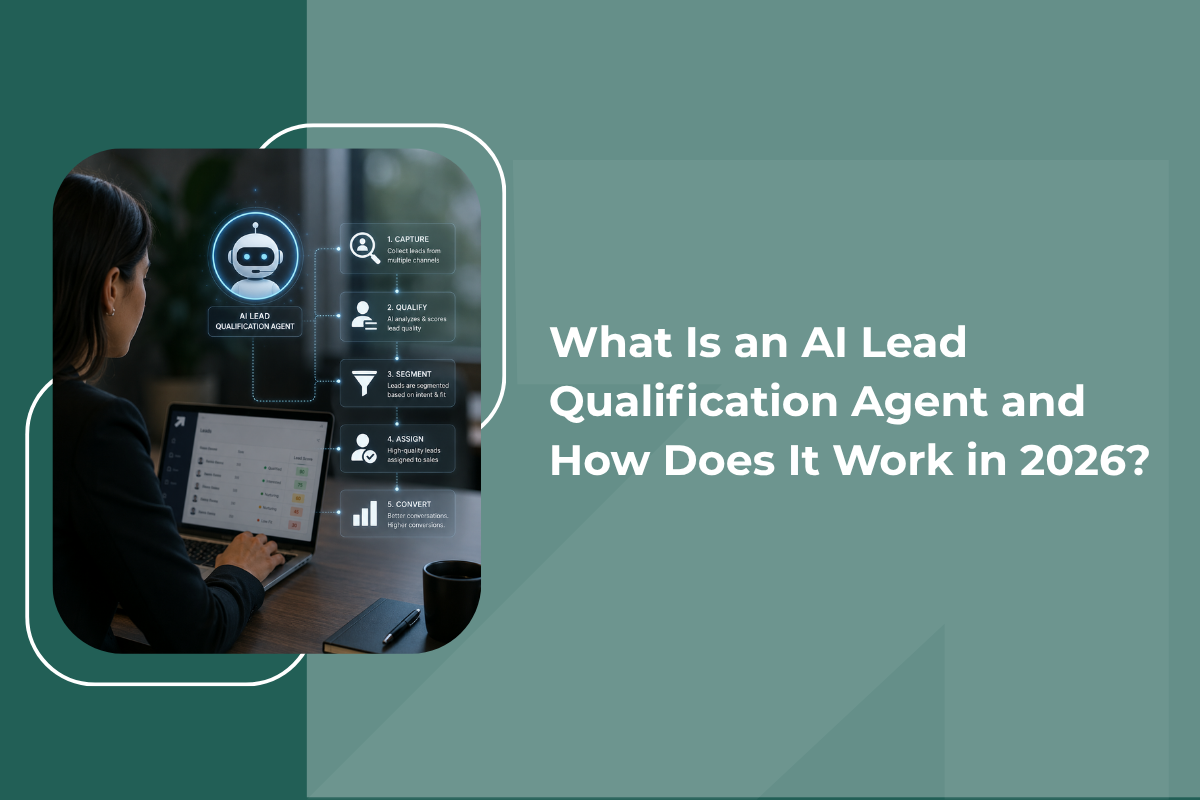
How Does an AI Lead Qualification Agent Work?
Step 1: A New Lead Enters the System
Step 2: The AI Starts the Conversation
Step 3: The Agent Asks Qualification Questions
Step 4: The AI Understands the Lead's Responses
Step 5: The Lead Is Classified Based on Intent
Step 6: Qualified Leads Are Handed to the Sales Team
Where Does an AI Qualification Agent Fit Into Lead Generation?
Benefits of Using an AI Lead Qualification Agent
Who Should Use an AI Lead Qualification Agent?
Generating leads is only half the job. A business can spend thousands on Meta ads, Google Ads, LinkedIn campaigns, or other marketing channels and receive hundreds of enquiries. But if nobody responds quickly, asks the right questions, or identifies which prospects are actually ready to buy, those leads can quickly become wasted opportunities. This is where an AI lead qualification agent comes in.
Instead of making a salesperson manually contact every new enquiry, an AI agent can start the conversation immediately, ask qualification questions, understand the prospect's intent, collect relevant information, and help determine whether that lead should be passed to the sales team.
In 2026, AI lead qualification is becoming an important part of the lead generation process because businesses are dealing with more conversations across more channels. A lead may come from a Facebook ad, Instagram campaign, Google search, website form, or a Click-to-WhatsApp campaign. Managing every enquiry manually becomes difficult as volume grows.
An AI lead qualification agent helps businesses respond faster and prioritize the leads most likely to convert. In this guide, we'll look at what an AI lead qualification agent is, how it works, what questions it can ask, and where it fits into a modern lead generation strategy.
What Is an AI Lead Qualification Agent?
An AI lead qualification agent is an AI-powered system that interacts with potential customers and evaluates whether they are a good fit for a business. The agent can communicate with leads through channels such as:
- Website chat
- Messaging platforms
- Lead forms
- Social media conversations
If you are unsure whether you need this level of intelligence or a simpler flow will do, see our comparison of an AI agent vs a traditional chatbot.
Its job is not simply to send an automated message. A proper AI qualification agent can collect information, understand responses, ask follow-up questions, identify buying intent, and determine what should happen next. For example, imagine a real estate company receives 100 enquiries from an ad campaign. Without automation, a salesperson may need to:
- Call every lead.
- Ask whether they are genuinely interested.
- Understand their budget.
- Find out their preferred location.
- Ask when they are planning to buy.
- Identify whether they are ready for a site visit.
An AI lead qualification agent can handle the first stage of this process automatically. It might start with:
Hi, thanks for your interest. Are you looking to buy a property for yourself or as an investment?
Based on the answer, it can continue the conversation. If the prospect is looking for a property within the right budget and plans to purchase it soon, the lead can be marked as high intent and passed to a salesperson.
If someone is only browsing or planning to buy next year, that lead can enter a nurturing process instead. This allows sales teams to spend more time talking to qualified prospects rather than repeatedly asking the same basic questions. The same principle applies to B2B companies, education providers, financial services, healthcare businesses, agencies, and other businesses that receive a large number of enquiries.
Why Lead Qualification Is Becoming More Important
The problem for many businesses is not always a lack of leads. It is a lack of qualified leads.
A campaign may generate 500 enquiries, but those 500 people will not all have the same level of interest. Some may be ready to buy today. Some may be comparing different providers. Others may simply be researching. And some may not be a good fit at all. Treating every lead exactly the same creates two problems.
First, sales teams waste time on prospects who are unlikely to convert. Second, genuinely interested prospects may have to wait for a response while the team works through every other enquiry. A structured lead qualification process helps separate leads based on factors such as:
- Buying intent
- Budget
- Location
- Product or service requirements
- Company size
- Decision-making authority
- Purchase timeline
Qualification works best when junk never reaches this stage in the first place, see our guide on filtering out fake and irrelevant leads before qualification.
GrowEasy's lead generation emphasizes on generating enquiries and qualifying them are separate stages of the process. A lead may become sales-ready only after information such as budget, authority, need, and timeline has been assessed. This is exactly where an AI qualification agent can help.
How Does an AI Lead Qualification Agent Work?
Although the exact workflow depends on the business, most AI lead qualification systems follow a similar process.
Step 1: A New Lead Enters the System
The process starts when someone takes an action that shows interest. For example, they might:
- Submit a Facebook or Instagram lead form.
- Click a Click-to-WhatsApp ad.
- Fill out a website enquiry form.
- Request a demo.
- Start a chat on the website.
- Respond to an outreach campaign.
Instead of waiting for a salesperson to notice the enquiry, the AI agent can respond immediately. This matters because the longer a business waits, the more likely the prospect is to move on or contact a competitor. For businesses running paid campaigns, fast response is particularly important because they have already paid to acquire that enquiry. The goal should not simply be to generate more leads. It should be to make the most of the leads already coming in.
Step 2: The AI Starts the Conversation
The first message should acknowledge the lead's enquiry and create a natural next step. For example:
Hi Rahul, thanks for your interest in our digital marketing services. To help us understand what you're looking for, can I ask you a few quick questions?
The conversation can then continue based on the lead's responses. This is one of the biggest differences between modern AI agents and a simple fixed workflow. A traditional automation may send:
Thank you for contacting us. Our team will get back to you shortly.
An AI agent can continue the conversation. If the lead says:
I need help generating B2B leads for my SaaS company.
The agent can ask a relevant follow-up question such as:
Are you currently running paid campaigns or looking to build a lead generation strategy from scratch?
The goal is to gather useful context before a salesperson joins the conversation.
Step 3: The Agent Asks Qualification Questions
The qualification questions should depend on the business. There is no single list of questions that works for every company.
A real estate business may want to know:
- Which location are you interested in?
- What type of property are you looking for?
- What is your approximate budget?
- Are you planning to purchase soon?
- Would you like to schedule a site visit?
A B2B company may ask:
- What is your company size?
- What problem are you trying to solve?
- Are you currently using another solution?
- Who is involved in the buying decision?
- What is your expected timeline?
An education business may ask:
- Which course are you interested in?
- What is your current qualification?
- When are you planning to enroll?
- Do you prefer online or offline learning?
The important thing is to avoid turning the conversation into a long form. A good AI qualification flow should feel like a conversation rather than an interrogation.
Step 4: The AI Understands the Lead's Responses
This is where AI becomes more useful than a rigid chatbot. People do not always answer questions in a predictable format. For example, instead of saying:
My budget is ₹50 lakh.
A prospect might say:
Somewhere between 45 and 55, depending on the payment plan.
A rigid rule-based chatbot may struggle with this type of answer. An AI agent can understand the context and continue the conversation accordingly. Similarly, if a lead says:
We're comparing a few agencies right now but want to start next month.
That response provides useful qualification information about both intent and timeline. The AI agent can use this information to help categorize the lead.
Step 5: The Lead Is Classified Based on Intent
After collecting enough information, the system can categorize leads as:
Hot Leads - These leads should usually be passed to the sales team quickly. These prospects show strong buying intent. They may:
- Have a clear need.
- Fit the target customer profile.
- Have an appropriate budget.
- Be ready to make a decision soon.
Warm Leads - These leads can enter a follow-up or lead nurturing process. These prospects are interested but may not be ready to buy immediately. They may be:
- Comparing options.
- Waiting for internal approval.
- Researching different solutions.
- Planning to purchase later.
Cold or Low-Intent Leads - These prospects may not currently be ready to buy. They may still be valuable, but they probably do not need immediate sales attention. The business can continue educating and nurturing them instead of asking a salesperson to repeatedly chase them.
A structured funnel and lead status process makes it easier to decide what should happen after each interaction.
Step 6: Qualified Leads Are Handed to the Sales Team
Once the lead reaches a certain qualification threshold, the AI agent can trigger the next action. The salesperson can then enter the conversation with useful context. For example:
- Notify a salesperson.
- Assign the lead to a specific team member.
- Schedule a call.
- Book a demo.
- Request a site visit.
- Send the lead details to the relevant system.
Instead of starting with:
Hi, what are you looking for?
They may already know:
- What the prospect wants.
- Their budget or requirements.
- Their timeline.
- The questions they have already asked.
- The channel where they originally came from.
Where Does an AI Qualification Agent Fit Into Lead Generation?
An AI agent should not be viewed as a separate system. It works best as part of the complete lead generation journey. The process may look like this:
Ad or Content → Lead Capture → Instant Response → AI Qualification → Lead Classification → Sales Handoff → Follow-Up → Conversion
To see how each of these stages maps to a lead status your CRM actually tracks, read our breakdown of lead statuses and where qualification fits in the funnel.
For example, a business could run targeted ads to attract prospects. GrowEasy is positioned around helping businesses launch lead generation campaigns across channels such as Facebook, Instagram, and Google, while its platform and related workflows focus on moving those enquiries toward follow-up and qualification. Once someone responds to a campaign, the next challenge is what happens after the lead arrives.
This is where an AI qualification agent becomes valuable. There is little benefit in generating more leads if the existing leads are not being contacted or followed up properly. For businesses using WhatsApp as a primary communication channel, automated qualification can also be combined with structured follow-ups.
Benefits of Using an AI Lead Qualification Agent
- Faster Response to New Leads
The AI can begin the conversation immediately.This reduces the gap between a prospect showing interest and receiving a response.
- Better Sales Team Productivity
Salespeople do not need to spend as much time asking basic qualification questions.They can focus more on high-value conversations.
- More Consistent Qualification
Every lead can go through a structured process.This reduces situations where one salesperson asks detailed questions while another only collects a phone number.
- Easier Lead Prioritization
Instead of working through leads in the order they arrived, teams can prioritize prospects based on intent and qualification.
- 24/7 Availability
Leads do not always arrive during business hours.An AI agent can start the conversation even when the sales team is unavailable.
- Scalable Conversations
As campaign volume grows, manually responding to every enquiry becomes harder.AI allows businesses to handle more initial conversations without proportionally increasing the number of people required.
Common Mistakes to Avoid
An AI lead qualification agent can be useful, but only when the workflow is designed properly.
- Asking Too Many Questions
If the agent asks ten questions before providing any value, many leads will leave. Only ask for information that is genuinely useful.
- Making the Conversation Sound Robotic
Avoid overly formal scripts. The conversation should match how real customers communicate on that channel.
- Treating Every Lead the Same
Different campaigns may attract different types of prospects. Someone coming from a pricing-focused ad may require a different conversation from someone who downloaded an educational resource.
- No Clear Human Handoff
The AI should know when to involve a person.For example, if a prospect asks a detailed technical question or is ready to purchase, the system should create a clear handoff.
- Focusing Only on Qualification
Not every lead needs to become sales-ready immediately.Some leads simply need more information and better follow-up.That is where lead nurturing becomes important. For more on this stage, you can read our Lead Nurturing on WhatsApp: Proven Techniques to Boost Conversions.
Who Should Use an AI Lead Qualification Agent?
AI qualification is particularly useful for businesses that:
- Receive a high number of enquiries.
- Run paid lead generation campaigns.
- Get leads outside working hours.
- Use WhatsApp heavily for sales conversations.
- Have sales teams spending too much time on low-intent leads.
- Struggle with slow response times.
- Want a more structured qualification process.
It can be especially useful in industries such as:
- Real estate
- Education
- B2B services
- Financial services
- Healthcare
- Automotive
- Professional services
The Future of Lead Qualification
Lead qualification is moving away from simple forms and fixed scoring systems.Businesses increasingly need systems that can understand context.For example, two prospects may have the same budget, but one may be ready to buy this week while the other is only researching options.
An AI agent can help capture those differences during the conversation.The goal is not to completely remove people from the sales process.The goal is to remove unnecessary manual work from the earliest stages of the process.Sales teams should spend their time where human interaction creates the most value.AI can handle the repetitive first steps.Humans can handle the complex conversations.
Final Thoughts
An AI lead qualification agent helps businesses move beyond simply collecting contact details.Instead of sending every new enquiry directly to a salesperson, businesses can start a conversation immediately, understand what the prospect wants, evaluate their intent, and determine the right next step.For businesses investing in paid advertising and lead generation, this can help make better use of the leads they are already paying to acquire.
The strongest lead generation process is not just about getting more enquiries. It is about responding quickly, qualifying intelligently, following up consistently, and helping the right prospects reach the sales team at the right time. If you're already generating leads through ads or digital campaigns, the next question is not simply how to generate more.
Easy and fast setup
Marketing Doesn't Have to Be Hard. Let AI Do the Work.
Start getting leads in 5 minutes – no marketing team needed.
Start Now