
Table of Contents
What Is the Core Difference: Intent vs. Interest?
Google Ads Captures Existing Demand (Intent-Driven)
Meta (Facebook & Instagram) Creates New Demand (Interest-Driven)
Comparing the Two User Journeys:
How Each Platform Actually Works
Google Ads: Capturing Active Buyer Intent
Facebook Ads: Targeted Audience Demographics
Instagram Ads: Visual Discovery and Reels Engagement
India Ad Cost Comparison: CPC, CPM, and Conversion Benchmarks (INR)
Cost Analysis for Indian Businesses:
Platform Decision Matrix by Industry
Sector-Specific Tactical Insights:
Budget Tiers: What to Run Based on Your Daily Spend (INR)
Tier 1: The Starter Budget (₹300 to ₹800 per day)
Tier 2: The Growth Budget (₹1,000 to ₹3,500 per day)
Tier 3: The Scaling Budget (₹5,000+ per day)
The Third Channel Most Guides Miss: Click-to-WhatsApp Ads
Comparing the Customer Journeys:
Why CTWA Ads Outperform Traditional Landing Pages in India:
The Hybrid Strategy: Combining Google, Meta, and WhatsApp
How GrowEasy Simplifies Multi-Platform Campaigns
Frequently Asked Questions (FAQs)
Is Google Ads or Facebook Ads better for small businesses?
How much do Google Ads cost for small businesses in India?
Can I run Google Ads and Facebook Ads at the same time?
What is Click-to-WhatsApp (CTWA) advertising?
Why do Facebook and Instagram ads generate so many junk leads?
What Is the Core Difference: Intent vs. Interest?
When business owners evaluate Google Ads vs Facebook Ads for driving revenue, they are comparing two fundamentally different buying psychology models:
Google Ads Captures Existing Demand (Intent-Driven)
When an individual in Bengaluru or Mumbai types "commercial interior designer near me" or "emergency plumbing repair" into Google, they have an active, immediate problem. They are actively searching for a solution with immediate purchase intent. Google acts as a high-precision digital directory matching direct intent with instant fulfillment.
Meta (Facebook & Instagram) Creates New Demand (Interest-Driven)
Users do not open Instagram Reels or scroll through Facebook feeds to shop. They browse to watch videos, catch up with friends, or relax. Your ad interrupts their scrolling. If your creative visual hook and offer are compelling, Meta stimulates curiosity and creates desire for a product they did not wake up planning to buy.
Key Rule of Thumb:
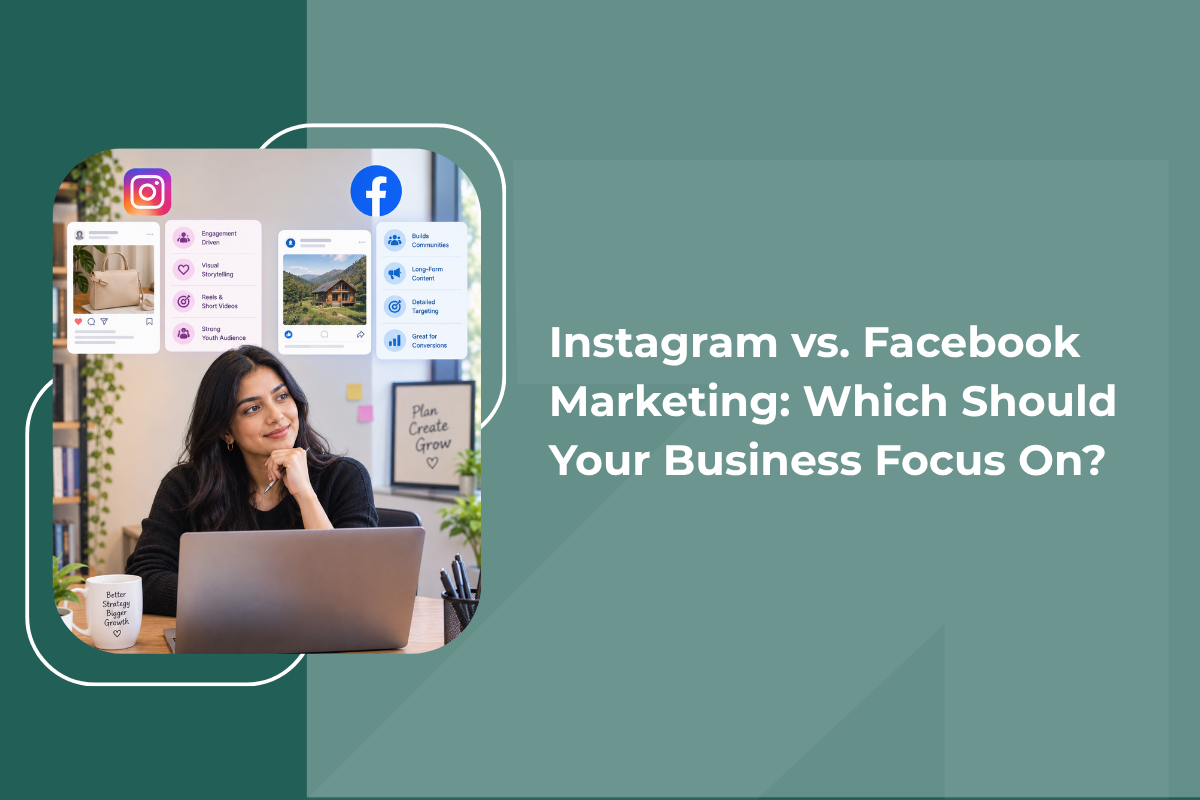
If buyers actively search for your service using specific keywords when an urgent or planned need arises, prioritize Google Ads. If your product is visual, impulse-driven, brand-new to the market, or requires a visual demonstration to spark desire, prioritize Facebook and Instagram Ads.
Comparing the Two User Journeys:
- The Google Search Journey: The user experiences a problem, searches for a solution on Google, reviews the top search results, and converts with high purchase intent. You pay a higher cost-per-click, but you capture immediate readiness to buy.
- The Social Feed Journey: The user browses social media for entertainment, encounters an eye-catching video ad, discovers a brand or solution they did not know existed, and enters your pipeline. You pay a lower cost per impression, but you need to nurture that interest into a sale.
Understanding this distinction prevents wasted ad spend. Running Facebook ads to generate emergency plumbing or towing inquiries rarely works because people do not browse social feeds when an urgent crisis occurs. Conversely, relying strictly on Google Search for an innovative lifestyle product or custom fashion line restricts your growth, because consumers cannot search for keywords they do not know exist.
How Each Platform Actually Works
Modern digital advertising relies on machine learning algorithms and automated bidding systems. However, how each network targets and engages users remains distinct.
Google Ads: Capturing Active Buyer Intent
Google processes billions of search queries every day. Its advertising ecosystem includes Search Ads, Performance Max campaigns, YouTube video ads, and Local Service Ads.
- Primary Mechanism: Keyword-based targeting and search queries. You place bids on commercial phrases that prospective customers type into Google Search.
- Targeting Precision: Targets users based on explicit intent, recent search history, physical location (down to specific pincodes), and real-time purchase signals.
- Format Strengths: Text-based search snippets, Google Maps sponsored business pins, Google Shopping product carousels, and YouTube video ads.
- Major Advantage: High conversion intent. Searchers actively want the service or product at that exact moment.
- Major Drawback: High competition in commercial sectors drives up the cost-per-click. Setting up negative keyword lists, conversion tracking, and bidding rules requires technical diligence.
To master campaign configuration, read our detailed guide on Google Ads types, examples, and AI optimization alongside our step-by-step walkthrough on how to run Google Ads successfully.
Facebook Ads: Targeted Audience Demographics
Facebook remains an effective advertising channel for reaching household decision-makers, older demographics, and family-oriented buyers in tier-1, tier-2, and tier-3 Indian cities.
- Primary Mechanism: Algorithmic audience modeling. Meta analyzes behavioral signals and profile engagement to deliver ads to users matching specific demographic groups and interests.
- Targeting Precision: Broad audience targeting powered by Meta artificial intelligence, custom audiences built from existing customer phone numbers, and retargeting based on website engagement.
- Format Strengths: Single-image carousels, long-form video presentations, Meta Instant Lead Forms, and community-focused feed placements.
- Major Advantage: Cost-effective scale. Facebook offers lower CPMs (cost per thousand impressions) than Google Search, making it an affordable channel for wide regional reach.
- Major Drawback: Form fatigue. Meta Instant Forms automatically pre-fill user profile information, which often produces invalid contact details or passive inquiries from users who do not remember submitting their information.
For a full breakdown of creative formats, see our guide to Facebook ad types.
Instagram Ads: Visual Discovery and Reels Engagement
Instagram is the primary digital storefront for Indian consumers between the ages of 18 and 40. Managed directly inside Meta Ads Manager alongside Facebook, Instagram operates with distinct creative dynamics.
- Primary Mechanism: Full-screen vertical video engagement (Instagram Reels) and ephemeral visual Stories.
- Targeting Precision: Uses Meta's shared audience intelligence, but is algorithmically optimized toward mobile-first visual interactions.
- Format Strengths: 9:16 vertical video Reels, aesthetic multi-slide carousels, influencer partnership tags, and direct messaging triggers.
- Major Advantage: High visual appeal and lifestyle influence. It is the premier platform for fashion, beauty, coaching, architectural design, hospitality, and direct-to-consumer (D2C) brands.
- Major Drawback: Demands continuous creative production. Static image ads quickly suffer from ad fatigue on Reels placements; campaigns require fresh video creatives every two to three weeks to sustain low acquisition costs.
To scale your creative performance on Reels, read our actionable guide to running high-converting Instagram ads using AI.
India Ad Cost Comparison: CPC, CPM, and Conversion Benchmarks (INR)
Most global comparison articles quote US benchmarks ($3.50 CPCs and $40 CPMs) that do not reflect the economics of running ads in India. Below are realistic benchmark ranges for Indian businesses across key advertising channels:
| Performance Metric | Google Search Ads | Facebook Feed Ads | Performance Metric | Google Search Ads |
| Average CPM (Cost per 1,000 views) | ₹250 – ₹900 | ₹80 – ₹220 | Average CPM (Cost per 1,000 views) | ₹250 – ₹900 |
| Average CPC (Cost per Click) | ₹18 – ₹160+ | ₹4 – ₹18 | Average CPC (Cost per Click) | ₹18 – ₹160+ |
| Average Conversion / Lead Rate | 5% – 14% (High intent) | 2% – 5% (Web forms) | Average Conversion / Lead Rate | 5% – 14% (High intent) |
| Average Cost per Lead (CPL) | ₹250 – ₹1,800 | ₹70 – ₹350 | Average Cost per Lead (CPL) | ₹250 – ₹1,800 |
| Primary Operational Challenge | High click costs in competitive niches | Fake or unverified phone numbers | Primary Operational Challenge | High click costs in competitive niches |
Cost Analysis for Indian Businesses:
- Google Ads Delivers Higher Cost, Higher Quality: A ₹60 cost-per-click on Google Search may appear expensive compared to an ₹8 click on Facebook. However, that Google visitor searched specifically for your commercial service. You pay a premium for high buying intent.
- Meta Ads Provide Volume at Lower Cost: Facebook and Instagram deliver significantly lower CPMs, making them practical for reaching thousands of local prospects on a modest marketing budget.
- The WhatsApp Advantage: Routing social ad traffic directly into WhatsApp instead of an external website landing page eliminates slow-loading web pages and form-drop-offs, resulting in a substantially lower acquisition cost per qualified inquiry.
Platform Decision Matrix by Industry
Which ad network produces the strongest return on investment for your specific business sector? Review this breakdown across common Indian business models:
| Industry Sector | Primary Recommended Platform | Secondary Support Platform | Strategic Reason |
| Real Estate (Residential & Commercial) | Meta Ads (Facebook + Instagram) | Google Search Ads | Meta generates high volume with video property walkthroughs and floor-plan downloads; Google captures specific high-intent keyword searches like "3 BHK flat in Whitefield". |
| Local Services (Plumbing, AC Repair, Clinics) | Google Search & Google Maps | Click-to-WhatsApp Ads | When an air conditioner stops working in peak summer, customers do not browse Instagram; they search Google immediately. |
| Direct-to-Consumer (D2C) & Fashion | Instagram Reels Ads | Google Shopping Ads | Visual presentation drives discovery and impulse buying; Google Shopping captures branded product searches. |
| Coaching, EdTech & Consultants | Facebook & Instagram Ads | YouTube Video Ads | Video ads showcasing student testimonials, course roadmaps, and free masterclasses build credibility and generate webinar sign-ups. |
| B2B Industrial & High-Ticket Equipment | Google Search Ads | Meta Audience Retargeting | Google Search captures commercial procurement buyers; Meta retargets those visitors to keep your brand top-of-mind during long buying cycles. |
Sector-Specific Tactical Insights:
- For Real Estate Developers: Relying exclusively on Google Search can rapidly drain budgets due to aggressive bidding from major property portals. Use Instagram Reels to showcase property walkthroughs, then capture buyer preferences directly through WhatsApp conversations.
- For Healthcare Clinics & Doctors: Patients search for symptoms, doctors, and treatments on Google. A clinic should invest its initial budget in Google Search and Google Maps, retargeting site visitors with helpful health tips on Meta.
- For Education and Coaching: Prospects need reassurance and social proof. Long-form video ads on Facebook and interactive student success stories on Instagram generate far more qualified enrollments than text-only search snippets.
Budget Tiers: What to Run Based on Your Daily Spend (INR)
A common mistake among growing businesses is spreading an initial marketing budget across too many platforms. Allocating ₹500 a day across Google, Facebook, and Instagram starves each platform's bidding algorithm of the data needed to optimize performance.
Use this budget-tier framework to guide your spend:
Tier 1: The Starter Budget (₹300 to ₹800 per day)
- Strategy: Choose a single platform. Do not divide your spending.
- If your business solves an immediate, urgent need: Dedicate 100% of your daily spend to Google Search Ads. Focus tightly on 5 to 10 high-intent phrase match keywords within your immediate geographic service radius.
- If your offering is visual, educational, or consultative: Dedicate 100% of your daily spend to Meta Ads, routing traffic directly to WhatsApp for instant engagement.
Tier 2: The Growth Budget (₹1,000 to ₹3,500 per day)
- Strategy: Implement an 80/20 budget allocation.
- Core Acquisition (80% of budget): Allocate the majority of your ad spend to your primary customer acquisition channel (Google Search for intent-based services, or Meta Ads for visual products).
- Retargeting (20% of budget): Allocate the remaining portion to retargeting campaigns on Instagram and Facebook to re-engage prospects who visited your website or interacted with earlier ads without completing an inquiry.
Tier 3: The Scaling Budget (₹5,000+ per day)
- Strategy: Deploy a multi-channel full-funnel strategy.
- Top of Funnel (40% of budget): Run Instagram Reels and Facebook video ads to build brand awareness, educate prospects, and drive wide market discovery.
- Middle of Funnel (35% of budget): Dominate high-intent Google Search queries and Google Maps placements to capture buyers who are evaluating solutions.
- Bottom of Funnel (25% of budget): Use automated Click-to-WhatsApp campaigns and Meta custom audience retargeting to convert warm prospects into closed sales.
The Third Channel Most Guides Miss: Click-to-WhatsApp Ads
Most ad guides treat digital advertising as a strict choice between Google and Meta. For businesses in India, there is a third option that frequently outperforms both traditional search ads and website lead forms: Click-to-WhatsApp (CTWA) Ads.
Comparing the Customer Journeys:
| Customer Stage | Traditional Website Lead Funnel | Click-to-WhatsApp Funnel |
| Initial Click | Prospect clicks an ad and leaves the social app | Prospect taps the ad and WhatsApp opens instantly |
| Loading Experience | Must wait 3 to 6 seconds for a landing page to load | Zero load delay; uses native mobile messaging |
| Data Submission | Must manually complete a 5-field web form | Sends a pre-filled WhatsApp message in one tap |
| Data Quality | Frequently receives fake or inactive phone numbers | Always receives a verified, active WhatsApp number |
| Follow-up Timing | Sales rep dials the lead hours later; call goes ignored | Automated AI replies within 15 seconds |
| Typical Conversion Rate | 2% to 4% of ad clicks submit a complete inquiry | 15% to 25% of ad clicks initiate a live conversation |
Why CTWA Ads Outperform Traditional Landing Pages in India:
- Zero Landing Page Drop-off: In India, mobile internet connections can be inconsistent. Over 30% of users leave when an external landing page takes longer than 3 seconds to load. CTWA ads bypass mobile websites entirely; tapping the ad immediately opens a conversation inside WhatsApp.
- Verified Phone Numbers: When a prospect fills out a website form or Meta Instant Form, they can provide invalid contact information. When they message you on WhatsApp, you immediately receive their verified, active phone number.
- Immediate, Two-Way Engagement: Instead of waiting hours for a sales rep to dial a cold lead, your business can engage prospects the moment they reach out, answering questions and qualifying interest within seconds.
For an end-to-end operational guide, explore our complete guide to Click-to-WhatsApp ads for Indian businesses.
The Hybrid Strategy: Combining Google, Meta, and WhatsApp
The most profitable marketing engines in 2026 do not treat advertising platforms as isolated silos. They combine them into a coordinated, multi-touch conversion funnel:
- Top of Funnel (Discovery on Meta):
A prospect watches an informative 30-second Instagram Reel addressing a common pain point (for example: "Why most solar panel installations fail within 2 years"). They do not buy immediately, but they notice your brand and remember your expertise. - Middle of Funnel (Validation on Google):
Two days later, that same prospect searches Google for "best solar panel installation company near me". Your optimized Google Search Ad appears at the top of the search results. Having already seen your social content, they trust your business and click your link over your competitors. - Bottom of Funnel (Conversion on WhatsApp):
Rather than directing them to a lengthy website form, your Google landing page includes a prominent button: "Chat with our Solar Engineer on WhatsApp". The prospect taps the button, receives an instant quote estimate, and connects with your sales team in real time.
This hybrid approach lowers customer acquisition costs by using Meta's cost-effective CPMs to build brand familiarity, making your Google Search Ads significantly more likely to earn the final click and conversion.
How GrowEasy Simplifies Multi-Platform Campaigns
Managing campaigns across Google Ads Manager, Meta Ads Manager, and WhatsApp Business tools can quickly overwhelm a marketing team.
GrowEasy unites these advertising channels into a single, automated operational platform designed for growing businesses:
- Unified Lead Ingestion: Connect your Meta Lead Ads, Instagram campaigns, Google Ads, and website forms into one clean dashboard with zero technical friction.
- Instant Conversational Engagement: When a prospect clicks an ad or submits an inquiry, GrowEasy initiates an immediate WhatsApp interaction, keeping response times under 30 seconds.
- Intelligent Lead Routing: Distribute inbound chats fairly across your sales team using dynamic round-robin rules, language preferences, or geographic territory assignment.
- End-to-End Pipeline Visibility: Track exactly which ad campaigns, keywords, and creative assets generate paying customers—giving you clear data on where to allocate your marketing budget.
Frequently Asked Questions (FAQs)
Is Google Ads or Facebook Ads better for small businesses?
Neither is universally better; the right choice depends on your business model. Google Ads is ideal for businesses that solve an immediate, active need (such as healthcare, local repair services, or commercial B2B) where customers search using specific keywords. Facebook and Instagram Ads are better for visual, consumer-facing, or educational offerings (such as D2C brands, real estate, hospitality, and coaching) that benefit from reaching targeted demographics.
How much do Google Ads cost for small businesses in India?
In India, average cost-per-click (CPC) on Google Search Ads ranges from ₹15 to ₹60 for standard consumer services, and can exceed ₹120 to ₹250+ for competitive industries like real estate, finance, and enterprise software. Most Indian small businesses see strong initial results with a testing budget of ₹1,000 to ₹2,000 per day.
Can I run Google Ads and Facebook Ads at the same time?
Yes. Running both platforms simultaneously is often the most effective growth strategy once your daily budget reaches ₹1,500 to ₹2,500+. Meta builds brand discovery and reaches broad audiences at a low CPM, while Google captures high-intent prospects when they actively search for your services.
What is Click-to-WhatsApp (CTWA) advertising?
Click-to-WhatsApp ads are paid advertisements on Facebook or Instagram that feature a "Send Message" call-to-action. When a prospect clicks the ad, it immediately opens a direct WhatsApp chat window with your business, bypassing slow-loading landing pages and complex forms.
Why do Facebook and Instagram ads generate so many junk leads?
Meta Instant Forms automatically pre-fill contact details from a user's social profile. If that profile contains an outdated phone number or secondary email address, invalid data passes directly to your team. You can fix this issue by using custom questions on your forms, requiring OTP verification, or routing traffic directly through Click-to-WhatsApp ads with automated AI qualification.
Easy and fast setup
Marketing Doesn't Have to Be Hard. Let AI Do the Work.
Start getting leads in 5 minutes – no marketing team needed.
Start Now