
Summary:
As businesses evolve, lead generation in 2026 demands more than basic chatbots answering FAQs. AI agents, unlike traditional chatbots, offer dynamic, context-aware interactions that adapt to user inputs, making them ideal for complex lead qualification. While chatbots suit predictable tasks, AI agents excel in nuanced conversations, enhancing lead prioritization and conversion. A hybrid approach, combining both technologies, can optimize lead handling by automating routine interactions and focusing human efforts on high-value prospects.
Table of Contents
AI Agent vs Chatbot: The Core Difference
How AI Agents Improve Lead Qualification
AI Agent vs Chatbot for Lead Qualification
Does an AI Agent Replace a Salesperson?
AI Agents for WhatsApp Lead Generation
When a Chatbot Is the Better Choice
When an AI Agent Is the Better Choice
Businesses have used chatbots for years. Visit a website and you may see a small chat window asking:
Hi! How can I help you today?
But lead generation in 2026 requires more than simply answering frequently asked questions.
Businesses need to respond to leads quickly, understand what they want, ask relevant qualification questions, follow up when necessary, and help move high-intent prospects toward a conversation with sales. This is where the conversation around AI agents vs chatbots becomes important.
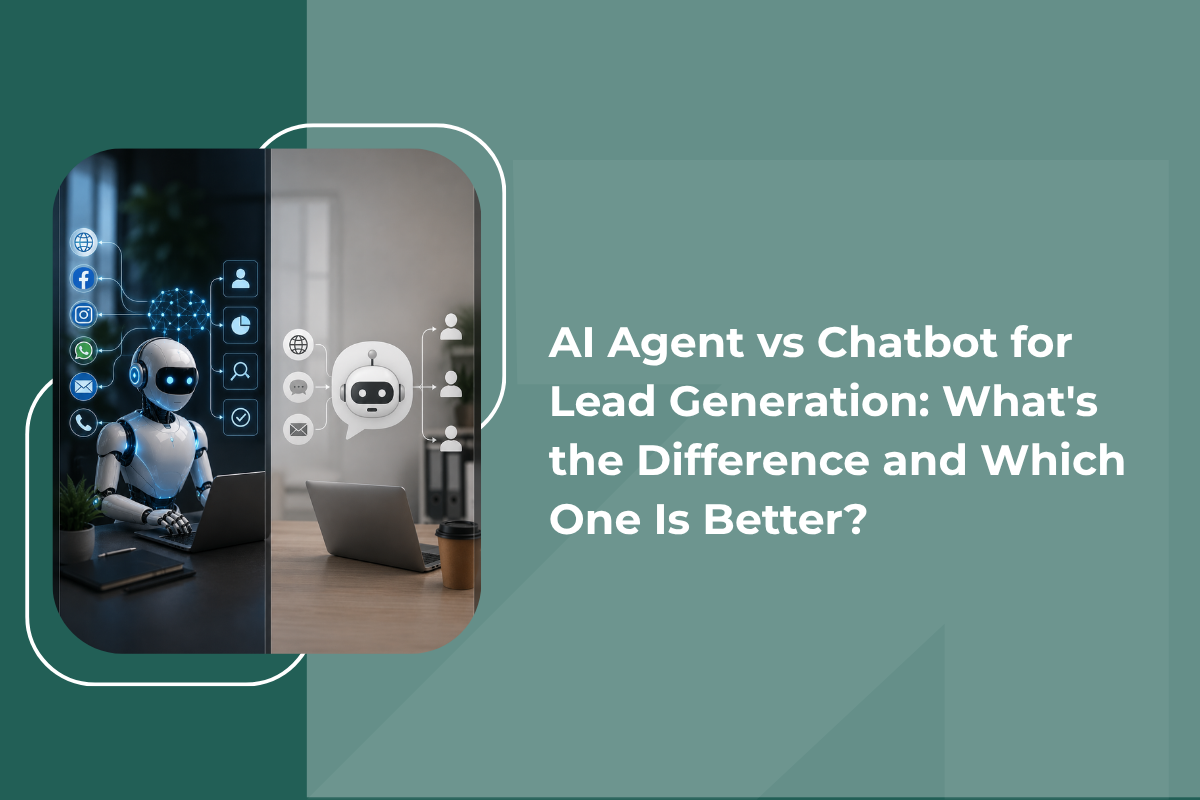
Although the two terms are sometimes used interchangeably, they are not exactly the same. A chatbot is generally designed to respond to messages within a defined conversation flow. An AI agent can take a more active role in understanding the conversation, gathering information, qualifying the prospect, and determining what should happen next.
In this guide, we will compare AI agents and chatbots for lead generation, look at where each works best, and help you decide which approach is right for your business.
What Is a Chatbot?
A chatbot is a software application designed to communicate with users through text or voice. Traditional chatbots usually work in one of two ways.
Rule-Based Chatbots
These follow predefined rules. For example:
User: I want pricing.
Chatbot: Please select a plan.
The conversation follows a predetermined structure. If the user selects the right option, the chatbot moves to the next step.
The limitation is that conversations can break when people say something unexpected. A lead might write:
We're a 50-person company and currently using another tool, but we're planning to switch before the end of this quarter. Can you help us understand if your solution would work?
A simple rule-based chatbot may not know what to do with that answer.
What Is an AI Agent?
An AI agent is designed to do more than follow a fixed sequence of responses. For lead generation, an AI agent can understand the context of a conversation and take actions based on what the prospect says. For example, if a lead says:
I'm interested, but I need something that can help us generate leads from Meta ads and follow up with them on WhatsApp.
The AI agent can identify multiple pieces of information:
- The prospect is interested in lead generation.
- They are considering Meta ads.
- WhatsApp follow-up is important.
- Their needs may fit the solution being offered.
It can then continue with relevant questions. For example:
Are you already running Meta campaigns, or would you be starting from scratch?
The next question can change depending on the answer. This makes the conversation more flexible.
AI Agent vs Chatbot: The Core Difference
The easiest way to understand the difference is this:
- A traditional chatbot follows a conversation flow.
- An AI agent can understand the conversation and adapt its next step.
That does not mean every chatbot is basic or that every AI agent is automatically better. The right choice depends on what the business wants to achieve.
| Feature | Traditional Chatbot | AI Agent |
| Conversation style | Predefined flow | Context-aware |
| Handles unexpected responses | Limited | More flexible |
| Qualification questions | Fixed sequence | Can adapt based on answers |
| Understanding intent | Basic or rule-based | Can interpret natural language |
| Follow-up | Preconfigured | Can be more context-aware |
| Lead prioritization | Usually rule-based | Can consider multiple signals |
| Best use | FAQs and simple workflows | Qualification and lead conversations |
How AI Agents Improve Lead Qualification
AI agents are particularly useful after the lead has already been captured. This is an important distinction. Lead generation is not just:
Run ad → Get form submission → Call lead
A stronger process looks more like:
Attract → Capture → Respond → Understand → Qualify → Prioritize → Follow Up → Convert
For a closer look at how an AI lead qualification agent actually works, step by step, see our dedicated guide.
AI agents can operate during the middle stages of this process. For example, GrowEasy's lead generation describes AI-powered workflows that combine campaign generation, lead capture, initial qualification, and follow-up rather than treating advertising and lead management as completely separate activities.
AI Agent vs Chatbot for Lead Qualification
Lead qualification is one of the clearest use cases where AI agents can provide more value. Businesses often use frameworks that consider factors such as budget, authority, timeline.
These are commonly associated with the BANT qualification framework. GrowEasy's lead generation helps in qualification criteria to identify whether prospects are worth prioritizing.
The challenge is that people rarely answer these questions in a neat form. A prospect may indirectly reveal their timeline by saying:
We're evaluating options now and want to launch in October.
They may reveal their authority by saying:
I need to discuss this with our founder.
They may reveal budget concerns by asking:
Can this work for a small business, or is it mainly for larger companies?
An AI agent can use these conversational signals to build a better understanding of the lead.
Does an AI Agent Replace a Salesperson?
This is one of the biggest misconceptions. The purpose of an AI agent should not be to remove every human interaction from the sales process. Instead, it should handle repetitive early-stage work.
For example:
- Greeting new leads.
- Asking basic qualification questions.
- Collecting requirements.
- Answering common questions.
- Following up with leads.
- Identifying high-intent prospects.
- Alerting the sales team.
The salesperson can then focus on:
- Complex questions.
- Product demonstrations.
- Negotiation.
- Relationship building.
- Closing the deal.
Once the agent flags a lead as ready, the next step is routing qualified leads to the right salesperson automatically.
This is particularly useful for businesses receiving a large number of enquiries. If a salesperson spends most of their day asking - “What are you looking for?” and “When are you planning to buy?”, there is less time available for actual selling.
AI Agents for WhatsApp Lead Generation
The difference between AI agents and chatbots becomes especially visible on conversational channels such as WhatsApp. WhatsApp conversations are usually less structured than website forms. People ask questions in different ways. They may send Short messages, Voice notes, Multiple questions at once. For example:
Hi, saw your ad. Interested but wanted to know if this works for real estate. We generate leads already but most are useless.
An effective AI agent can understand the context and continue naturally. A rigid chatbot might only recognize specific keywords. For businesses running Click-to-WhatsApp campaigns, this matters because the conversation itself becomes part of the lead qualification process.
When a Chatbot Is the Better Choice
Despite the advantages of AI agents, a chatbot may be the better option when the task is simple. Use a traditional chatbot when:
- You Mainly Need to Answer FAQs
For example:
- What are your prices?
- What are your business hours?
- Where are you located?
- Do you offer a free trial?
- Your Conversation Flow Is Highly Predictable
If almost every user follows the same steps, a simple automated flow may work perfectly.
- You Need a Controlled Experience
Some businesses want every user to receive exactly the same approved responses. A rule-based chatbot can provide more control.
- Your Lead Volume Is Low
If your team only receives a few enquiries per day and can respond quickly, a complex AI system may not be necessary.
When an AI Agent Is the Better Choice
An AI lead agent becomes more useful when:
- Lead volume is increasing.
- Leads arrive from multiple channels.
- Response speed is a problem.
- Qualification requires several questions.
- Prospects give unpredictable responses.
- Sales teams are wasting time on low-intent leads.
- The business wants to prioritize high-intent prospects.
- Follow-up conversations need to be more personalized.
For these businesses, AI can help create a more scalable lead handling process.
The Best Approach May Be Both
Businesses do not necessarily need to choose one forever. A simple chatbot can handle basic navigation and common questions. An AI agent can take over when the conversation becomes more complex. The AI agent can then begin a qualification conversation. This hybrid approach gives businesses control where they need it and flexibility where conversations require more intelligence. This mirrors the broader case for manual vs automated lead management, most growing businesses land on a hybrid model rather than picking one extreme.
How AI Agents Fit Into the Future of Lead Generation
In 2026, the biggest change is not simply that more businesses are using AI. It is that AI is increasingly being used across the entire lead journey. Businesses can use AI to:
- Create campaigns.
- Improve targeting.
- Generate ad creatives.
- Capture leads.
- Respond instantly.
- Qualify prospects.
- Prioritize opportunities.
- Support follow-up.
GrowEasy's positioning is built around AI-powered lead generation, including campaign creation and workflows that help businesses capture and handle incoming enquiries.
Final Thoughts
A chatbot and an AI agent can both help businesses generate leads. But they solve different problems. A chatbot is useful for structured interactions, FAQs, and basic lead capture.
An AI agent is better suited to conversations where the business needs to understand the prospect, ask relevant questions, identify buying intent, and determine what should happen next. For businesses focused on improving lead quality rather than simply collecting more contact details, this difference matters.
The goal should not be to automate every conversation. The goal should be to automate the repetitive parts of the lead generation process so that human sales teams can focus on the prospects where their time has the greatest impact.
In many cases, the best lead generation system will include both. But if your biggest challenge is identifying which leads are genuinely interested and ready to talk to sales, an AI lead qualification agent is likely to provide more value than a traditional fixed-flow chatbot.
Easy and fast setup
Marketing Doesn't Have to Be Hard. Let AI Do the Work.
Start getting leads in 5 minutes – no marketing team needed.
Start Now