
Summary:
Automated lead distribution is crucial for managing the influx of leads generated by marketing campaigns. It ensures that leads are promptly and accurately assigned to the appropriate salespeople based on predefined criteria such as location, product interest, or campaign source. This process reduces response delays, prevents missed opportunities, and balances workloads among sales teams. By integrating lead distribution with lead capture, qualification, and follow-up, businesses can enhance their lead conversion rates and maximize the value of their advertising efforts.
Table of Contents
Why Does Lead Distribution Matter for Lead Generation?
How Does Automated Lead Distribution Work?
Common Ways Businesses Can Distribute Leads
1) Round-Robin Lead Distribution
Location-Based Lead Distribution
Product or Service-Based Distribution
Lead Source-Based Distribution
Should You Distribute a Lead Before or After Qualification?
How Lead Distribution Helps Sales Teams
Lead Distribution for WhatsApp Leads
What Information Should Be Used for Lead Distribution?
What Happens When a Salesperson Is Unavailable?
What happens if the person assigned to the lead does not act?
Do not Forget About Follow-Up After Assignment
How to Measure Your Lead Distribution Process
Common Lead Distribution Mistakes
Lead Distribution as Part of a Scalable Lead Generation Strategy
Generating a consistent flow of leads is a good sign that your marketing campaigns are working. But as the number of enquiries grows, businesses often run into a problem they did not expect: who is going to handle all these leads?
When a business receives only a handful of enquiries every day, lead assignment is usually simple. Someone checks the new enquiries, decides which salesperson should handle them, and forwards the details. But this process becomes much harder when leads start coming from Facebook, Instagram, Google, website forms, landing pages, and WhatsApp at the same time.
A lead may arrive and sit unanswered because nobody knows who is responsible for it. Another may be sent to a salesperson who does not handle that location or service. Two salespeople may contact the same prospect while another lead receives no response at all. These problems may seem like sales-team issues, but they can directly affect the return you get from your lead generation campaigns.
These breakdowns are part of a bigger pattern, see why leads get lost between ads, WhatsApp, and sales in the first place.
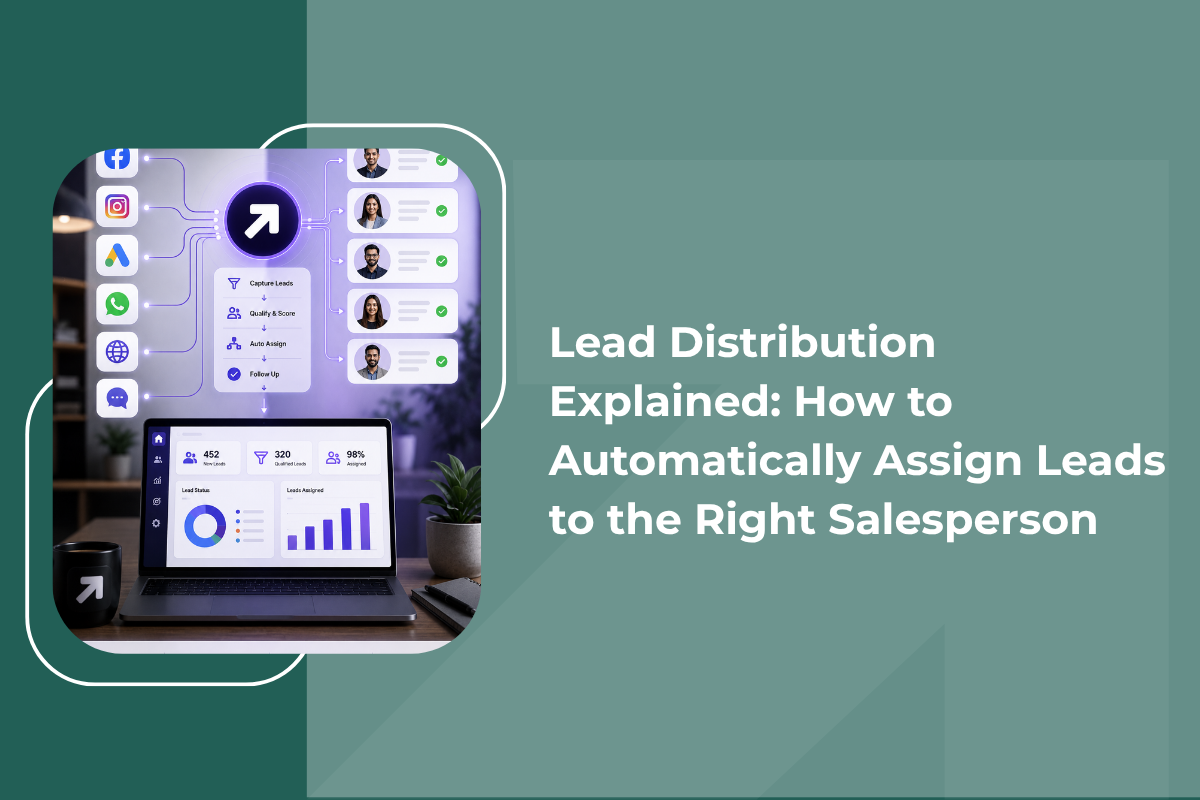
This is where lead distribution becomes important. Lead distribution is the process of automatically assigning new leads to the salesperson or team best suited to handle them. Instead of relying on someone to manually check every enquiry and decide where it should go, businesses can create rules that route leads to the right person as soon as they enter the lead generation process.
When lead distribution is set up properly, it creates a smoother path from lead generation to qualification to sales follow-up. It helps reduce response delays, prevents leads from being forgotten, and allows salespeople to focus on the opportunities that are most relevant to them.
What Is Lead Distribution?
Lead distribution is the process of assigning incoming leads to specific salespeople or teams based on predefined rules. Those rules can be as simple as rotating leads equally between team members or as detailed as considering the lead's location, service requirement, industry, campaign source, budget, or level of buying intent.
Why Does Lead Distribution Matter for Lead Generation?
Lead generation does not end when someone submits a form or sends a WhatsApp message. That is simply the point where the prospect enters your sales process. What happens next can have a major impact on whether that lead eventually converts.
A business may spend money running Facebook or Instagram campaigns and generate hundreds of enquiries. On paper, the campaign may look successful. But if those leads take several hours to reach a salesperson, or if some of them never get contacted, the business is not getting the full value from its advertising spend. This is why lead distribution should be considered part of the broader lead generation process. A strong process connects the different stages instead of treating them as separate activities:
Ad or Campaign → Lead Capture → Qualification → Lead Distribution → Sales Follow-Up → Conversion
GrowEasy's lead generation approach focuses on this wider journey, helping businesses generate enquiries through digital campaigns while improving what happens after those leads are captured. The goal is not simply to produce a larger number of leads. It is to make sure relevant leads are handled quickly and efficiently once they enter the business.
How Does Automated Lead Distribution Work?
Automated lead distribution works by connecting incoming leads to a set of rules that determine who should receive each enquiry. When a new lead enters the system, relevant information about that lead is used to determine the appropriate salesperson or team. Once the matching rule is identified, the lead is assigned automatically rather than waiting for someone to make the decision manually.
For example, suppose a business provides home renovation services across several cities. A new lead submits a form and provides their location, project type, and expected timeline. The distribution process can use this information to route the enquiry to the salesperson responsible for that city or project category.
The salesperson can then receive the lead along with the information already provided by the prospect. This means the sales conversation can begin with context rather than starting from scratch. The real advantage is not simply that the lead gets assigned automatically. It is that assignment becomes part of the lead generation workflow instead of being a separate manual task.
Common Ways Businesses Can Distribute Leads
There are several ways to distribute leads, and the right method depends on how your sales team is structured.
1) Round-Robin Lead Distribution
Round-robin distribution is one of the simplest approaches. New leads are distributed among salespeople in a rotating order, so each person receives their turn. For example, if three salespeople are available, the first lead goes to Salesperson A, the second to Salesperson B, the third to Salesperson C, and the next lead returns to Salesperson A.
This approach works well when salespeople have similar responsibilities and can handle the same types of enquiries. It can also help prevent one person from receiving most of the incoming leads simply because they happen to respond first. However, round-robin distribution is not suitable for every business. If your sales team is divided by territory, product, industry, or customer type, a more specific routing system will usually make more sense.
Location-Based Lead Distribution
Location-based distribution assigns leads according to where the prospect is located or where the service is required. This can be particularly useful for real estate, home services, healthcare, education, and businesses with regional sales teams.
For example, a company might automatically send leads from Delhi to one team, Mumbai to another, and Bangalore to a third. This saves managers from manually sorting enquiries and ensures that prospects are contacted by people who understand their market. Location-based distribution can also be useful when certain salespeople have responsibility for specific territories.
Product or Service-Based Distribution
Businesses offering multiple products or services may benefit from distributing leads according to what the prospect is interested in. For example, an interior design company may have separate teams for residential projects and commercial projects. A financial services company may have different specialists for different types of financial products.
If a lead indicates that they are interested in a particular service during the enquiry process, that information can be used to route the lead directly to the relevant team. This reduces unnecessary transfers and gives the prospect a better experience because they are connected with someone who understands their specific requirement.
Lead Source-Based Distribution
Leads can also be distributed based on where they originated. For example, leads generated through a specific Facebook campaign could be assigned to the team responsible for that campaign or offer, while leads generated through Google Ads could follow a different distribution rule. This can be useful when different campaigns target different audiences or promote different services. It also allows businesses to create more relevant follow-up processes based on the source of each lead.
Skill-Based Distribution
Some leads require a specific level of expertise. In these situations, assigning leads simply based on availability may not be enough. A B2B company, for example, might have salespeople specializing in different industries. A lead from a healthcare company could be routed to someone who understands healthcare businesses, while a manufacturing lead could be sent to another specialist. Skill-based distribution helps make sure that the person receiving the lead has the knowledge required to have a productive conversation.
Should You Distribute a Lead Before or After Qualification?
For some businesses, the best approach is to assign the lead immediately. This is especially true when every enquiry needs to be handled by a specific salesperson based on location, territory, or availability. For other businesses, it can be more efficient to perform basic qualification before assigning the lead.
Imagine a company receives 300 enquiries from an advertising campaign. If every enquiry is immediately sent to a salesperson, the sales team still has to determine which prospects are relevant, what they need, and how ready they are to buy. An AI lead qualification process can handle some of this initial work. It can ask a few relevant questions, understand the prospect's requirements, and identify signals that indicate buying intent. The lead can then be distributed based on the information collected. For example, instead of simply sending a salesperson a phone number, the process could provide context such as:
“The prospect is looking for a commercial property, has shared their expected budget, and wants to schedule a site visit this week.”
If you want to understand this qualification stage in more detail, What Is an AI Lead Qualification Agent and How Does It Work in 2026? explains how AI can engage with new leads, ask qualification questions, assess intent, and determine when a prospect is ready for human sales attention.
How Lead Distribution Helps Sales Teams
Automated lead distribution is not just about making things easier for managers. It can directly improve how sales teams use their time. When leads are automatically assigned, salespeople do not need to constantly check multiple sources to find new enquiries. They can focus on the leads that have already been routed to them.
It can also reduce repetitive administrative work. Sales managers no longer need to spend time forwarding enquiries manually, and salespeople do not need to determine whether a particular lead belongs to them. More importantly, better distribution can create a better workload balance. If one salesperson is receiving far more enquiries than another, distribution rules can be adjusted to account for capacity, availability, or performance. The main benefits include:
- Faster lead response: New enquiries can reach the appropriate salesperson without waiting for manual assignment.
- Fewer missed opportunities: Every lead has a defined destination rather than sitting in a shared inbox.
- Better workload distribution: Leads can be divided more evenly among available salespeople.
- More relevant conversations: Prospects can be connected with people who understand their requirements.
- Less administrative work: Managers spend less time manually forwarding and tracking enquiries.
- Better scalability: The process can handle increasing lead volume without requiring every assignment to be made manually.
Distribution rules work best alongside a clear set of lead statuses your CRM should be tracking, so every assigned lead also has a clear next action.
Lead Distribution for WhatsApp Leads
WhatsApp can be an excellent channel for lead generation, particularly when businesses use Click-to-WhatsApp campaigns to start conversations directly from Facebook and Instagram. However, WhatsApp also creates a challenge when many leads arrive simultaneously.
A salesperson may have dozens of active conversations, each at a different stage. One person may be asking for pricing, another may be ready for a consultation, and another may have stopped responding after the first message. Without a structured distribution process, important conversations can easily get buried.
A more effective approach is to connect the initial lead generation activity with qualification and assignment. A prospect can enter through an advertisement, begin a WhatsApp conversation, answer a few qualification questions, and then be routed to the appropriate salesperson. The workflow becomes:
Advertisement → WhatsApp Conversation → Qualification → Lead Distribution → Sales Follow-Up
This creates a much clearer path between marketing and sales and reduces the number of manual decisions required along the way.
What Information Should Be Used for Lead Distribution?
Automated lead distribution works best when businesses collect the information that actually matters for assigning leads. Depending on the business, this might include:
- Location
- Product or service interest
- Lead source
- Campaign
- Industry
- Company size
- Budget range
- Purchase timeline
- Lead intent
- Type of enquiry
You do not need to collect every possible piece of information. Asking for too much information can create unnecessary friction during lead capture. Instead, identify the few factors that genuinely determine which salesperson should handle the enquiry.
For example, if location is the only factor that matters, do not build a complicated qualification process around ten additional questions. If both location and service type matter, use those two factors to create the distribution rules. The best automated workflows are usually the ones that are simple enough to maintain but detailed enough to make useful decisions.
What Happens When a Salesperson Is Unavailable?
Lead distribution should also account for situations where the assigned salesperson cannot respond. Salespeople may be on calls, in meetings, on leave, or already handling a large number of enquiries. If the system assigns a lead to someone who is unavailable and simply stops there, the distribution process hasn't solved the real problem.
Businesses can create fallback rules to handle these situations. For example, a lead can be reassigned if there is no response within a defined period, or a high-intent enquiry can be escalated to another available salesperson. The exact rule will depend on the business, but there should always be an answer to one question:
What happens if the person assigned to the lead does not act?
This is particularly important for high-intent leads. A prospect who has clearly indicated that they are ready to talk should not sit unanswered simply because the first assigned salesperson was unavailable.
Do not Forget About Follow-Up After Assignment
Assigning a lead to the right salesperson is only one part of the process. The salesperson still needs to respond, qualify the opportunity further, answer questions, and follow up consistently. This is why lead distribution should be connected to the rest of the lead generation journey rather than treated as an isolated automation. A useful process might look like this:
Lead Generated → Lead Captured → Initial Qualification → Lead Assigned → Sales Contact → Follow-Up → Conversion
If the process stops at "Lead Assigned," you have simply moved the problem from one stage to another. For leads that are not ready to buy immediately, automated nurturing can help maintain the conversation while salespeople focus on higher-intent prospects. This is particularly useful on WhatsApp, where consistent follow-up can keep a business connected with prospects who need more time before making a decision.
How to Measure Your Lead Distribution Process
Once lead distribution is automated, do not assume that the process is automatically working well. Measure what happens after assignment. Some useful metrics include:
- Average time from lead generation to assignment.
- Average time from assignment to first response.
- Percentage of leads successfully assigned.
- Percentage of leads contacted.
- Number of qualified leads generated.
- Conversion rate by salesperson.
- Conversion rate by lead source.
- Number of leads that remain untouched.
- Number of leads requiring reassignment.
Measuring distribution alone is not enough, it is worth checking whether you're actually optimizing the right cost metric upstream.
These numbers can reveal problems that are not obvious from the total number of leads. For example, if leads are being assigned within seconds but salespeople are taking several hours to respond, the distribution system is not the bottleneck. The issue may be workload or sales capacity. If certain types of leads consistently require reassignment, your distribution rules may need to be adjusted.
Common Lead Distribution Mistakes
Automating lead distribution does not automatically guarantee a good process. Businesses can still create problems if the rules are not designed carefully. One common mistake is creating too many complicated rules. If nobody understands why a lead was assigned to a particular salesperson, it becomes difficult to troubleshoot the process.
Another mistake is ignoring salesperson capacity. A salesperson may be the right person for a particular type of lead but already have more enquiries than they can realistically handle. Businesses should also avoid distributing leads based solely on convenience. The fastest available salesperson is not necessarily the best person to handle a specialized enquiry.
Lead Distribution as Part of a Scalable Lead Generation Strategy
As businesses increase their advertising spend, lead distribution becomes increasingly important. Imagine a company currently generates 30 leads per week. A manager can probably assign those enquiries manually without much difficulty.
Now imagine the same company starts generating 300 leads per week from Facebook, Instagram, Google, and WhatsApp campaigns. The old process suddenly becomes a bottleneck. Someone has to monitor multiple channels, check new enquiries, decide which salesperson should receive each lead, forward the information, and make sure nobody has been overlooked.
That is a lot of repetitive work. Automation allows businesses to build a process that can handle a larger volume of enquiries without requiring every lead to be manually reviewed and assigned. This is one of the reasons lead distribution should be considered when scaling lead generation campaigns. More leads are only useful when your business has the capacity and process to handle them.
Final Thoughts
Lead distribution may seem like a small part of the lead generation process, but it can have a major impact on what happens after an inquiry is generated. When leads are not assigned properly, businesses risk slow responses, duplicated conversations, overloaded salespeople, missed follow-ups, and lost opportunities. These problems become increasingly difficult to manage as campaign volume grows.
Automated lead distribution provides a more structured way to handle this challenge. Leads can be routed according to location, product, service, industry, campaign source, salesperson expertise, availability, or buying intent.
The most effective approach is not simply to automate assignment and stop there. Lead distribution should work alongside lead capture, qualification, follow-up, and sales handoff so that every enquiry has a clear path forward. For growing businesses, the ideal process is straightforward:
Generate the right leads. Qualify them effectively. Assign them to the right salesperson. Respond quickly. Follow up consistently. Measure what converts.
That way, increasing your lead volume does not automatically mean increasing the number of leads that get lost along the way.
Easy and fast setup
Marketing Doesn't Have to Be Hard. Let AI Do the Work.
Start getting leads in 5 minutes – no marketing team needed.
Start Now