
Summary:
Balancing manual and automated lead management is crucial for growing businesses. While manual processes offer flexibility and human judgment, they struggle with scalability and consistency as lead volume increases. Automation provides speed and efficiency by handling repetitive tasks, allowing sales teams to focus on meaningful interactions. A hybrid approach, combining both methods, optimizes lead management by automating initial responses and follow-ups while reserving human input for complex sales interactions. This strategy ensures leads are managed effectively, enhancing overall sales performance and customer engagement.
Table of Contents
What Is Manual Lead Management?
What Is Automated Lead Management?
Manual vs Automated Lead Management: Key Differences
The Biggest Problem With Manual Lead Management: Inconsistency
Response Time: Manual vs Automated
Lead Qualification: Human vs Automated
Follow-Ups: Where Automation Can Make the Biggest Difference
Where Manual Lead Management Still Wins
Where Automated Lead Management Wins
The Best Approach for Growing Businesses: Hybrid Lead Management
Stage 1: Automated Lead Capture
Stage 2: Instant Automated Response
Stage 3: AI or Automated Qualification
How GrowEasy Fits Into an Automated Lead Generation Workflow
How to Start Automating Lead Management
Step 1: Identify Where Leads Are Being Lost
Step 2: Define Your Lead Stages
Step 3: Automate the First Response
Step 4: Automate Basic Qualification
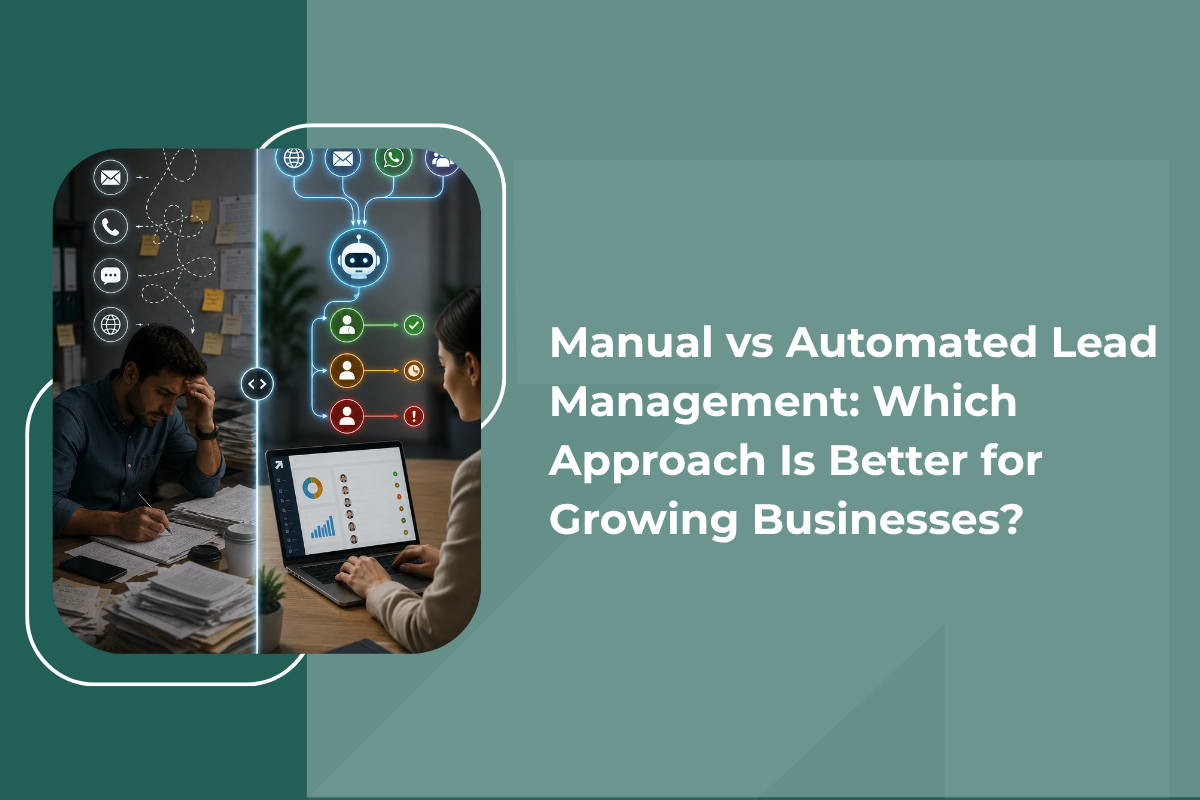
You launch a lead generation campaign. The campaign starts working. Enquiries begin coming in. At first, everything feels manageable. Your team receives a few leads every day, adds them to a spreadsheet, calls them, and follows up when necessary. Then lead volume increases. Now leads are coming from all platforms . One salesperson responds immediately. Another is busy. Someone forgets to update the spreadsheet. A lead gets contacted twice. Another lead never receives a follow-up. And a highly interested prospect sits unanswered for several hours.
This is when businesses usually start asking whether manual lead management is still sustainable. The answer is not always simple. Manual lead management offers flexibility and human judgment. Automated lead management offers speed, consistency, and scalability. The right approach depends on the number of leads you receive, the complexity of your sales process, and how quickly your business is growing.
In this guide, we'll compare manual vs automated lead management, explain the advantages and limitations of each approach, and look at how growing businesses can combine automation with human sales teams.
What Is Manual Lead Management?
Manual lead management means people handle most of the process after a new lead arrives. A typical workflow might look like this:
- A prospect submits a form.
- Someone receives a notification.
- A salesperson reviews the lead.
- The salesperson contacts the prospect.
- They ask qualification questions.
- The lead details are entered into a spreadsheet or system.
- The salesperson schedules follow-ups.
- The lead is manually updated as hot, warm, cold, won, or lost.
For a small business receiving a limited number of enquiries, this process can work. Manual management also gives salespeople complete control over every interaction. However, the process becomes more difficult as volume increases. The biggest problem is not that people are bad at managing leads. The problem is that repetitive processes do not scale easily. If your business receives 10 leads per day, a salesperson may manage them comfortably. If that number increases to 100, the amount of repetitive work increases dramatically.
What Is Automated Lead Management?
Automated lead management uses software and automation to handle repetitive tasks throughout the lead journey. Depending on the system, automation can help with:
- Capturing leads from different sources.
- Sending instant responses.
- Assigning leads to salespeople.
- Asking qualification questions.
- Categorizing leads.
- Scheduling follow-ups.
- Sending reminders.
- Tracking lead status.
- Alerting sales teams about high-intent prospects.
The important point is that automation does not necessarily mean removing humans. A better way to think about automated lead management is:
Automation handles repetitive work. Humans handle conversations that require judgment.
For example, an automated system may respond immediately to a new enquiry and ask:
Thanks for contacting us. Can I ask a few questions to understand what you're looking for?
After collecting the required information, the system can notify a salesperson. The salesperson then enters the conversation when the lead is more clearly qualified.
Manual vs Automated Lead Management: Key Differences
| Area | Manual Lead Management | Automated Lead Management |
| Initial response | Depends on team availability | Can happen instantly |
| Follow-ups | Requires manual reminders | Can be scheduled automatically |
| Lead assignment | Managed manually | Can follow predefined rules |
| Qualification | Handled by sales team | Initial qualification can be automated |
| Data entry | Often repetitive | Can be captured automatically |
| Scalability | Requires more people as volume grows | Can handle increasing volume |
| Personalization | Highly flexible | Depends on workflow and AI capabilities |
| Human judgment | Available immediately | Used when needed |
The Biggest Problem With Manual Lead Management: Inconsistency
Manual processes depend heavily on individual habits. One salesperson may respond within five minutes. Another may respond after an hour. One team member may follow up three times. Another may forget after the first call. This creates an inconsistent experience for leads. The business may be spending money to generate enquiries but have no consistent process for what happens after those enquiries arrive. This inconsistency is one of the main reasons behind leads slipping through the cracks between channels, worth a read if this sounds familiar.
Response Time: Manual vs Automated
Speed is one of the strongest arguments for automation. When a prospect fills out a form or sends a message, their interest is usually highest at that moment. If they have to wait several hours, they may:
- Contact another company.
- Forget why they enquired.
- Lose interest.
- Make a decision elsewhere.
With manual management, response speed depends on whether someone is available.
With automation, the first response can happen immediately. For example:
Lead submits a form at 10:42 PM.
A manual system may require someone to respond the next morning. An automated system can immediately send:
Hi, thanks for your enquiry. We've received your details. To help us connect you with the right person, can I ask what you're looking for?
The AI or automation does not need to close the sale. It simply prevents the conversation from going cold while the human team is unavailable.
Lead Qualification: Human vs Automated
Manual qualification has one major advantage: experienced salespeople can understand nuance. A skilled salesperson may notice details that a predefined system cannot. For complex sales, this remains valuable. However, asking every new lead the same basic questions is often repetitive.
For example:
- What are you looking for?
- What is your budget?
- When are you planning to buy?
- Where are you located?
- What is your company size?
These early-stage questions can often be automated. An AI lead qualification agent can collect information and identify signals such as intent, urgency, and fit before the sales team gets involved. This is especially useful when businesses receive a large volume of enquiries.
For a deeper guidance you can refer to our guide on What Is an AI Lead Qualification Agent and How Does It Work in 2026?
Follow-Ups: Where Automation Can Make the Biggest Difference
Most leads do not convert after a single interaction. They may need:
- More information.
- Time to make a decision.
- Internal approval.
- A reminder.
- A different offer.
- Another conversation.
Manual follow-up is difficult to manage consistently. A salesperson may need to remember:
- Who was contacted.
- When they were contacted.
- What was discussed.
- When to follow up.
- What message to send.
As lead volume increases, things get missed. Automation can create structured follow-up sequences.
The Scalability Problem
Manual lead management scales by adding more people. More leads usually mean:
- More salespeople.
- More administrative work.
- More managers.
- More coordination.
Automation changes this equation. A single automated workflow can handle many repetitive tasks at the same time. That does not mean a company can grow indefinitely without hiring.
Eventually, more qualified leads may require more sales capacity. But automation can reduce the amount of manual work required before a lead reaches the salesperson.
For example, imagine a company receives 500 enquiries per month. Without automation, the sales team may need to:
- Check every enquiry.
- Send the first response.
- Ask qualification questions.
- Update records.
- Schedule follow-ups.
With automation, much of the early-stage administrative work can happen automatically. The sales team can spend more time on actual sales conversations.
Where Manual Lead Management Still Wins
Automation is not always the best answer. Manual lead management can be better when:
- The Sales Process Is Highly Complex
Enterprise B2B sales may involve long conversations, multiple stakeholders, technical requirements, and custom proposals. Human involvement should begin earlier.
- Lead Volume Is Low
If your business receives five high-quality enquiries per month, building a complex automated workflow may not be necessary.
- Every Lead Requires Personal Attention
Some businesses sell highly customized services where every prospect requires a unique conversation from the beginning.
- The Business Is Still Testing Its Sales Process
Before automating a workflow, you need to understand what actually works.If the team is still experimenting with qualification questions and messaging, manual conversations can provide valuable insights.
Where Automated Lead Management Wins
Automation becomes particularly useful when businesses experience:
- High Lead Volume
The more repetitive conversations your team handles, the greater the potential benefit.
- Slow Response Times
If leads regularly wait for a response, automation can provide immediate engagement.
- Missed Follow-Ups
If your team struggles to maintain consistent follow-up, automated reminders and sequences can help.
- Multiple Lead Sources
Managing leads from Meta, Google, WhatsApp, websites, and other channels manually can become complicated.
- Repetitive Qualification Questions
If salespeople ask the same questions dozens of times every day, initial qualification can often be automated.
The Best Approach for Growing Businesses: Hybrid Lead Management
For most growing businesses, the best answer is not completely manual or completely automated. It is a hybrid approach. A strong workflow may look like this:
Stage 1: Automated Lead Capture
Leads from ads, forms, and messaging channels enter a centralized process.
Stage 2: Instant Automated Response
The lead receives an immediate acknowledgement.
Stage 3: AI or Automated Qualification
The system asks basic questions and gathers context.
Stage 4: Lead Classification
The lead is categorized based on factors such as intent, fit, and urgency.
Stage 5: Human Sales Handoff
High-intent or qualified prospects are assigned to the appropriate salesperson. This handoff step is exactly where automated rules for assigning leads to the right salesperson automatically remove the most manual work.
Stage 6: Automated Follow-Up
Leads that are not ready yet continue receiving relevant communication.
Stage 7: Human Closing
Salespeople handle detailed discussions, objections, negotiation, and closing.
This approach uses automation where speed and consistency matter and people where expertise and relationship-building matter.
How GrowEasy Fits Into an Automated Lead Generation Workflow
The most effective automation starts before the lead enters the sales process. It starts with generating the right type of lead.
GrowEasy is positioned as an AI-powered lead generation platform that helps businesses launch campaigns across channels such as Facebook, Instagram, and Google and then handle the enquiries generated through those campaigns. From a lead generation perspective, the workflow can be viewed as:
Campaign → Lead → Instant Response → Qualification → Follow-Up → Sales Conversation
This is more useful than thinking about advertising and lead handling as two completely separate processes. For example, a business may generate a lead through a Meta campaign. The lead can then receive an immediate WhatsApp response. An AI agent can ask initial qualification questions. High-intent leads can be passed to the sales team. Other leads can continue through a structured follow-up process.
How to Start Automating Lead Management
You do not need to automate everything at once. Start with the most repetitive problem.
Step 1: Identify Where Leads Are Being Lost
Look at your current process. Where does the breakdown happen? Is it:
- Slow first response?
- Missed follow-ups?
- Poor lead qualification?
- Delayed assignment?
Step 2: Define Your Lead Stages
Create a simple structure such as:
- New
- Contacted
- Qualified
- Hot
- Nurturing
- Converted
- Lost
You can check out our blog on What Is a Lead Funnel and Lead Statuses for a more organized lead handling process.
Step 3: Automate the First Response
This is usually one of the easiest improvements to make. Make sure every new lead receives an immediate acknowledgement.
Step 4: Automate Basic Qualification
Identify the two to five questions your sales team asks most frequently. Those questions may be suitable for an AI agent or automated conversation.
Step 5: Build Follow-Up Rules
Decide what should happen when:
- A lead does not respond.
- A lead asks for more information.
- A lead is interested but not ready.
- A lead is highly qualified.
Step 6: Keep Humans in the Process
Automation should make the sales team more effective, not create a wall between your business and potential customers. Make it easy for a person to enter the conversation when necessary.
Final Thoughts
The question is not whether manual lead management or automated lead management is universally better. The real question is:
Which parts of your current process actually need a human, and which parts are simply repetitive work?
Growing businesses often reach a point where manual processes begin slowing down the very growth they worked hard to create. Leads arrive faster. Marketing channels expand. Sales teams become busier. Follow-ups become harder to manage.
That is where automation can help create consistency. But the goal should not be to automate the entire customer relationship. The goal is to automate the repetitive work surrounding lead generation so your team can spend more time having valuable conversations with people who are genuinely interested.
A strong lead management system combines both approaches. Automation makes sure leads do not get ignored. AI helps collect context and identify intent. Humans take over when expertise, trust, and judgment matter most. For a growing business, that combination is usually more sustainable than choosing either manual work or automation alone.
Easy and fast setup
Marketing Doesn't Have to Be Hard. Let AI Do the Work.
Start getting leads in 5 minutes – no marketing team needed.
Start Now