
Table of Contents
Why Manual Lead Prioritization Breaks Down in 2026
How AI Lead Scoring Actually Works Under the Hood
The Building Blocks of a Good Lead Scoring Model
What This Looks Like in Practice: WhatsApp as the Scoring Engine
Signs You Need AI Lead Scoring (Not Just a Bigger Sales Team)
Common Mistakes Businesses Make with Lead Scoring
Every business running ads in 2026 has the same problem, just dressed up differently. You spend money to generate leads, leads land in a spreadsheet or a CRM, and somewhere between "lead captured" and "lead contacted," the good ones get buried under the bad ones. A sales rep with 40 fresh leads and 20 minutes will call whoever is at the top of the list, not whoever is most likely to buy. That's not a sales problem. It's a prioritization problem, and it's exactly what AI lead scoring is built to solve.
If you've ever asked "why are we generating leads but not closing them," this is usually where the answer lives.
What Is AI Lead Scoring?
Lead scoring itself isn't new, sales teams have ranked prospects by firmographics and behavior for two decades. What's changed in 2026 is who does the scoring and how fast it happens.
Traditional lead scoring was a static rulebook: "+10 points if they downloaded a brochure, +5 if they visited the pricing page, -20 if their email bounces." A human built the rules once, and the rules rarely got updated. It worked reasonably well for slow-moving B2B funnels where a lead might take weeks to convert.
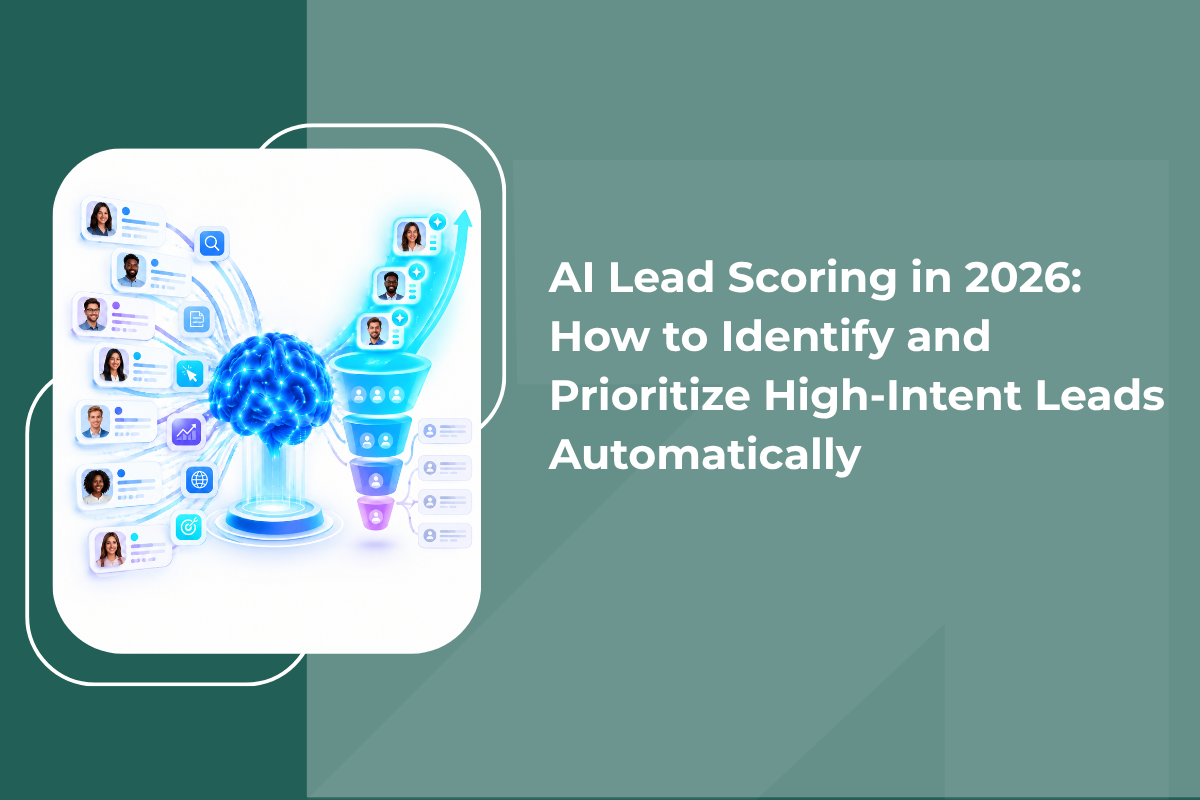
AI lead scoring replaces the static rulebook with a model that learns from your actual conversion data, every past lead that became a customer, and every one that went cold, and scores new leads in real time based on the patterns that genuinely predicted a sale. It looks at dozens of signals simultaneously: how a lead responded to your first WhatsApp message, how quickly they replied, what words they used, whether they asked about price or just browsed, what ad or keyword brought them in, their location, the time of day they engaged, and more. Instead of a rep guessing which lead is "hot," the system tells them, with a number.
Why Manual Lead Prioritization Breaks Down in 2026
Three things have changed that make manual prioritization unworkable for most growing businesses:
1. Lead volume has exploded, especially on WhatsApp - Click-to-WhatsApp ads, QR codes, and website chat widgets now generate leads faster than any sales team can triage by hand. A business running a modest ad budget can easily receive 50–150 leads a day. No sales manager can read every conversation and rank it fairly, consistently, and instantly.
2. Intent signals are now conversational, not just behavioral - In the past, "high intent" meant a page visit or a form fill. Today, real intent shows up inside a chat: "what's the price for a 2BHK," "do you have EMI options," "can someone call me today." These signals are rich, but they're buried in free text, exactly the kind of unstructured data that rule-based systems can't parse but AI models handle well.
3. Speed-to-lead has become the single biggest predictor of conversion - Multiple industry studies over the last few years have shown that contacting a lead within five minutes dramatically increases the odds of qualifying them, compared to waiting even 30 minutes. When you're getting leads around the clock, including nights and weekends, a human-only triage process simply cannot keep up. This is where automation stops being a "nice to have" and becomes the difference between winning and losing the deal to a faster competitor.
How AI Lead Scoring Actually Works Under the Hood
At a high level, an AI lead scoring engine does four things:
- Ingest signals - Form data, ad source, WhatsApp conversation content, response time, call transcripts (if you use AI voice agents), page behavior, and past interaction history.
- Compared against historical outcomes - It looks at your closed-won and closed-lost leads to understand which combinations of signals actually predicted a sale for your business, not a generic industry average.
- Assigns a live score - Usually expressed as Hot / Warm / Cold, or a numeric scale (e.g., 0–100), updated continuously as new information comes in.
- Triggers an action - Routes hot leads to a sales rep instantly, nudges warm leads with a follow-up sequence, and quietly nurtures cold leads without wasting rep time.
The important shift here is that scoring isn't a one-time snapshot. A lead that looked cold on day one can turn hot after a single WhatsApp reply, "actually, can we talk today?", and a good AI scoring system re-ranks them immediately instead of waiting for a human to notice.
The Building Blocks of a Good Lead Scoring Model
If you're evaluating a platform or building this in-house, look for these core inputs:
- Source quality: Leads from Click-to-WhatsApp ads, Google Search, organic referrals, and Meta lead forms don't convert at the same rate. The model should weight source performance based on your own historical data.
- Engagement depth: Did the lead just say "hi," or did they ask three follow-up questions? Message count and message content both matter.
- Response latency: How quickly did the lead reply after your first message? Fast replies correlate strongly with intent.
- Qualifying answers: Budget, timeline, and specific need, captured conversationally rather than through a long form. More on this in our guide to qualifying leads on WhatsApp without asking too many questions.
- Behavioral recency: A lead who engaged 10 minutes ago should generally outrank one who went quiet three days ago, even if their original score was similar.
- Negative signals: Generic answers, one-word replies, obviously fake numbers, or no response after multiple follow-ups should pull a score down automatically.
What This Looks Like in Practice: WhatsApp as the Scoring Engine
For most Indian SMBs and D2C brands, WhatsApp has become the primary conversation channel for leads, which makes it a goldmine for AI lead scoring, because every message is a fresh data point.
Here's a simplified real-world flow:
- A prospect clicks a Click-to-WhatsApp ad and lands directly in your WhatsApp inbox.
- An AI-powered auto-reply greets them and asks one or two light qualifying questions, not a 10-field form.
- Based on their answers (and how they answer, enthusiastic vs. vague, specific vs. generic), the AI assigns a live score.
- Hot leads are instantly flagged and routed to a sales rep or added to a priority call queue.
- Warm leads go into an automated nurture sequence, a catalog, a case study, a gentle follow-up the next day.
- Cold or unresponsive leads are tagged for a longer-term drip campaign instead of eating rep bandwidth.
This is precisely the workflow GrowEasy's AI-powered CRM and WhatsApp automation platform is built around, ads, WhatsApp conversations, and lead scoring living in one system instead of three disconnected tools. If you're already running Click-to-WhatsApp campaigns, our guide on combating fake leads and reducing CPL with Click-to-WhatsApp ads is a useful companion read, lead scoring and lead quality control go hand in hand.
Signs You Need AI Lead Scoring (Not Just a Bigger Sales Team)
You probably need this now, not later, if:
- Your reps say "most of these leads are junk" but you don't have data to confirm or refute it.
- Leads sit unattended for hours, especially ones that come in after business hours.
- You're generating 50+ leads a day across ads, WhatsApp, and forms, and no one has time to read every conversation.
- Your best reps quietly cherry-pick the "good" leads by instinct, and everyone else works the leftovers.
- You've scaled ad spend but conversion rate has stayed flat or dropped, a classic sign that lead volume has outpaced lead quality control.
If any of that sounds familiar, the fix usually isn't hiring, it's putting a scoring layer between "lead captured" and "lead assigned." For businesses managing high daily volume, this pairs directly with the workflow we break down in how to handle 100+ WhatsApp leads a day without missing conversations or follow-ups.
Common Mistakes Businesses Make with Lead Scoring
- Scoring on assumptions instead of your own data. A generic "downloaded whitepaper = hot lead" rule might be dead wrong for your business. Good AI scoring learns from your closed-won history, not a template.
- Treating the score as final instead of live. A lead's intent changes mid-conversation. If your system only scores once at capture, you'll miss leads that warm up later, and act on stale signals for leads that went cold.
- Over-qualifying before scoring. Asking eight questions before you even know if a lead is worth pursuing wastes their patience and your resources. Score off lighter signals first, then qualify deeper only for leads that clear the bar, a principle we cover in more depth in our piece on qualifying leads without over-asking.
- No feedback loop to sales. If reps don't tell the system which "hot" leads actually converted and which didn't, the model can't improve. The best setups close this loop automatically through CRM stage updates.
Getting Started: A Practical Rollout Plan
- Audit your current lead sources. List every channel bringing in leads, ads, WhatsApp, website forms, referrals, and pull at least 90 days of outcome data (won/lost) if you have it.
- Identify your top 3–5 intent signals. Don't try to model 40 variables on day one. Response time, source, and answer to one qualifying question will get you most of the way there.
- Automate the first response. Speed-to-lead is the single highest-leverage fix. Even a simple AI-powered WhatsApp auto-reply that starts qualifying instantly will lift conversion before you've even built a sophisticated model.
- Set score-based routing rules. Hot leads to reps immediately, warm leads to nurture sequences, cold leads to long-term drip.
- Review and retrain monthly. Markets shift, ad creative changes, and buyer behavior drifts. A scoring model needs occasional recalibration to stay accurate.
The Bottom Line
AI lead scoring isn't about replacing your sales team's judgment, it's about giving them a head start. Instead of scrolling through a raw list of leads hoping to spot the good ones, your reps open their day already knowing exactly who to call first. For businesses running WhatsApp-led campaigns, the opportunity is even bigger, because every conversation is already generating the exact data an AI model needs to score accurately, you just need a system built to capture and act on it.
If you're evaluating tools, look for a platform that combines ad generation, WhatsApp automation, and built-in lead scoring rather than stitching together three separate products. GrowEasy's pricing plans are built for exactly this, SMBs and growing teams that want lead generation, WhatsApp conversations, and automatic prioritization in one place, without hiring a data science team to build it from scratch.
FAQs
Does AI lead scoring work for small businesses, or only large sales teams?
It works especially well for small teams, because it does the triage work a larger sales org would normally handle with headcount. A 2-person sales team using AI scoring can often outperform a 5-person team working leads in raw chronological order.
How much historical data do I need before AI scoring becomes accurate?
Most models start producing useful signals with as little as a few hundred closed leads (won and lost combined), and improve steadily from there. You don't need years of data to get started, you need a system that keeps learning as new outcomes come in.
Can lead scoring work directly inside WhatsApp conversations?
Yes, and for many Indian and global SMBs, WhatsApp is now the richest source of intent data available, since it captures real conversational responses rather than static form fields. This is one of the reasons AI lead scoring and WhatsApp automation are increasingly built as a single connected workflow rather than separate tools.
Easy and fast setup
Marketing Doesn't Have to Be Hard. Let AI Do the Work.
Start getting leads in 5 minutes – no marketing team needed.
Start Now