
Summary:
Effective lead generation requires more than just capturing prospects' details; it demands a seamless process from ad click to conversion. Many businesses struggle with handling leads post-capture, leading to lost opportunities. To prevent this, companies should integrate their lead sources, ensure immediate responses, maintain context in communications, and prioritize high-intent leads. Automation can streamline repetitive tasks, allowing sales teams to focus on converting qualified leads into customers. By optimizing the entire lead journey, businesses can enhance the value of their existing leads without solely relying on increasing their advertising spend.
Table of Contents
Why Do Leads Get Lost After They Are Generated?
The Real Problem: Lead Generation and Lead Handling Are Connected
1. Connect Your Lead Sources to One Process
2. Respond to New Leads Immediately
3. Move the Conversation to WhatsApp Without Losing Context
4. Don't Send Every Lead Directly to Salespeople
5. Automatically Identify High-Intent Leads
6. Assign Every Lead to a Specific Person
7. Make Sure Salespeople Know Where the Lead Came From
8. Track What Happens After the Lead Is Generated
Build a Lead Journey That does not Depend on Manual Work
What Should You Automate and What Should Stay Human?
Good Candidates for Automation
What If You Are Getting Leads but Still Not Getting Sales?
How AI Can Help Prevent Leads From Getting Lost
Running lead generation campaigns is only the beginning. A prospect sees your Facebook or Instagram ad, clicks on it, submits their details, and becomes a lead. On paper, the campaign has done its job. But what happens next can determine whether that lead becomes a customer or disappears without a response.
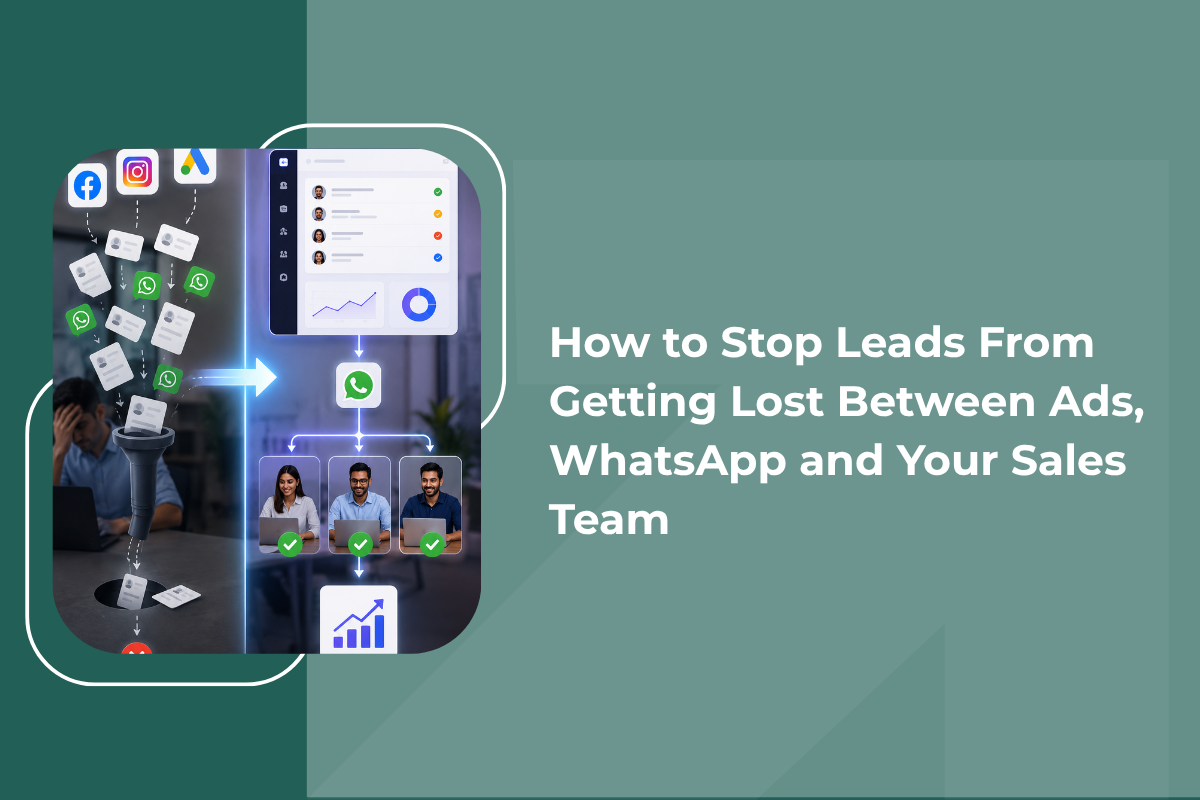
For many businesses, the journey between ad click, lead capture, WhatsApp conversation and sales follow-up is where things start breaking down.
A lead may submit a form but nobody notices it immediately. Another may send a WhatsApp message and wait several hours for a response. Some leads may be contacted once but never followed up. Others may be assigned to the wrong salesperson or simply get buried among hundreds of new enquiries.
This is a common problem for businesses that are actively investing in lead generation. The issue is not always that the campaigns are generating poor leads. Sometimes, the business simply does not have a reliable process for handling those leads after they arrive.
A strong lead generation strategy needs to cover the entire journey:
Ad → Lead Capture → Instant Response → WhatsApp Conversation → Qualification → Sales Assignment → Follow-Up → Conversion
Let's look at why this happens and what businesses can do to prevent it.
Why Do Leads Get Lost After They Are Generated?
Getting a lead does not automatically mean your sales team has successfully received and handled it. Modern lead generation often involves several platforms at once. A business might generate leads through Facebook Lead Ads, Instagram campaigns, Google Ads, website forms and other digital channels, while using WhatsApp as the primary channel for communicating with prospects.
The more platforms involved, the more opportunities there are for leads to fall through the cracks. Some of the most common reasons include:
- Leads are coming from multiple advertising platforms.
- Notifications are missed or delayed.
- Salespeople don't know who is responsible for a new lead.
- Leads are manually copied between different tools.
- The first response takes too long.
- Sales teams don't have enough information about the lead.
- Follow-ups depend on individual salespeople remembering to do them.
- High-intent leads aren't prioritized.
- Conversations happen on WhatsApp but aren't properly tracked.
- Marketing generates more leads than the sales team can manually handle.
Individually, each problem may seem small but together, they can create a serious leak in your lead generation funnel.
The Real Problem: Lead Generation and Lead Handling Are Connected
Businesses often look at lead generation as a simple equation:
More ads = More leads = More customers
But the actual journey is more complicated.
A better way to look at it is:
More relevant traffic → More enquiries → Faster response → Better qualification → Consistent follow-up → More sales opportunities
If you generate 1,000 leads but your sales team only manages to respond properly to 500 of them, increasing your advertising budget may not solve the underlying problem.
You may simply generate more leads that never get handled properly. This is why lead generation should not end when someone fills out a form. The next stage is making sure that the enquiry reaches the right person, receives a timely response, and moves forward based on the prospect's level of interest.
GrowEasy's lead generation approach is built around connecting lead acquisition with the actions that happen after a prospect enters the funnel, rather than treating campaign generation as an isolated activity.
For businesses looking to understand the broader process, What Is Lead Generation? Meaning, Process, Strategies and Best Practices can provide useful context.
1. Connect Your Lead Sources to One Process
One of the first steps in preventing lost leads is understanding exactly where your enquiries are coming from. You may currently be generating leads through:
- Facebook Lead Ads
- Google Ads
- Website forms
- Click-to-WhatsApp campaigns
- Organic social media
- Landing pages
- Referral campaigns
If every source is handled differently, it becomes difficult for your sales team to maintain consistency.
For example, a Facebook lead may be emailed to one salesperson, while a WhatsApp enquiry goes directly to another person. A website enquiry may sit inside an email inbox until somebody checks it. The result is a fragmented lead journey. Instead, businesses should create a consistent process regardless of where the lead originated.
The ideal workflow should answer three basic questions:
- Where did the lead come from?
- Who is responsible for it?
- What should happen next?
Once these answers are clear, it becomes much harder for an enquiry to disappear.
2. Respond to New Leads Immediately
When someone responds to an advertisement, their interest is usually highest at that moment. They have just seen your offer, clicked your ad and taken an action. If they receive no response for several hours, that interest can decline. They may continue researching, contact another business or simply forget about the enquiry.
This does not mean a salesperson needs to personally call every lead within seconds. An immediate automated response can keep the conversation moving while the sales team prepares to take over. For example:
“Hi, thanks for your enquiry. We'd be happy to help. Can I ask you a couple of quick questions so we can understand what you're looking for?”
This simple response confirms that the enquiry has been received and gives the prospect a reason to continue the conversation.
For businesses using WhatsApp heavily, this can be particularly useful because WhatsApp naturally supports conversational follow-up.
3. Move the Conversation to WhatsApp Without Losing Context
WhatsApp has become an important channel for businesses that want to communicate directly with leads. It is convenient for prospects and allows businesses to have conversations rather than relying entirely on emails or phone calls. But moving a lead from an advertisement to WhatsApp can also create another point where information gets lost.
- For example:
- A prospect clicks an Instagram ad and submits their phone number.
- The sales team receives the number.
- Someone sends a WhatsApp message.
- The prospect replies with their requirements.
- But nobody records what was discussed.
When another salesperson eventually contacts the lead, they may ask the same questions again. This creates a poor experience.
A better process ensures that information collected during the initial lead generation and WhatsApp conversation remains connected. The sales team should be able to understand:
- Which campaign generated the lead.
- What the prospect initially showed interest in.
- What questions they answered.
- What they are looking for.
- Whether they appear ready to buy.
- What should happen next.
This context becomes particularly important when several people are handling leads.
4. Don't Send Every Lead Directly to Salespeople
It may sound illogical, but immediately sending every new lead to a salesperson is not always the most efficient process.
Imagine your campaign generates 200 enquiries.
- Some people are ready to buy.
- Some are researching.
- Some aren't sure what they need.
- Others may not even match your target audience.
This filtering step becomes even more important if you're also dealing with fake or irrelevant leads clogging that same pipeline.
If your sales team has to manually identify which leads are worth prioritizing, a large portion of their time will be spent on basic qualification. This is where automated or AI-powered lead qualification can help.
An AI lead qualification agent can start the conversation, ask relevant questions and gather information before a salesperson takes over. For example, a real estate business may want to know:
- Which property type the prospect wants.
- Preferred location.
- Approximate budget.
- Purchase timeline.
- Whether they are interested in a site visit.
A B2B company might need to know:
- Company size.
- Business requirements.
- Current solution.
- Expected timeline.
- Decision-making process.
The exact questions should depend on the business. The goal is not to create a long questionnaire. It is to collect enough information to determine what should happen next.
For more information, see What Is an AI Lead Qualification Agent and How Does It Work in 2026?.
5. Automatically Identify High-Intent Leads
Not every enquiry deserves the same level of urgency.
Consider these two messages:
"Can you send me more information? I'm just researching."
And:
"I'm interested and would like to speak to someone today about getting started."
Both are leads. But the second prospect is clearly showing stronger buying intent. Your lead handling process should be able to recognize that difference. High-intent leads can be prioritized for faster human follow-up, while prospects who need more information can enter a nurturing process.
This prevents your sales team from treating every lead as if it has exactly the same value. It also reduces the risk of a genuinely interested prospect waiting behind a large list of lower-intent enquiries.
6. Assign Every Lead to a Specific Person
One of the easiest ways to lose a lead is to make everyone responsible for it. If a new enquiry arrives and the team thinks:
"Someone will call them."
There's a good chance nobody will. Every lead should have a clear owner. For example, a business could automatically assign leads based on location:
Delhi lead → Delhi sales representative
Mumbai lead → Mumbai sales representative
Or based on service:
Residential enquiry → Residential sales team
Commercial enquiry → Commercial sales team
This is exactly the problem automated lead distribution rules are built to solve, you can set them up once and stop relying on managers to route enquiries manually.
The exact method depends on the business, but the principle remains the same:
Every lead should have a clear next owner. This is where automated lead distribution can remove a significant amount of manual coordination. Instead of sales managers repeatedly checking incoming enquiries and deciding who should receive them, predefined rules can handle the initial assignment.
7. Make Sure Salespeople Know Where the Lead Came From
A salesperson should ideally know whether a prospect came from:
- A Facebook campaign.
- An Instagram advertisement.
- Google Search.
- A website landing page.
- A WhatsApp campaign.
- Organic content.
This information helps them understand what the prospect may already know. For example, someone who clicked an ad promoting a specific property may not need a generic introduction to the business. They may want information about that particular property. Similarly, a lead generated through a campaign offering a specific service may expect the salesperson to already understand why they made the enquiry. Better context can make conversations more relevant and reduce repetitive questions.
8. Track What Happens After the Lead Is Generated
One of the biggest mistakes businesses make is measuring only the top of the funnel. They look at:
- Number of leads.
- Cost per lead.
- Click-through rate.
- Ad impressions.
These metrics matter. But they don't tell you what happens afterward. You should also know:
- How many leads received a response?
- How quickly were they contacted?
- How many were qualified?
- How many sales conversations happened?
- How many appointments were booked?
- How many leads converted?
- Which campaigns generated actual customers?
This is the difference between measuring lead volume and measuring lead quality and business outcomes. For example, Campaign A might generate 500 leads at a low cost. Campaign B might generate only 150 leads.
But if Campaign B produces twice as many qualified sales opportunities, it may actually be the better campaign. That is why lead generation optimization should extend beyond the initial form submission.
Build a Lead Journey That does not Depend on Manual Work
The more your business grows, the harder it becomes to rely entirely on people remembering what to do next. A stronger lead journey can automate the repetitive steps while keeping salespeople involved where human interaction matters. A practical workflow could look like this:
1. Run targeted campaigns
Generate enquiries through channels such as Facebook, Instagram and Google.
2. Capture the lead
Collect the essential contact and enquiry information.
3. Respond immediately
Send an acknowledgement instead of making the prospect wait.
4. Start qualification
Ask a few relevant questions to understand the lead.
5. Identify intent
Separate high-intent opportunities from leads that need more nurturing.
6. Assign the lead
Send qualified prospects to the appropriate salesperson.
7. Continue follow-up
Keep engaging prospects who are interested but not yet ready. This workflow only works if it's backed by a proper lead funnel and status system that tells everyone what stage each enquiry is actually in.
8. Measure the outcome
Track which leads and campaigns eventually create sales opportunities and customers. This workflow helps close the gaps that typically appear between marketing and sales.
What Should You Automate and What Should Stay Human?
Not every part of lead handling needs automation. The key is deciding where automation saves time without making the customer experience feel impersonal.
Good Candidates for Automation
- Instant lead responses.
- Basic qualification questions.
- Lead notifications.
- Lead assignment.
- Follow-up reminders.
- Routine nurturing messages.
- Lead categorization.
- Notifications for high-intent prospects.
Better Handled by Salespeople
- Complex questions.
- Product recommendations.
- Negotiation.
- Pricing discussions that require context.
- Objection handling.
- High-value prospects.
- Closing conversations.
This combination allows automation to handle speed and consistency while salespeople focus on conversations that actually require their expertise.
What If You Are Getting Leads but Still Not Getting Sales?
If your campaigns are generating enquiries but sales remain low, don't immediately assume that your advertising is the problem. The leak could be happening after the lead is generated. Ask yourself:
- Are new leads being contacted quickly?
- Does every lead have an owner?
- Are leads being qualified before salespeople spend time on them?
- Are WhatsApp conversations being followed up consistently?
- Do salespeople know where each lead came from?
- Are high-intent leads being prioritized?
- Do you know how many leads actually become sales opportunities?
If you cannot answer these questions, there may be a lead handling problem rather than simply a lead generation problem. You can also read Getting Leads but No Sales? 10 Reasons Your Lead Generation Campaign Is Failing for a broader look at why campaigns can generate enquiries without producing enough customers.
How AI Can Help Prevent Leads From Getting Lost
AI can add another layer to the lead generation process. Instead of relying entirely on salespeople to review every new enquiry, an AI-powered system can help handle the initial interaction. It can:
- Respond to new enquiries.
- Ask qualification questions.
- Understand natural-language responses.
- Identify potential buying intent.
- Collect important information.
- Trigger follow-ups.
- Notify sales teams when human attention is needed.
For example, a lead might say:
"I'm interested, but I'm still comparing options. I probably want to get started next month."
An AI system can recognize that the lead is interested but not immediately sales-ready. Rather than treating the prospect as a cold lead or sending them directly to a salesperson, the business can continue the conversation and follow up at the appropriate time. This creates a more intelligent lead journey. The goal is not to replace salespeople. It is to make sure they spend more of their time on leads that actually need them.
A Simple Checklist to Stop Losing Leads
Before increasing your advertising budget, check whether your current lead process covers these basics:
- Every lead source is connected to a clear process.
- New leads receive an immediate response.
- Leads can move into WhatsApp conversations without losing context.
- Basic qualification happens early.
- High-intent leads are prioritized.
- Every lead has a clear salesperson or team owner.
- Follow-ups don't depend entirely on memory.
- Unresponsive leads enter a nurturing process.
- Salespeople know where leads came from.
- You track qualified leads, not just total leads.
- You measure conversions back to the original campaign.
If several of these are missing, fixing the lead handling process may produce better results than simply spending more money on ads.
Final Thoughts
A lead does not become valuable simply because someone submitted a form. The real opportunity begins after the enquiry arrives. If that lead sits unanswered, gets lost between platforms, receives inconsistent follow-up, or never reaches the right salesperson, the money spent generating it may be wasted.
The solution is not necessarily more advertising. It is a better connection between lead generation, WhatsApp conversations, qualification, sales assignment and follow-up.
Businesses that want to scale their lead generation should build a process where every enquiry has a clear path. Capture it. Respond quickly. Understand the prospect. Qualify the opportunity. Assign it to the right person. Follow up consistently. Measure the outcome.
With automation and AI handling repetitive parts of the journey, sales teams can focus their attention where it matters most: turning qualified prospects into customers. And once you stop losing leads between the ad and the salesperson, you may find that the next step in growth is not generating more leads. It is getting more value from the ones you're already generating.
Easy and fast setup
Marketing Doesn't Have to Be Hard. Let AI Do the Work.
Start getting leads in 5 minutes – no marketing team needed.
Start Now